What is the McKinsey 7S framework?
The McKinsey 7S framework is a way to check whether an organization’s parts fit together. It names seven elements: strategy, structure, systems, shared values, style, staff and skills. Its claim is simple. A change in one element only works when the other six move with it, so a new strategy laid over an old structure and old habits will stall.
This template draws the seven as linked circles, sets a table beside them that compares today with where each element must be, and ends with next steps. The example is Cobalt Bank after buying a digital lender.
Seven elements, all connected
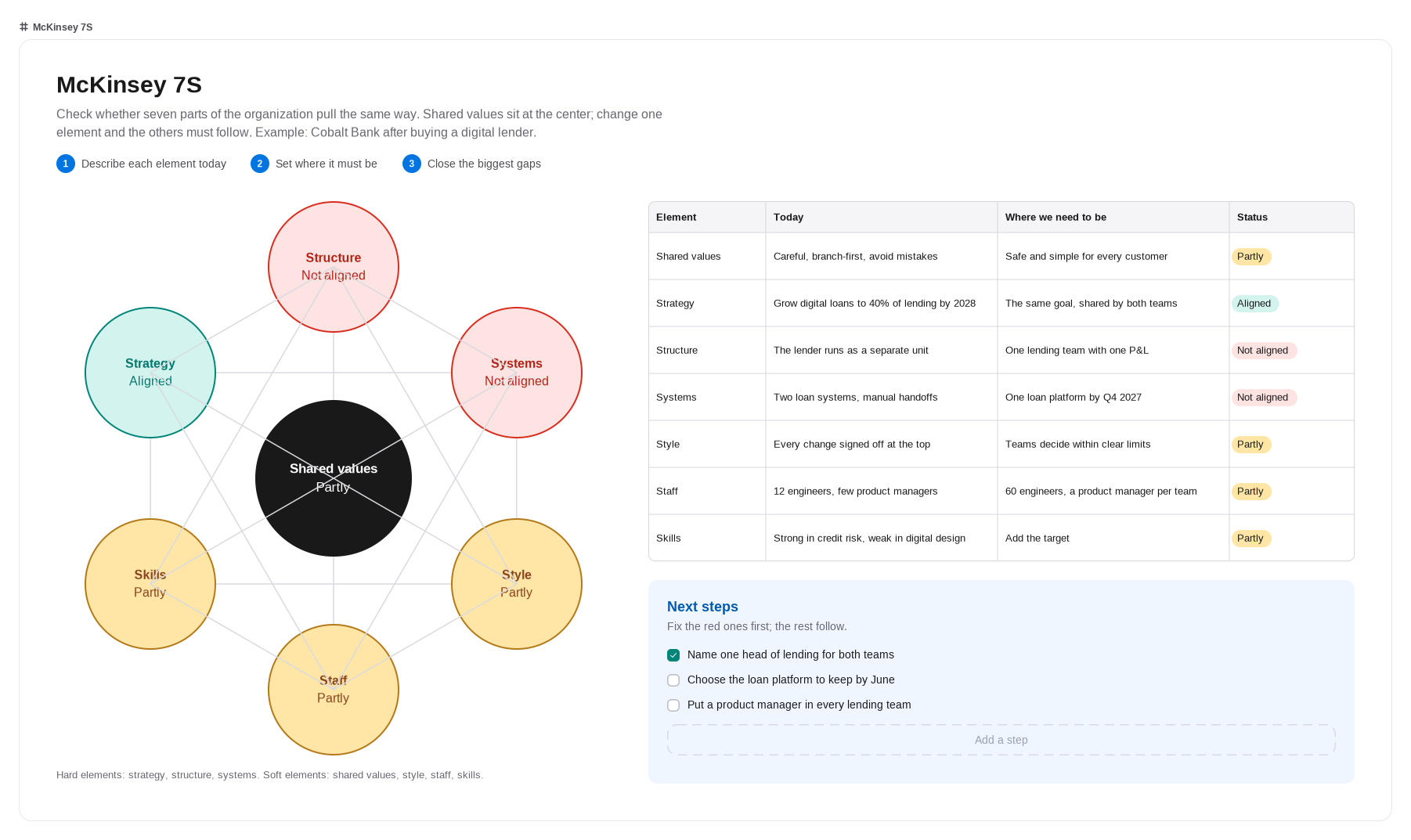
Six circles form a ring: Structure at the top, then Systems, Style, Staff, Skills and Strategy. Shared values sits in the middle as a dark circle, because the beliefs people actually hold shape all the others. Thin gray lines join the circles to one another. None of the lines has an arrowhead, and no element comes first.
A note under the diagram splits the seven into two kinds. Hard elements, strategy, structure and systems, can be written down and changed by decision. Soft elements, shared values, style, staff and skills, live in people and change slowly. Plans tend to cover the hard three and trip over the soft four.
Today against where you need to be
The table gives each element one row and three answers: Today, Where we need to be, and Status. This is where the framework stops being a poster. For Cobalt Bank:
- Strategy. Grow digital loans to 40% of lending by 2028; the target is the same goal, shared by both teams. Aligned.
- Structure. The lender runs as a separate unit; it should be one lending team with one P&L. Not aligned.
- Systems. Two loan systems with manual handoffs; one loan platform by Q4 2027. Not aligned.
- Style. Every change signed off at the top; teams should decide within clear limits. Partly.
Write Today as an observation, not a verdict. "12 engineers, few product managers" is something both sides of a merger can agree on. The Skills row leaves its target as "Add the target" for you to complete.
Color shows where the misfit is
Each status in the table is repeated on the diagram. Strategy is green and reads Aligned. Structure and Systems are red and read Not aligned. Style, Staff and Skills are amber and read Partly, and so does the dark Shared values circle in the middle.
The picture tells the story of this acquisition at a glance. Everybody agrees on the goal, yet the two things that would let the teams work as one, the org chart and the loan platform, have not moved. A leadership team can absorb that from the circles in ten seconds and then read the table for the reasons.
Next steps: start with the red ones
The card under the table carries one rule, "Fix the red ones first; the rest follow", and a short checklist. The first step is ticked: name one head of lending for both teams. Two are open: choose the loan platform to keep by June, and put a product manager in every lending team. A dashed row, Add a step, takes the next one.
Notice how the steps map to the rows. The head of lending answers Structure. The platform choice answers Systems. The product managers answer Staff. If a step does not close a gap in the table, it does not belong on this card.
How to use the McKinsey 7S template
- Open it as a new board. Your copy includes the bank example to overwrite row by row.
- Describe each element today. Fill the Today column from interviews and documents. Do shared values last; they are easier to name once the other six are on the table.
- Set where it must be. Write the target that your strategy requires for each element, with a date where one exists.
- Rate and recolor. Give each row a status, then change the matching circle’s color and label so the diagram agrees with the table.
- Close the biggest gaps. Write two or three steps for the red elements and give each a deadline.
When the 7S framework fits, and when to use something else
Use it after a merger, before a reorganization, when a new strategy is not landing, or when a company has grown fast and its habits have not kept up. It looks inward only.
For the market outside the company, pair it with a SWOT analysis. If you only need to compare a current state with a target on a few measures, a gap analysis is lighter. And to redraw reporting lines once Structure is decided, use an org chart.
Questions about the McKinsey 7S template
What are the seven S’s?
Strategy, structure, systems, shared values, style, staff and skills. Strategy is the plan, structure is who reports to whom, and systems are the processes and tools. Shared values are the core beliefs, style is how leaders behave, staff is the people and their numbers, and skills are what the organization does well.
Why are shared values in the center?
Because they influence every other element. What people believe matters decides which strategies they accept, how they use the systems and whom they hire. In the example the bank’s values read careful and branch-first, which explains much of the friction with a digital lender.
Which element should we change first?
Start with the elements rated not aligned, and among those the hard ones, since structure and systems can be changed by decision. Then plan for the soft elements that the change will strain, such as the skills and leadership style the new setup needs.
How long does a 7S assessment take?
A first pass fits in a half-day workshop if the participants know the organization well. A careful one, with interviews to fill the Today column honestly, takes two to three weeks. The board stays useful afterwards as a place to update statuses.