What is a SWOT analysis?
A SWOT analysis sorts what you know about a business into four groups: strengths and weaknesses inside it, and opportunities and threats in the market around it. Seeing the four side by side shows where the business can push and where it is exposed.
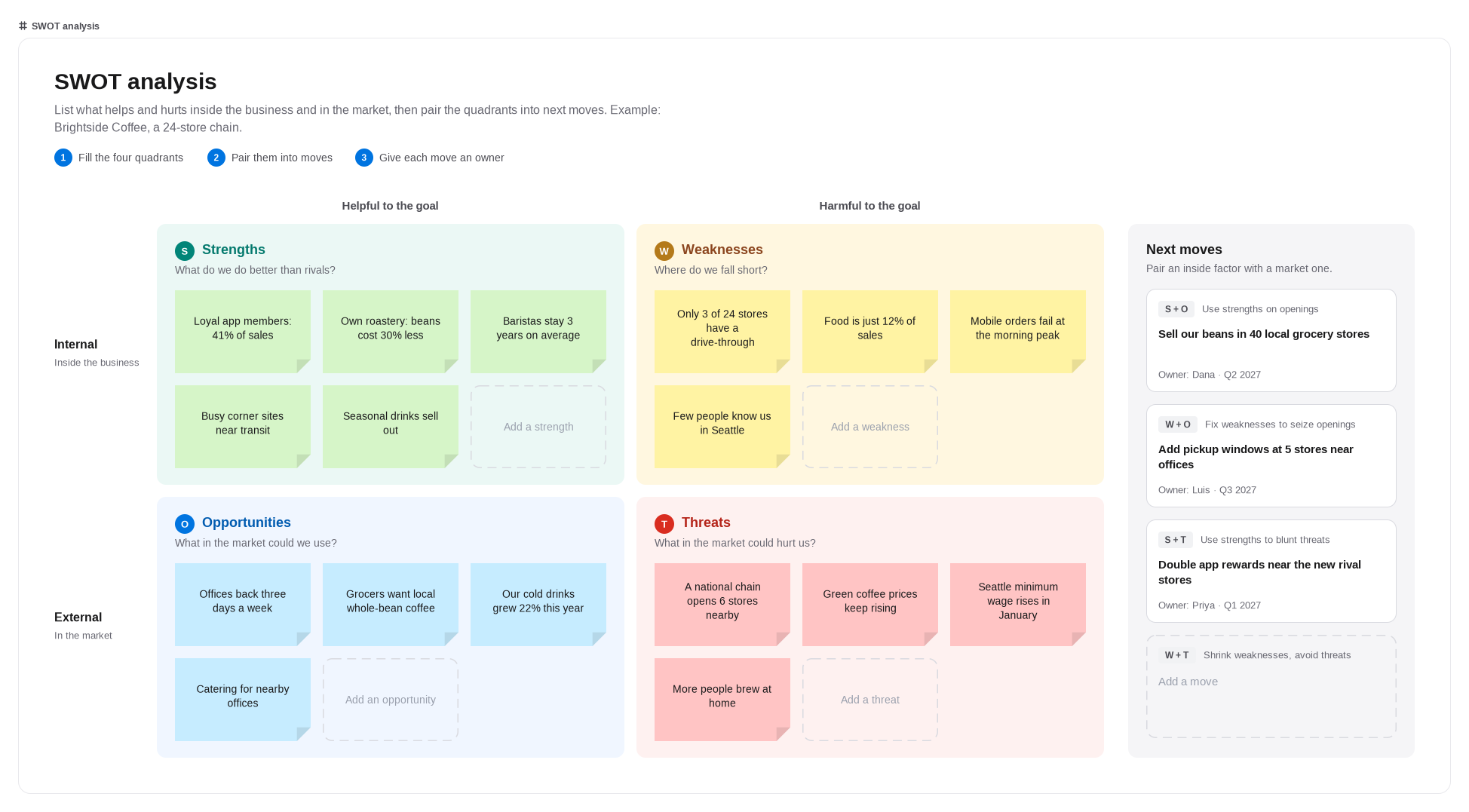
This template lays the four groups out as a grid and adds a fifth area most SWOT grids leave out: the moves you will make because of what the grid shows. The example is Brightside Coffee, a chain of 24 stores, so you can see what a useful note looks like before you write your own.
The four quadrants
The grid has two rows and two columns. The top row is internal: things inside the business that you control. The bottom row is external: things in the market that happen whether you like them or not. The left column helps your goal and the right column harms it.
- Strengths. What you do better than rivals. In the example: the chain roasts its own beans, so they cost 30% less.
- Weaknesses. Where you fall short. Only 3 of the 24 stores have a drive-through.
- Opportunities. What in the market you could use. Grocers want local whole-bean coffee.
- Threats. What in the market could hurt you. A national chain opens 6 stores nearby.
Each quadrant asks one question under its title, so a team new to SWOT knows what belongs there.
Write notes you can check
A SWOT fails when its notes are opinions: “great team”, “strong brand”. Look at the strengths in the example. Each one is a fact with a number or a detail someone could verify: loyal app members bring 41% of sales, and baristas stay 3 years on average.
Write one fact on one note. If a note needs the word “and”, split it in two. The dashed card at the end of each quadrant is the place for the next one.
Turn the grid into next moves
The grid is only the first half. The column on the right pairs an inside factor with a market one, which is where a SWOT turns into a plan:
- S + O: use a strength on an opening. The roastery plus grocers who want local beans becomes “Sell our beans in 40 local grocery stores”.
- W + O: fix a weakness to seize an opening. Few drive-throughs plus offices filling up again becomes pickup windows at 5 stores near offices.
- S + T: use a strength to blunt a threat, such as doubling app rewards near the new rival stores.
- W + T: shrink a weakness that a threat would make worse.
Every move gets an owner and a quarter. A move without a name on it rarely happens.
How to use the SWOT analysis template
- Open it as a new board. Use this template makes a copy in your workspace, with the example still in place.
- Fill the four quadrants. Replace the coffee chain’s notes with your own. Give the team ten quiet minutes to add notes before anyone discusses them.
- Pair them into moves. Take one note from the top row and one from the bottom row and ask what you would do about the two together.
- Give each move an owner. Write a name and a date on every move you keep, and delete the rest.
Short on time? FlowDraw AI can draft the SWOT from a description of your business, and you edit the notes on the board afterwards.
When a SWOT analysis helps, and when it does not
Use it before a yearly plan, a new product, a new market or a funding round: any moment when the team needs one shared picture before it chooses. It also works for a single product or a department.
A SWOT is a snapshot, so it does not rank anything. If you need to choose between the moves it produces, score them on an impact effort matrix. If the question is the market itself rather than your place in it, a PESTLE analysis or Porter’s five forces goes deeper.
Questions about the SWOT analysis template
Is the SWOT analysis template free?
Yes. The template opens on the Free plan, which includes three boards. You can edit every note, add your own and export the finished board as PNG, SVG or PDF.
How many notes should each quadrant have?
Three to six. Fewer than three usually means the team has not looked hard enough, and more than six hides the notes that matter. If a quadrant fills up, group similar notes and keep the strongest of each group.
What is the difference between a weakness and a threat?
A weakness is inside the business and you can fix it, like a slow ordering app. A threat comes from outside and you can only prepare for it, like a rival opening nearby or a rise in costs.
Can my team fill it in together?
On the Team plan everyone edits the board at the same time. On the Free and Pro plans one person edits, and the people you share the board with can view it and leave comments on any note.