What is a mind map?
A mind map starts with one subject in the center and grows outward. Main ideas branch off the center, details branch off the main ideas, and the result shows a whole subject on one page with nothing ranked above anything else.
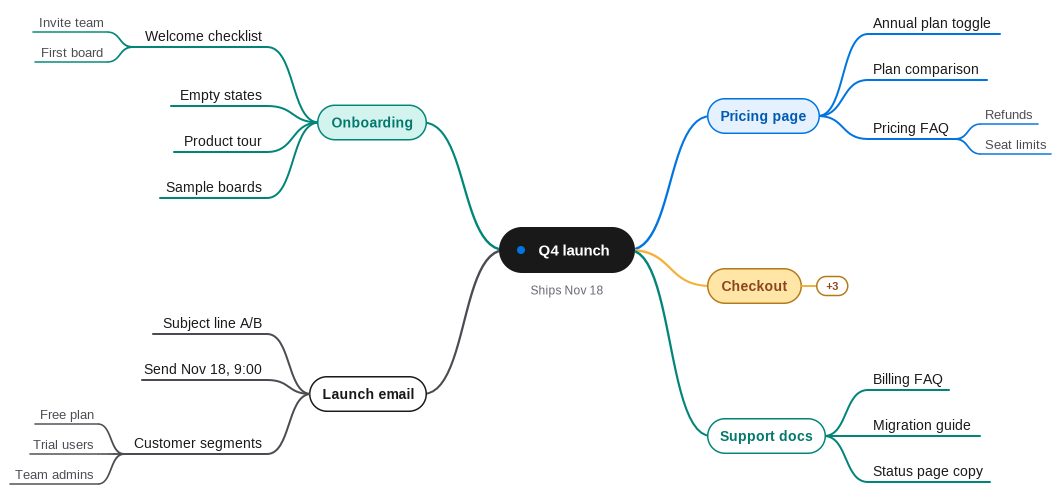
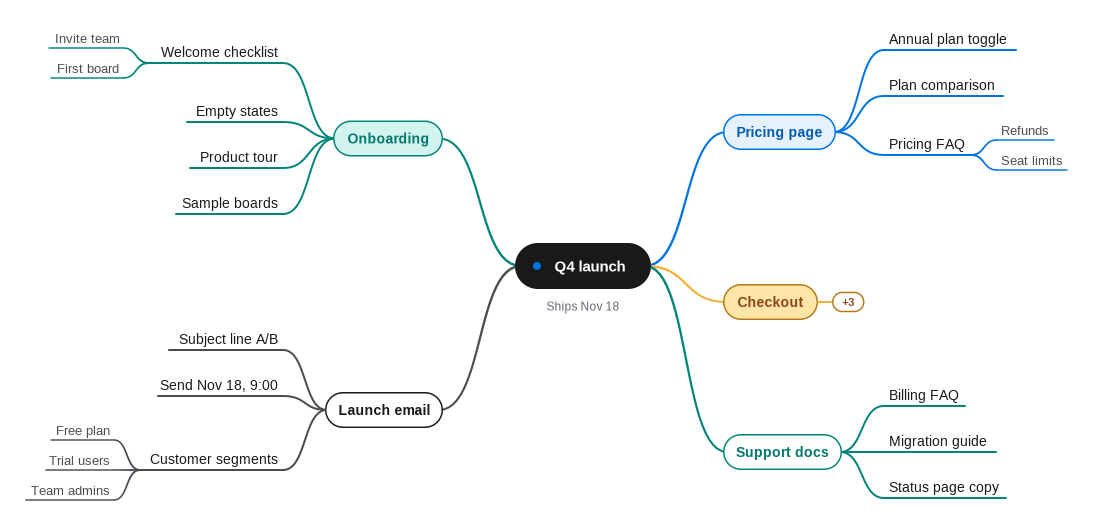
The template is a map of a product launch. Q4 launch sits in the middle with its date, “Ships Nov 18”, underneath. Five branches spread to the left and right, and each carries the work that belongs to it. Read it as an example of how far to break a subject down before the map stops helping.
The center and its five main branches
Everything on the map answers one question: what has to be ready for the launch? The five main branches are the five answers.
- Pricing page, Checkout and Support docs on the right.
- Onboarding and Launch email on the left.
Five is a comfortable number. With three or fewer the center is probably too narrow a subject, and with more than seven the first ring becomes a list nobody can hold in their head. Notice also that the main branches are all the same kind of thing: each is a piece of work a team can own. Mixing kinds, such as a deliverable next to a worry next to a person, is what makes a map hard to read.
Second and third levels
Follow Pricing page outward. It splits into three topics: “Annual plan toggle”, “Plan comparison” and “Pricing FAQ”. One of them goes a level further: the FAQ has two questions of its own, “Refunds” and “Seat limits”.
That is the whole depth of the template: center, branch, topic, and now and then one more step. Only three topics on the whole board branch again, and that restraint is deliberate. Go deeper only where the detail changes what someone will do. A branch that needs five levels is usually a subject for a map of its own.
Keep every topic to a few words
Look at the Onboarding branch: “Welcome checklist”, “Empty states”, “Product tour”, “Sample boards”. No topic on it is longer than two words, and the checklist breaks into “Invite team” and “First board”.
Short topics are what let a map be read at a glance. If a topic needs a sentence, it is really a note, and it belongs in a document that the topic can point to. A quick test: read one branch aloud from the center out. “Q4 launch, Onboarding, Welcome checklist, Invite team” should sound like a path from the general to the specific. If a step in the path surprises you, the topic is hanging on the wrong branch.
How to use the mind map template
- Open it as a new board. The launch example comes with it.
- Rename the center. Replace Q4 launch with your subject, and use the line under it for the one fact everyone must remember, as the example does with its ship date.
- Rewrite the five main branches. Name the big parts of the subject before touching any detail. Delete a branch you do not need.
- Fill one branch at a time. Add topics until you run out, then move to the next branch. Jumping around leaves half the map thin.
- Prune. Merge topics that say the same thing and remove any that would not change a decision.
The Launch email branch shows how concrete a finished map can get: “Subject line A/B”, “Send Nov 18, 9:00”, and “Customer segments” split into “Free plan”, “Trial users” and “Team admins”. To start from a sentence, FlowDraw AI can grow a first map from your subject.
When a mind map helps, and when to use something else
Reach for a mind map when you are exploring: planning a launch, outlining a talk, taking notes on a book, or collecting everything a project touches before you put it in order.
A mind map has no cross-links, so it cannot show that one topic depends on another. When the links between ideas matter as much as the ideas, draw a concept map. When the branches are really a strict breakdown, such as a product into parts, a tree diagram reads top to bottom. And when the map is done and the work needs an order, move the topics onto a kanban board.
Questions about the Mind map template
How many branches should a mind map have?
Four to seven main branches is a good range. The template uses five. More than seven usually means two branches overlap and can be merged, or that the center topic is really two subjects.
What is the difference between a mind map and a concept map?
A mind map has one center and every topic hangs from exactly one parent. A concept map has no single center, and its lines carry labels that say how two ideas relate, so one idea can connect to several others.
Can I use a mind map for meeting notes?
Yes. Put the meeting’s subject in the center and one agenda point on each main branch, then add what was said as short topics. Keep decisions and owners in a few words each so the map still reads at a glance.
Does the mind map template work on the Free plan?
It does. The Free plan includes three boards and up to 150 elements on each, and the launch example is far smaller than that, so you can grow it several times over before reaching the limit.