What is the AEIOU framework?
AEIOU is a way to organize what you see during field observation. The letters stand for Activities, Environments, Interactions, Objects and Users. Sorting notes under the five headings stops an observer from recording only what people did and forgetting the room, the tools and who else was there.
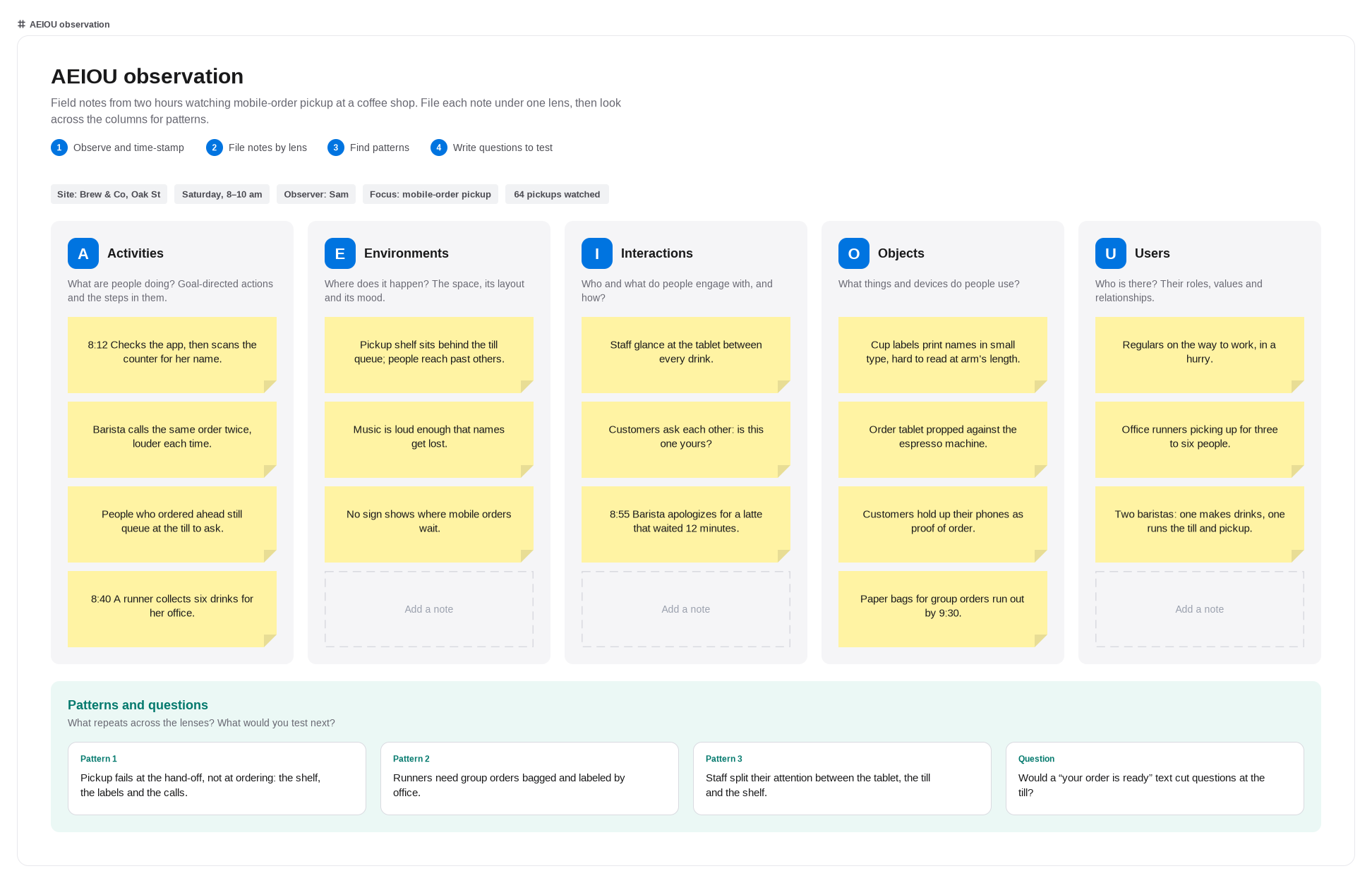
This template gives each lens a column of sticky notes and adds a row underneath for the patterns that cut across them. The example comes from a coffee shop, Brew & Co on Oak St, where an observer named Sam watched 64 mobile-order pickups on a Saturday from 8 to 10 am.
The five lenses
Every column has a letter, a name and a prompt that says what belongs there:
- Activities. What are people doing? One note: “People who ordered ahead still queue at the till to ask.”
- Environments. Where does it happen? “Pickup shelf sits behind the till queue; people reach past others.”
- Interactions. Who and what do people engage with? “Customers ask each other: is this one yours?”
- Objects. What things and devices do people use? “Customers hold up their phones as proof of order.”
- Users. Who is there? “Office runners picking up for three to six people.”
Three columns end in an empty “Add a note” card. Uneven columns are fine; pad nothing.
Write what happened, not what you think
The Activities notes show the standard to aim for. “8:12 Checks the app, then scans the counter for her name” is a time, a person and an action. Anyone who was in the shop would agree it happened. “Customers are confused by pickup” is a conclusion, and it belongs later.
The Environments column works the same way: “Music is loud enough that names get lost” and “No sign shows where mobile orders wait” describe the room without blaming anyone. Time-stamp the moments that might matter, such as the 8:40 runner who collects six drinks for her office, so you can line notes up afterwards.
Patterns and questions
The row at the bottom is where interpretation starts. It asks what repeats across the lenses and what you would test next. The example draws three patterns from the notes above:
- Pattern 1. Pickup fails at the hand-off, not at ordering: the shelf, the labels and the calls.
- Pattern 2. Runners need group orders bagged and labeled by office.
- Pattern 3. Staff split their attention between the tablet, the till and the shelf.
Each pattern leans on notes from more than one column. Pattern 1 combines an Environments note about the shelf, an Objects note about small type on cup labels and an Activities note about orders called twice. The fourth card is a question to test: would a “your order is ready” text cut questions at the till?
How to use the AEIOU observation template
- Make your own copy. Use this template opens the coffee shop example as a new board; clear the notes but keep the prompts.
- Fill the context line. Replace the site, date, observer, focus and number of sessions watched, so a reader knows what the notes cover.
- Observe and time-stamp. Take raw notes on site, then type one observation on each sticky.
- File notes by lens. Drag every sticky into the column whose prompt it answers. If it fits two, choose the one you have fewer notes in.
- Find patterns and write a question. Read across the columns and fill the bottom row last.
FlowDraw AI can draft the board’s structure from a description of your study, and you add the real observations yourself.
When AEIOU fits, and when to pick another board
Use AEIOU when you can watch people in the place where the behavior happens: a shop floor, a clinic desk, a warehouse, a kitchen. It suits the first days of a project, before anyone has decided what the problem is.
When your material is what people said and not what you saw, an interview synthesis board holds it better. To lay one customer’s experience out over time, move the notes to a user journey map. To capture what a single person thinks and feels, use an empathy map.
Questions about the AEIOU observation template
What does AEIOU stand for?
Activities, Environments, Interactions, Objects and Users. Each is a lens for field notes: what people do, where it happens, who and what they engage with, the things they use, and who is present.
Where does a note go if it fits two lenses?
Pick the lens that carries the surprise. “Customers hold up their phones as proof of order” mentions people, but the phone used as a receipt is the point, so the example files it under Objects. Do not duplicate notes; duplicates inflate patterns later.
How many notes should each column have?
Enough to describe the session honestly. The example has three or four in each column after two hours of watching. If a column stays empty, plan to look for that lens on your next visit.
Can two observers share one board?
On the Team plan several people edit the same board at once, so two observers can add stickies side by side. On the Free and Pro plans one person edits and the other can view the board and leave comments.