What is interview synthesis?
Interview synthesis is the step between finishing a round of interviews and telling the team what you learned. You pull out what each person said, group similar remarks, state what each group means and decide what could be done about it. Skipped or rushed, it leaves a team with anecdotes and no findings.
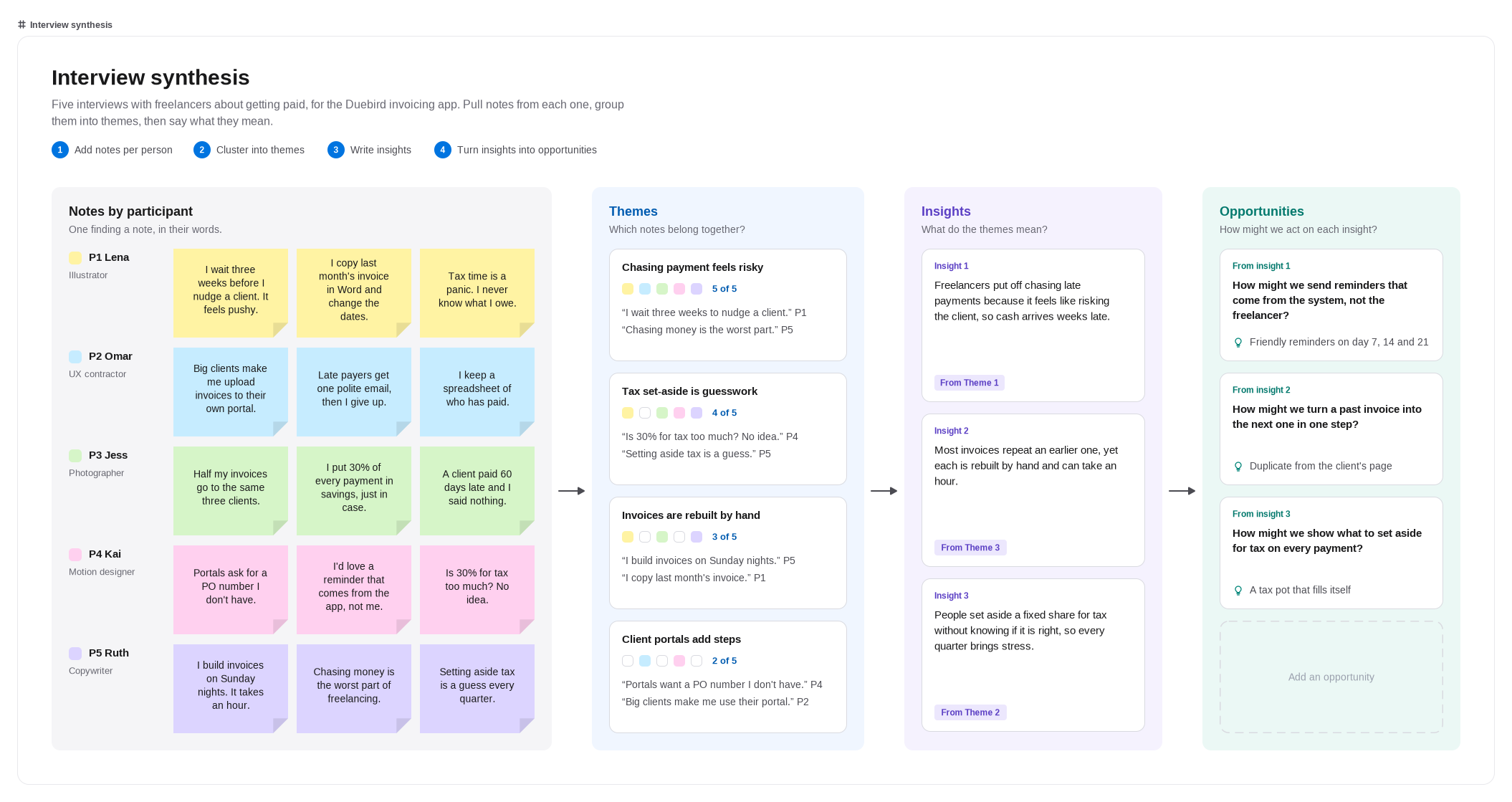
This template gives each of those moves a column, joined by arrows: Notes by participant, Themes, Insights and Opportunities. The example is a study for Duebird, a made-up invoicing app, based on five interviews with freelancers about getting paid.
One finding a note, in their words
The first column has a row per participant, labelled with a name and a role: P1 Lena, illustrator; P2 Omar, UX contractor; P3 Jess, photographer; then Kai and Ruth. Each row holds three sticky notes in that person’s own color, so a note can be traced back after it moves.
The notes follow the rule printed under the heading. Each carries one finding, written the way the person said it: “Late payers get one polite email, then I give up.” “I put 30% of every payment in savings, just in case.” “A client paid 60 days late and I said nothing.” A summary such as “struggles with late payments” would lose the detail that makes these three different, and the detail is what themes are built from.
Cluster the notes into themes
The second column asks “Which notes belong together?” Each theme is a card with a short name, a row of colored dots, a count and two quotes as proof. The top card reads Chasing payment feels risky, 5 of 5, with quotes from P1 and P5. The next is Tax set-aside is guesswork, 4 of 5.
Further down are “Invoices are rebuilt by hand” at 3 of 5 and “Client portals add steps” at 2 of 5. The count is the number of people, not the number of notes, and the dots show which people. That stops one talkative participant from creating a theme alone.
Say what each theme means
A theme describes; an insight explains. The third column answers “What do the themes mean?” with full sentences that include a cause and a consequence. Insight 1: freelancers put off chasing late payments because it feels like risking the client, so cash arrives weeks late. The words “because” and “so” do the work.
Every insight carries a tag back to its source: “From Theme 1”, “From Theme 3”, “From Theme 2”. Notice the order. Insight 2 comes from the third theme, about invoices that repeat an earlier one yet are rebuilt by hand. And the fourth theme, heard from only two people, produced no insight at all. Not everything you group has to be carried forward.
Turn insights into opportunities
The last column asks “How might we act on each insight?” Each card is tagged with its insight, phrases the problem as an open question and adds one first idea under it:
- How might we send reminders that come from the system, not the freelancer? Idea: friendly reminders on day 7, 14 and 21.
- How might we turn a past invoice into the next one in one step? Idea: duplicate from the client’s page.
- How might we show what to set aside for tax on every payment? Idea: a tax pot that fills itself.
Keeping question and idea apart matters. The team can reject the idea and keep the question. A dashed card, “Add an opportunity”, waits at the bottom.
How to use the interview synthesis template
- Open it as a new board. The freelancer study is there to overwrite, one row at a time.
- Add notes per person. Rename the rows, then go through each recording and write one remark per sticky note. Duplicate a row for a sixth participant.
- Cluster into themes. Drag similar notes side by side, name each group in the Themes column and count the people behind it.
- Write insights. For the strongest themes, write a sentence with “because” and “so”, and set its tag.
- Turn insights into opportunities. Phrase each as “How might we” and share the board for comments.
For a longer list of raw notes, FlowDraw AI can draft a first diagram from pasted text, which you then regroup yourself.
When this template fits, and when to pick another
It suits a small round of interviews, about four to eight people, where you want the path from quote to recommendation visible on one board. Stakeholders who doubt a conclusion can follow the tags back to the notes.
With dozens of sessions or hundreds of notes, start with an affinity diagram, which gives clustering more room. To capture what one type of user says, thinks, does and feels, use an empathy map. And if the interviews have not happened yet, write the interview guide first.
Questions about the Interview synthesis template
What is the difference between a theme and an insight?
A theme is a label for notes that belong together, such as “Tax set-aside is guesswork”. An insight explains the theme: why it happens and what it leads to. If you can read it aloud and someone asks “so what?”, it is still a theme.
How many interviews do I need before I synthesize?
You can start after the first two or three and add as you go. For one type of user, five to eight interviews usually bring out the main patterns. The example uses five, and its top theme came up in every one.
Should a theme that only two people mentioned be kept?
Keep it on the board with its count, as the example does with “Client portals add steps” at 2 of 5. It may matter for a segment or grow in a later round. Just be careful about building an insight on it yet.
Can several people synthesize on the same board?
On the Team plan, everyone can edit the board at once, which suits a synthesis session. On Free and Pro there is one editor, and the people you share the board with can view it and comment on notes and themes.