What is a competitor analysis?
A competitor analysis puts your product next to the ones your buyers also consider and compares them on the same criteria. Done well, it shows where you already win, where you lose, and which rival you should worry about for which customer.
This template does it in two layers. A table compares the products row by row, and a set of cards under it records what each comparison means for you. The example is Tickr, a made-up time-tracking app for agencies, measured against three rivals called Punchcard, Hourglass and Logbook.
Start with positioning, buyer and price
The first three rows are words and numbers, not checkmarks. They say what each product claims to be, who it is for and what it costs:
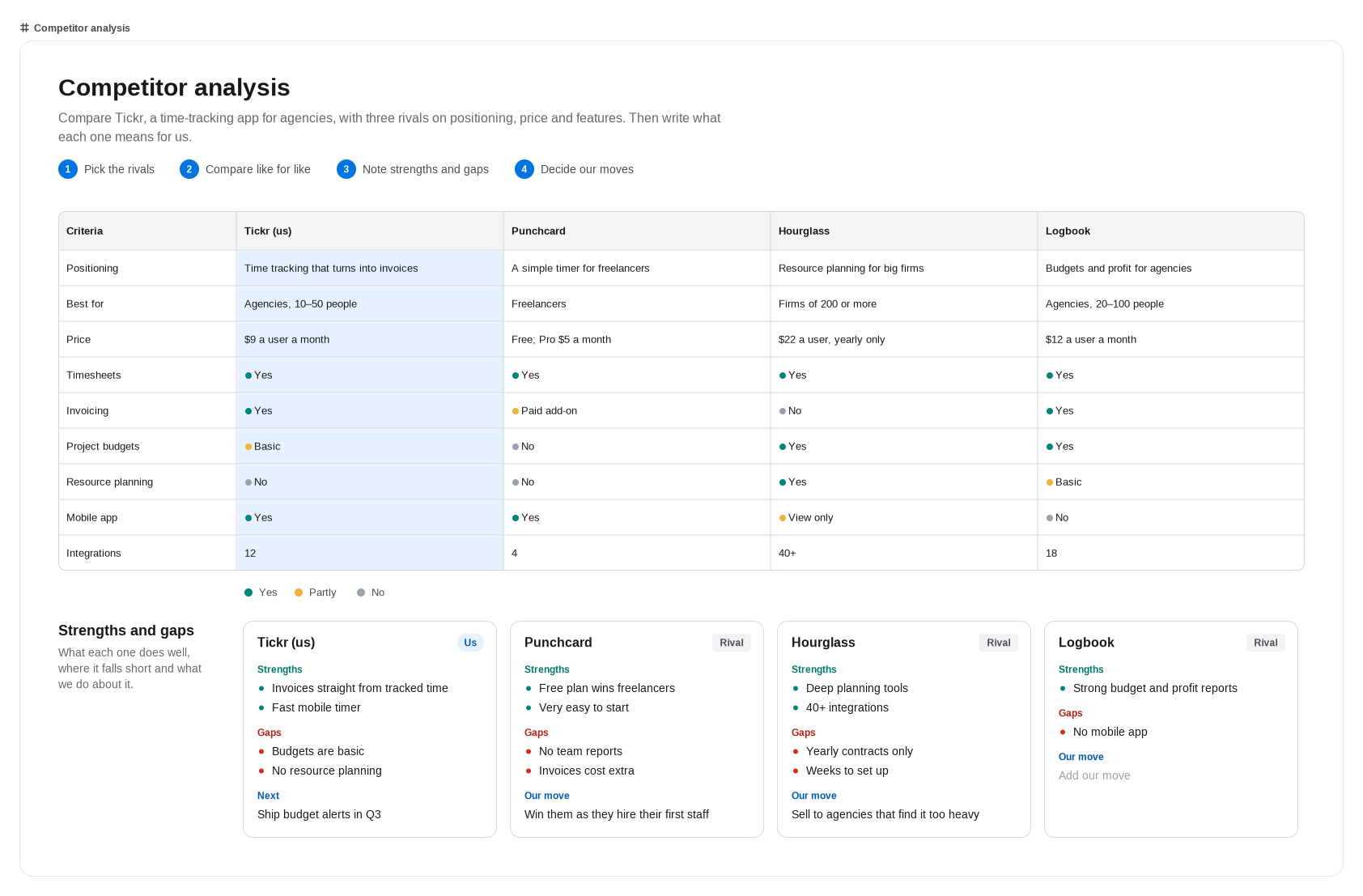
- Positioning. Tickr is “Time tracking that turns into invoices”. Punchcard is “A simple timer for freelancers”.
- Best for. Tickr suits agencies of 10 to 50 people, Hourglass firms of 200 or more.
- Price. $9 a user a month for Tickr, a free plan with Pro at $5 for Punchcard, $22 a user on yearly contracts for Hourglass and $12 for Logbook.
These rows often settle the question before any feature does. Hourglass and Punchcard are barely chasing the same customer; Logbook, built for agencies of 20 to 100 people, is the direct rival.
Compare features like for like
The lower rows cover six features: timesheets, invoicing, project budgets, resource planning, mobile app and integrations. Each cell has a colored dot and a short word. The legend under the table gives three levels: Yes, Partly and No.
The middle level is what keeps the table honest. Punchcard has invoicing, but as a “Paid add-on”. Tickr has project budgets, but only “Basic”. The mobile app from Hourglass is “View only”. A plain yes for any of these would mislead the reader. The last row uses counts in place of dots: 12 integrations for Tickr, 4, 40+ and 18 for the others.
Strengths, gaps and your move
Under the table, each product gets a card with the same three parts. Strengths are what it does well, gaps are where it falls short, and the last line is what you do about it.
Read across the rivals and the moves differ because the rivals differ. Punchcard wins freelancers with its free plan but has no team reports, so the move is “Win them as they hire their first staff”. Hourglass has deep planning tools and takes weeks to set up, so the move is to sell to agencies that find it too heavy. The Logbook card ends with “Add our move”, left open for you.
Be as hard on yourself as on the rivals
The first card is your own product, and it follows the same rules. Tickr lists two strengths, invoices straight from tracked time and a fast mobile timer, and two gaps: budgets are basic and there is no resource planning. Both gaps appear in the table too, so the card and the table agree.
Its last line is not “Our move” but Next: “Ship budget alerts in Q3”. That is one concrete change with a date, aimed at the gap that Logbook, the closest rival, is strongest on. Write your own card last, after the three others have shown you which gaps cost you deals.
How to use the competitor analysis template
- Open it as a new board. You get your own copy with the time-tracking example still filled in.
- Pick the rivals. Rename the three rival columns to the products your lost deals went to, not the biggest names in the market.
- Compare like for like. Replace the six feature rows with the ones your buyers ask about, and take prices from public pricing pages on the same day.
- Note strengths and gaps. Fill a card per product from what the table shows, two or three lines each.
- Decide your moves. Write one line per rival and one “Next” for yourself, then delete any move nobody will own.
To start from a description of your market instead, FlowDraw AI can draft a board that you then correct by hand.
When to use it, and when another template fits
Use it before pricing changes, a launch, a sales playbook or a yearly plan, and refresh it when a rival ships something that changes a row. It works best with three or four rivals; more columns than that become hard to read.
A table shows detail but not shape. To see where every brand sits on two axes and where the open space is, draw a positioning map. To look at your own business from inside and outside, use a SWOT analysis. For the forces of a whole industry, suppliers and new entrants included, choose Porter’s five forces.
Questions about the Competitor analysis template
How many competitors should I compare?
Three or four direct ones. The template has room for your product and three rivals, which keeps every column readable. If you track more, make a second copy of the board for a different segment instead of adding narrow columns.
Where do I find the information for the table?
Public pricing pages, product documentation, review sites, free trials and notes from lost deals. Write down the date you checked, because prices and feature lists change. Avoid guessing: an empty cell is more useful than a wrong one.
What is the difference between a direct and an indirect competitor?
A direct competitor sells a similar product to the same buyer, like Logbook and Tickr for agencies in the example. An indirect one solves the same problem another way or for another buyer, like a free timer aimed at freelancers.
Can I add more rows or columns?
Yes. The table and the cards are ordinary elements on your copy of the board, so you can add criteria, rename products and remove what you do not need. The Free plan allows up to 150 elements on a board.