What is Porter’s five forces?
Porter’s five forces is Michael Porter’s way of judging how hard it is to earn a profit in a market. It looks at four pressures from outside, new entrants, suppliers, buyers and substitutes, and at the rivalry among existing competitors that those four feed. Strong forces squeeze profit. Weak ones leave room to earn.
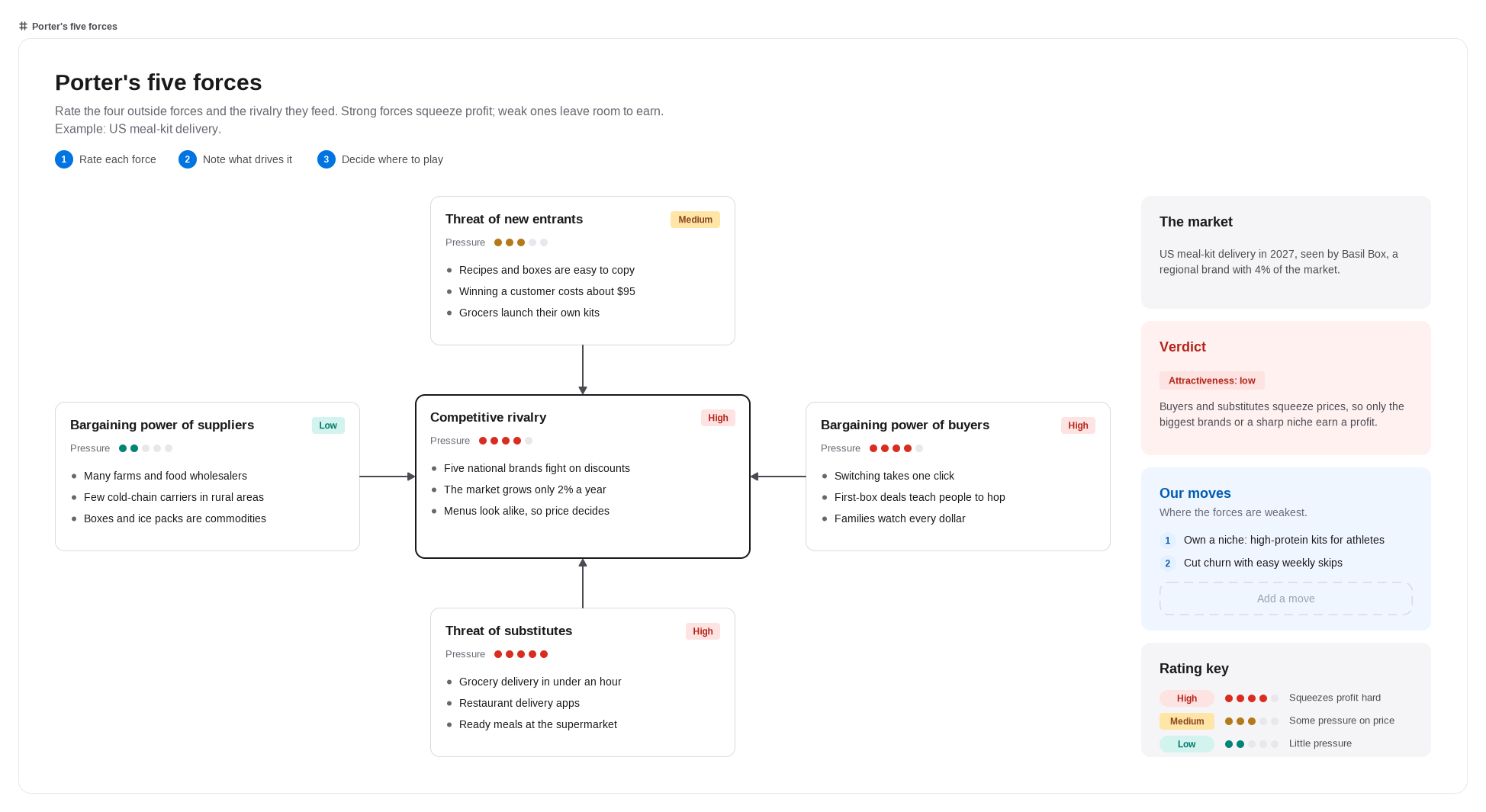
The template arranges the five forces as a cross with rivalry in the middle, and adds a column for the verdict and your moves. The example rates US meal-kit delivery in 2027 from the seat of Basil Box, a regional brand with 4% of the market.
Five cards in a cross
Each force has a card. Arrows run from the four outer cards into the center one, because each outside pressure makes the fight among competitors harder.
- Threat of new entrants (top): how easily a newcomer can start. Rated Medium for meal kits.
- Bargaining power of suppliers (left): how much those who sell to you can dictate terms. Rated Low.
- Bargaining power of buyers (right): how easily customers can push prices down or leave. Rated High.
- Threat of substitutes (bottom): other ways to get the same job done. Rated High.
- Competitive rivalry (center): how fiercely the existing players compete. Rated High.
Every card has the same three parts: a rating tag, a row of five pressure dots and three short reasons.
Back every rating with reasons
A rating is only as good as the evidence under it. The rivalry card says High, then explains: “Five national brands fight on discounts”, “The market grows only 2% a year” and “Menus look alike, so price decides”. Anyone who disagrees with the rating now has something specific to argue with.
The buyers card works the same way: “Switching takes one click”, “First-box deals teach people to hop” and “Families watch every dollar”. Notice that each reason describes the market, not Basil Box. Keep your own company out of the five cards. It enters in the next column.
Three reasons per force is enough. If you can only find one, the rating is probably a guess, and it is worth an hour of research before the workshop.
From ratings to a verdict and moves
The column on the right turns the picture into a decision. The first card fixes the scope: one market, one year, one point of view. The second gives the verdict. For meal kits it reads “Attractiveness: low”, with the reason in one sentence: buyers and substitutes squeeze prices, so only the biggest brands or a sharp niche earn a profit.
The third card, “Our moves”, asks where the forces are weakest for you. Basil Box lists two: “Own a niche: high-protein kits for athletes”, which sidesteps the price fight, and “Cut churn with easy weekly skips”, which answers the buyers who switch with one click. An empty slot waits for a third.
How to use the five forces template
- Open it as a new board. The copy keeps the meal-kit ratings, which are handy to compare against while you write yours.
- Name the market. Rewrite the first card in the right column: which market, which year and whose point of view. A whole industry and a single city give different answers.
- Rate each force. Set the tag to High, Medium or Low and fill the pressure dots to match the rating key.
- Note what drives it. Replace the three reasons on each card with facts about your market: counts, prices, growth rates.
- Decide where to play. Write the verdict, then list moves aimed at the weakest forces.
When five forces helps, and when to use another view
Use it before entering a market, before raising money for one, or when margins fall and nobody can say why. It answers one question: is this a market where a company like ours can earn?
It says little about any single competitor. For that, a competitor analysis compares features, pricing and positioning. For forces beyond the industry, such as law and technology, run a PESTLE analysis. To bring the findings back to your own strengths and weaknesses, finish with a SWOT analysis.
Questions about the Porter's five forces template
What are the five forces?
Threat of new entrants, bargaining power of suppliers, bargaining power of buyers, threat of substitutes and competitive rivalry. The first four press on the market from outside, and together they decide how intense the fifth becomes.
Is a high rating good or bad?
Bad for profit. A high rating means the force is strong, and the template’s key puts it plainly: high squeezes profit hard, medium puts some pressure on price and low means little pressure. An attractive market has mostly low ratings.
What is the difference between a substitute and a competitor?
A competitor sells the same kind of product. A substitute solves the same need another way. For a meal-kit brand, another meal-kit brand is a rival, while grocery delivery in under an hour and ready meals at the supermarket are substitutes.
Can I analyze more than one market on the board?
Keep one market per board. Ratings change with scope, so mixing two markets blurs both. Use the template again for the second market and compare the two verdicts side by side.