What is customer segmentation?
Customer segmentation divides the people who buy from you into groups that differ enough to be served, priced or reached differently. A segment is useful when you can describe who is in it, say what they need, count them and tell what they are worth.
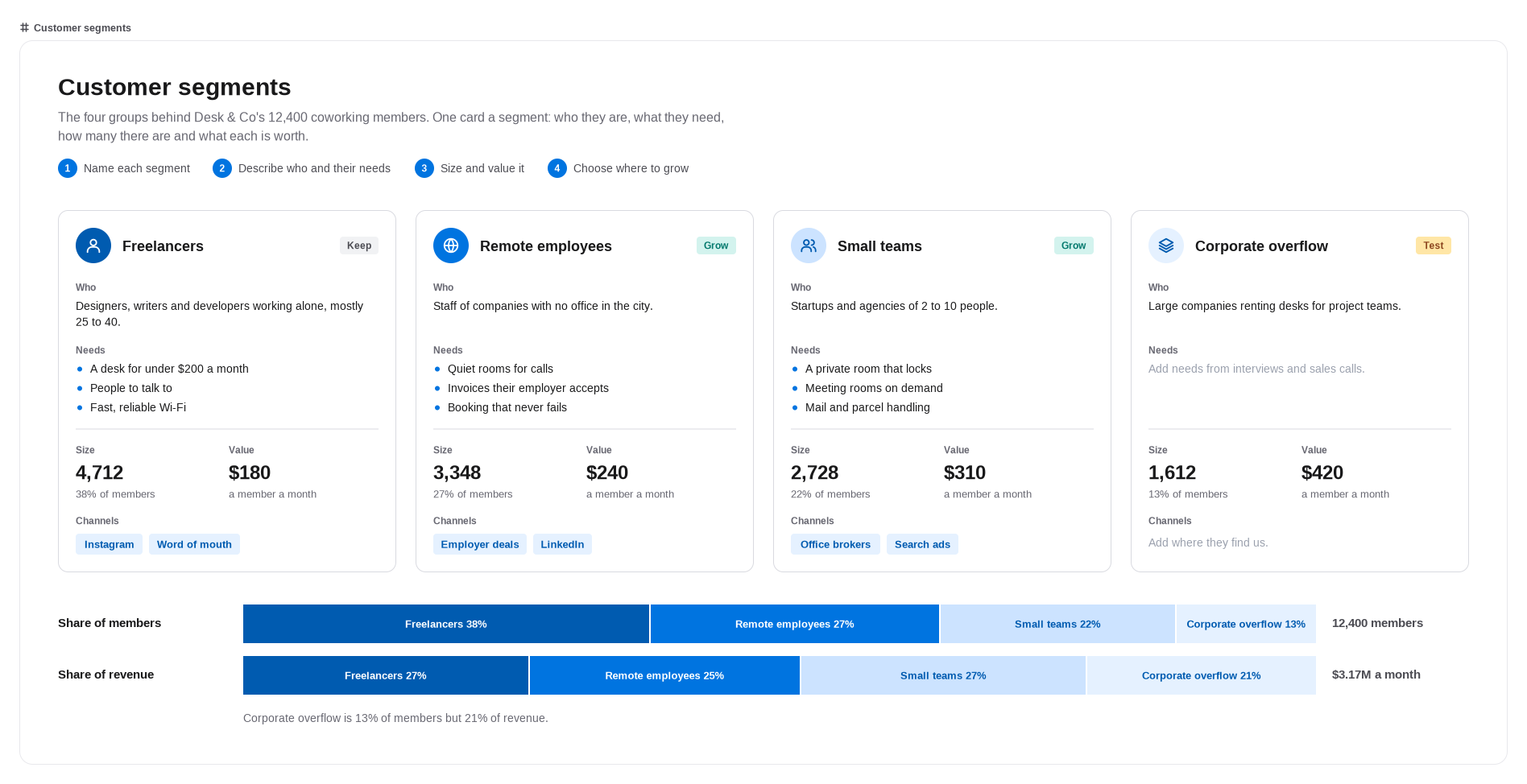
This template puts those four answers on one card for each segment and lines the cards up so you can compare them. The example is Desk & Co, a coworking company with 12,400 members in four groups. Two bars under the cards show how the groups split the membership and the revenue.
Four cards, one for each segment
The cards run left to right from the largest group to the smallest:
- Freelancers. 4,712 people, 38% of members.
- Remote employees. 3,348 people, 27% of members.
- Small teams. 2,728 people, 22% of members.
- Corporate overflow. 1,612 people, 13% of members.
Each card carries a short label in its top corner that states the plan for that group: Keep for freelancers, Grow for remote employees and small teams, Test for corporate overflow. One word forces a choice. A segment you cannot label is one you have not decided about.
What goes on a card
Take the Freelancers card. Who is one sentence: “Designers, writers and developers working alone, mostly 25 to 40.” Needs are three short lines: a desk for under $200 a month, people to talk to, and fast, reliable Wi-Fi. Size and Value sit side by side: 4,712 members at $180 a member a month. Channels names where the segment comes from, here Instagram and word of mouth.
The Remote employees card next to it shows how different a neighbor can be. They need quiet rooms for calls and invoices their employer accepts, pay $240 a month, and arrive through employer deals. If two cards read almost the same, merge them.
Size is not value
The two bars at the bottom make the point a table of numbers hides. The first splits the 12,400 members: freelancers are the widest block at 38%. The second splits the $3.17M of monthly revenue, and the blocks shift: freelancers shrink to 27%, small teams grow from 22% to 27%, and corporate overflow goes from 13% to 21%.
The line under the bars says it outright: “Corporate overflow is 13% of members but 21% of revenue.” That gap is why the smallest card carries the Test label and not Ignore.
Show what you do not know yet
The Corporate overflow card is deliberately unfinished. Who, Size and Value are filled in: large companies renting desks for project teams, 1,612 members, $420 a member a month. But Needs reads “Add needs from interviews and sales calls”, and Channels reads “Add where they find us.”
Leave gaps like these visible on your own board. A card padded with guesses looks as solid as one built on interviews, and nobody can tell the difference a month later. Compare it with Small teams beside it, where every line is specific: “A private room that locks”, “Mail and parcel handling”.
How to use the customer segments template
- Open the template as a board of your own. The Desk & Co cards stay in place until you overwrite them.
- Name each segment. Use a name the sales and support teams would recognize, and delete a card if you have only three groups.
- Describe who they are and what they need. One sentence for Who, three lines for Needs, taken from interviews or support conversations.
- Size and value it. Type the head count, the share and the revenue for each member, then resize the bar blocks to match your percentages.
- Choose where to grow. Give every card one label and write the reason in the line under the bars.
The bars are drawn shapes, so they change only when you resize them.
When to segment, and what to make next
Build this board when one message, one price or one roadmap has stopped fitting everybody, or before planning where next year’s growth should come from.
A segment describes a group. To make one member of that group concrete for a design team, write a user persona. To estimate how many people outside your customer base could join a segment, use market sizing. To see how rivals serve the same groups, plot them on a positioning map.
Questions about the Customer segments template
How many customer segments should a business have?
Usually three to six. Fewer than three often means real differences are being averaged away. More than six is hard for any team to act on. The template starts with four cards; add or delete to fit.
What makes a segment worth its own card?
It should differ from the others in needs, value or channel, be large enough to matter, and be reachable on its own. In the example, small teams need a private room that locks and come through office brokers, which no other group does.
What is the difference between a segment and a persona?
A segment is a countable group, such as 3,348 remote employees worth $240 a month each. A persona is one invented person who stands for a segment, with a name, goals and frustrations. Segment first, then write personas for the groups you choose to serve.
Where do the size and value figures come from?
From your own records: a customer list, billing reports or a survey. You type them onto the cards. Write the date of the data on the board so readers know how fresh the numbers are.