What is a design sprint?
A design sprint is a five-day process for answering a big product question without building the product. A small team maps the problem on Monday, sketches solutions on Tuesday, decides on Wednesday, builds a prototype on Thursday and tests it with real customers on Friday. By the end of the week the team has evidence where it had opinions.
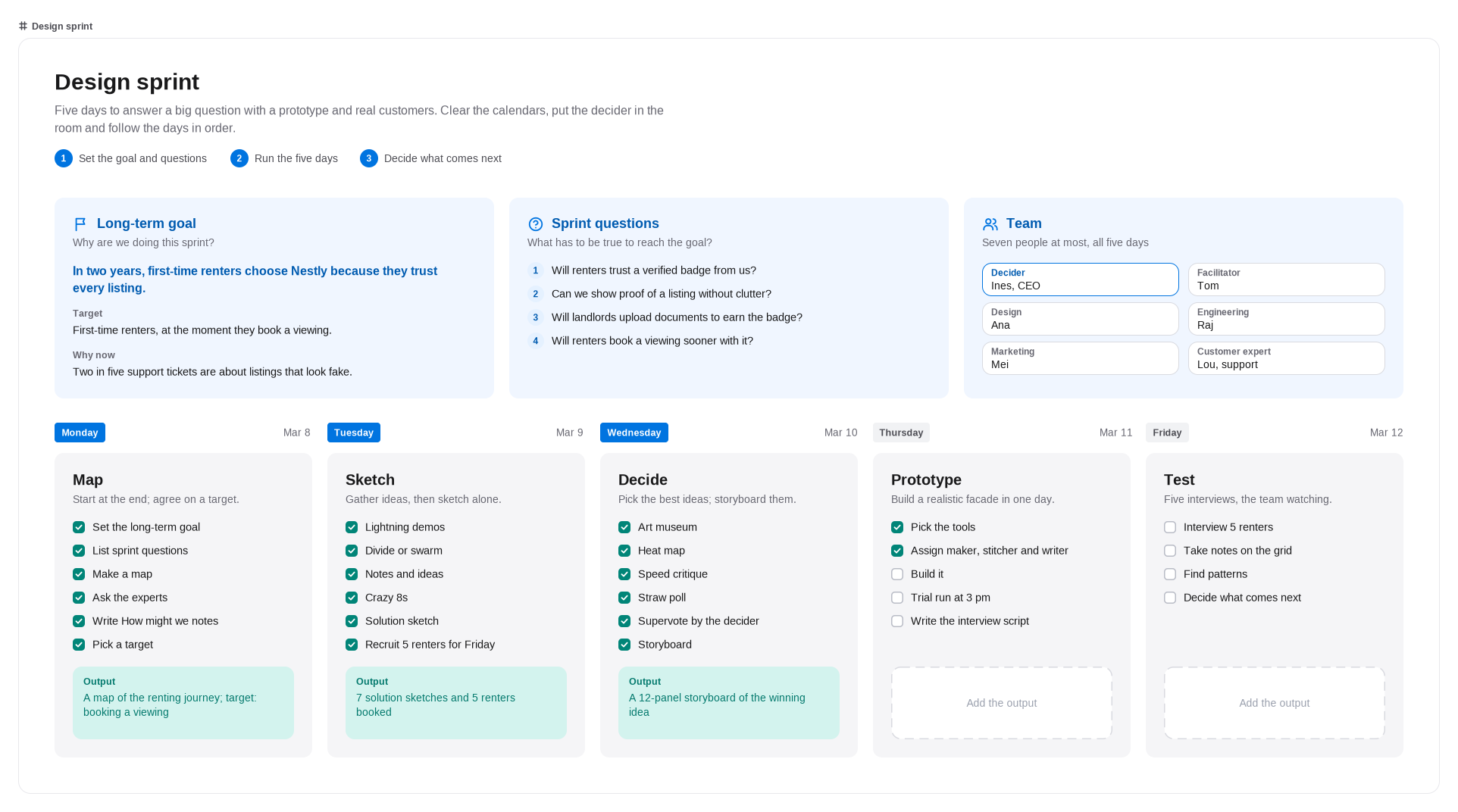
This template is the sprint’s control board. The top row records why the sprint exists and who is in it. The bottom row has a card for each day with its activities and its output. The example comes from a rental listings company whose support tickets keep mentioning fake listings.
The long-term goal and the sprint questions
The first card asks “Why are we doing this sprint?” The example looks two years ahead: first-time renters choose the company because they trust every listing. Two short fields narrow it. Target: first-time renters, at the moment they book a viewing. Why now: two in five support tickets are about listings that look fake.
The second card turns the goal into doubts. Under “What has to be true to reach the goal?” it lists four questions, each starting with will or can. “Will renters trust a verified badge from us?” “Will landlords upload documents to earn the badge?” These are what Friday’s test must answer, so write them before anything else.
Seven people at most
The Team card has six role slots and a rule in its subtitle: seven people at most, all five days. The roles in the example are a decider, a facilitator, design, engineering, marketing and a customer expert, who here comes from support.
Two roles decide whether the sprint works. The decider, the CEO in the example, makes the calls on Wednesday, so the result is not overturned the week after. The facilitator keeps time and stays out of the debate. Fill both slots with names before you book the room.
Monday to Wednesday: map, sketch, decide
Each day card has a title, a one-line aim, a checklist and an output box. Map, on Monday, starts at the end and agrees on a target. Its checklist runs from setting the long-term goal to asking the experts and picking a target. The output in the example is a map of the renting journey with booking a viewing as the target.
Sketch, on Tuesday, gathers ideas and then has everyone sketch alone. It includes lightning demos, Crazy 8s and a solution sketch, and one practical task: recruit 5 renters for Friday. The output was 7 solution sketches and 5 renters booked.
Decide, on Wednesday, picks the best ideas through a heat map, a speed critique, a straw poll and a supervote by the decider. It ends with a 12-panel storyboard of the winning idea.
Thursday and Friday: prototype and test
Prototype has one aim: build a realistic facade in one day. The checklist assigns a maker, a stitcher and a writer, schedules a trial run at 3 pm and ends with writing the interview script. A facade is enough because the test needs reactions, not working code.
Test is five interviews with the team watching. The checklist is short: interview 5 renters, take notes on the grid, find patterns, decide what comes next. In the example the output boxes for these two days still read “Add the output”, which shows a board halfway through its week.
How to use the design sprint template
- Open the board a week ahead. Use this template makes your copy. Change the dates on the day cards to your sprint week.
- Set the goal and questions. Write the long-term goal with the decider, then list three to five sprint questions and fill the team slots.
- Run the five days. Work down each day’s checklist in order and write the output into its box before the team leaves.
- Decide what comes next. After Friday’s interviews, mark each sprint question as answered yes, no or unclear, and agree on the next step.
When a sprint is worth a week
Run a sprint when the question is big, the answer is uncertain and a wrong guess would cost months. A new product, a new market or a redesign of a core flow all qualify. It takes five full days from as many as seven people, so it is the wrong tool for small decisions.
For a short burst of ideas, a Crazy 8s session takes minutes. To shape the Wednesday storyboard, the storyboard template gives you the panels. And when Friday’s interviews are done, record what you saw in usability test findings.
Questions about the Design sprint template
What happens on each day of a design sprint?
Monday maps the problem and picks a target. Tuesday is for sketching solutions. Wednesday the team decides and storyboards the winner. Thursday it builds a prototype. Friday five customers try it while the team watches and takes notes.
How many people should take part?
Seven at most, and the same people on all five days. The board has slots for a decider, a facilitator, design, engineering, marketing and a customer expert. More than seven slows every discussion and vote.
Why test with only five customers?
Five interviews fit in one day and are usually enough for patterns to repeat. The sprint looks for strong signals about its questions, not for statistics. If three of five renters ignore the badge, the team has learned what it needed.
What does the decider do?
The decider has the final say on the target, the winning sketch and what happens after the test. In the example it is the CEO. Without that person in the room, the sprint’s outcome tends to be reopened afterwards.