What is feedback analysis?
Feedback analysis turns a pile of comments into a short list of things to do. You gather what customers wrote, tag every comment with a theme and a sentiment, count the tags, and decide what each theme calls for. The counting keeps the loudest complaint from passing for the most common one.
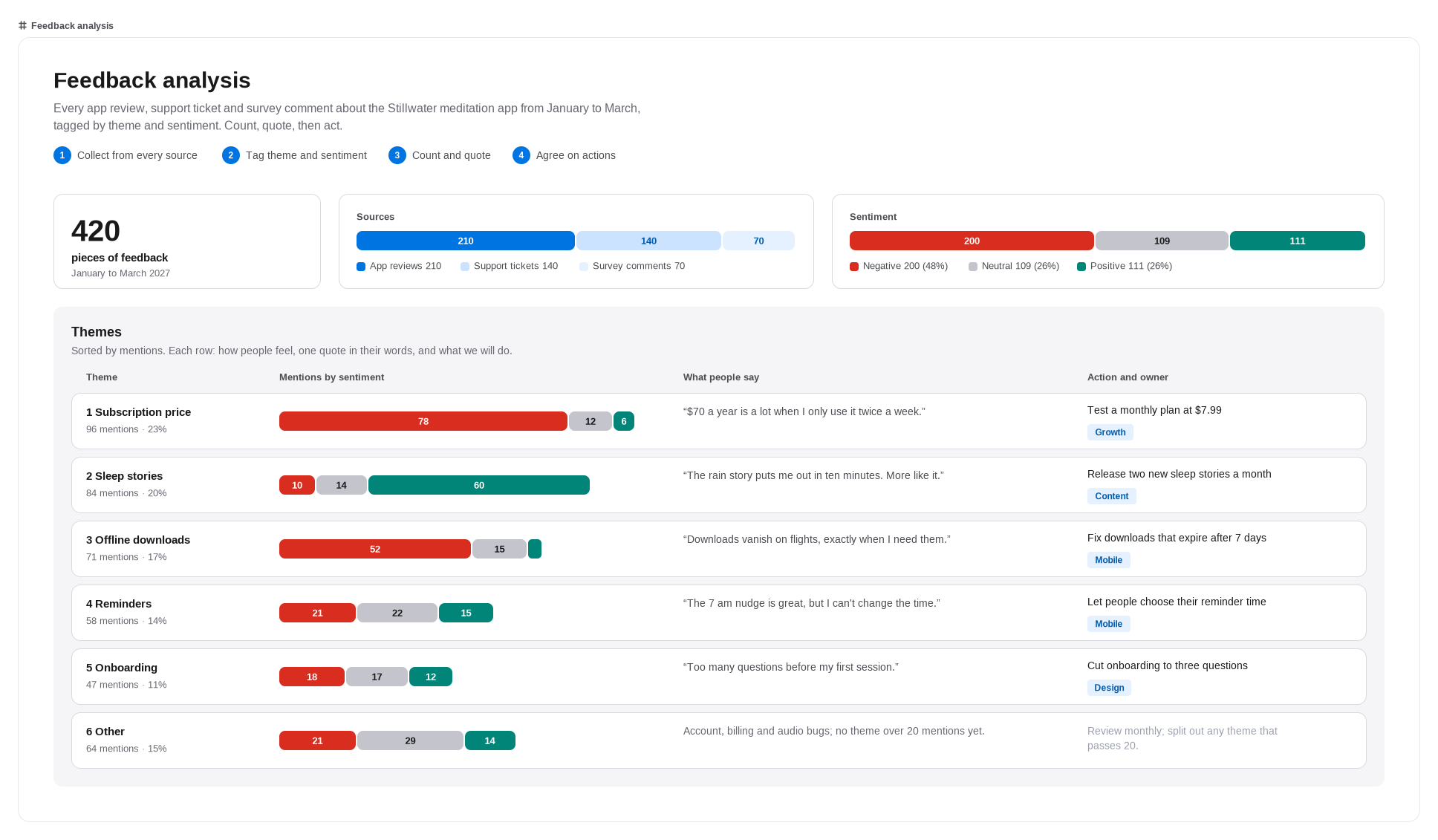
This template lays that out on one page. The example covers the Stillwater meditation app from January to March 2027: every app review, support ticket and survey comment, 420 in all. Three panels at the top give the totals, and a table below ranks six themes.
Start with the totals
The first panel is one large number: 420 pieces of feedback, with the period underneath. The second splits that number by source in a single bar: 210 app reviews, 140 support tickets and 70 survey comments.
The split matters because sources lean different ways. People open tickets when something is broken and answer surveys when asked. A reader who sees that half the feedback is app reviews can judge the themes with that in mind. Leave a source out and the table below it describes only part of your customers.
Sentiment at a glance
The third panel shows how the 420 comments feel: 200 negative (48%), 109 neutral (26%) and 111 positive (26%). It is one bar with three blocks and a legend.
Keep neutral as its own tag. Questions, feature requests without complaint and plain bug reports often land there, and folding them into negative makes the product look worse than customers said it is.
The themes table
The main panel lists the themes, sorted by mentions. Each row has four parts: the theme with its count and share, a small bar that splits its mentions by sentiment, one quote in the customer’s words, and an action with an owner.
The example ranks Subscription price first with 96 mentions (23%), then Sleep stories with 84, Offline downloads with 71, Reminders with 58 and Onboarding with 47. The sixth row is Other: 64 mentions of account, billing and audio bugs, with no theme over 20 mentions yet. Its action is a rule, not a task: review monthly and split out any theme that passes 20.
A row that ends in an action
Read the first row from left to right. Of 96 mentions of price, 78 are negative. The quote makes the count human: “$70 a year is a lot when I only use it twice a week.” The action answers that exact complaint, “Test a monthly plan at $7.99”, and the owner is Growth.
The second row shows that analysis is not only a list of complaints. Sleep stories drew 84 mentions and 60 of them are positive: “The rain story puts me out in ten minutes. More like it.” The action is to release two new sleep stories a month. Themes people love need an owner as much as themes they hate.
How to use the feedback analysis template
- Create a board from the template. Keep the Stillwater rows as a model while you prepare your own data.
- Collect from every source. Pull reviews, tickets and survey comments for one fixed period, and enter the totals in the top panels.
- Tag theme and sentiment. Read each comment once and give it one theme and one of three sentiments. Start a new theme only when the old ones do not fit.
- Count and quote. Type each theme’s mentions, resize its bar blocks to match, and paste the one quote that says it best.
- Agree on actions. In a review meeting, write one action and one owning team in every row.
FlowDraw AI can add rows or redraw the layout from a description, and the counts stay yours to enter.
When this board helps, and when another fits better
Use it at the end of a quarter, after a launch, or whenever the product team argues from anecdotes. It works for any set of open-text comments you can read through.
If your feedback is a survey score with follow-up comments, an NPS analysis keeps score and reasons together. If you have not found the themes yet, cluster raw comments on an affinity diagram first. For long conversations with a handful of customers, an interview synthesis suits the material better.
Questions about the Feedback analysis template
How many themes should a feedback analysis have?
Five to eight named themes plus Other is a workable range. The example has five and an Other row that holds 15% of mentions. If Other grows past a quarter of the total, read it again: a theme is hiding in it.
Should one comment count toward two themes?
Tag the main point only, so the mentions add up to the total: the six rows in the example sum to 420. If a comment truly makes two separate points, split it into two pieces of feedback before you tag.
Which quote should represent a theme?
Pick a typical one, not the angriest. It should be short, specific and in the customer’s own words, like “Downloads vanish on flights, exactly when I need them.” A good quote lets a reader who skips the numbers still understand the problem.
How often should the analysis be repeated?
Use a fixed period and repeat it, so counts can be compared. The example covers three months and reviews its Other row monthly. Keep each period’s board; the change in a theme’s share between two boards says more than either number alone.