What are the 5 whys?
The 5 whys is a way to find the cause behind a problem by asking “why?” of each answer until you reach something you can fix. It comes from lean manufacturing and needs no data tools, only a clear problem and people who know the process. The risk is that it turns into guessing, so each answer needs proof.
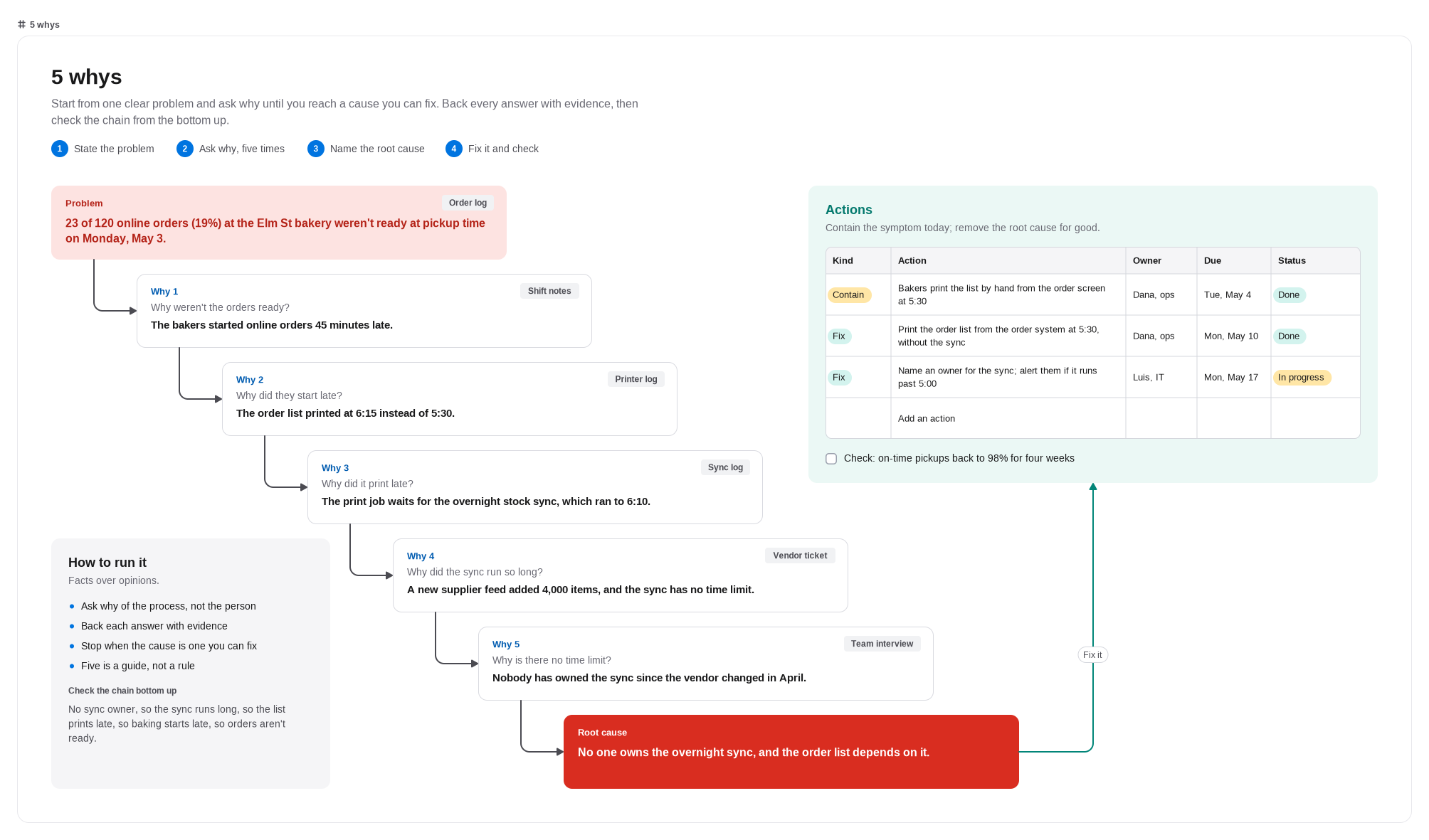
This template builds that proof in. The problem and each why are cards that step down and to the right, every card names its evidence, and the root cause points to a table of actions. The example is a bakery on Elm St where 23 of 120 online orders (19%) were not ready at pickup time on Monday, May 3.
The staircase from problem to root cause
Each card asks one question and gives one answer, and the answer becomes the subject of the next question:
- Why 1. Why weren’t the orders ready? The bakers started online orders 45 minutes late.
- Why 2. Why did they start late? The order list printed at 6:15 instead of 5:30.
- Why 3. Why did it print late? The print job waits for the overnight stock sync, which ran to 6:10.
- Why 4. Why did the sync run so long? A new supplier feed added 4,000 items, and the sync has no time limit.
- Why 5. Why is there no time limit? Nobody has owned the sync since the vendor changed in April.
The steps shift to the right as they go down, so the eye follows the chain without arrows having to cross.
Put evidence on every answer
Look at the top right corner of each card. A small tag names where the answer comes from: Order log for the problem, Shift notes for why 1, then Printer log, Sync log, Vendor ticket and Team interview. An answer without a tag is an opinion, and a chain built on one opinion leads to the wrong fix.
The problem card sets the standard. It does not say “orders are often late”. It gives a count, a share, a place and a date. A problem stated that exactly can be checked again after the fix, which is how you learn whether the analysis was right.
Stop at a cause you can fix
The last card is the root cause, and it reads: “No one owns the overnight sync, and the order list depends on it.” Notice what kind of cause this is. It is not “the sync was slow”, which is a symptom, and not “IT made a mistake”, which blames a person. It is a missing piece of the process, and a team can add it.
The fourth why would have been a tempting place to stop. A time limit on the sync sounds like a fix. One more question showed why the limit was never set, and that the same gap would produce the next failure too.
Contain today, fix for good
The arrow labelled “Fix it” leads to the Actions table. Its first column separates two kinds of work. Contain stops the symptom now: bakers print the list by hand from the order screen at 5:30. Fix removes the cause: print the order list at 5:30 without the sync, and name an owner for the sync who is alerted if it runs past 5:00.
Every row has an owner, a due date and a status, and one row is still “In progress”. Under the table is the check that closes the loop: on-time pickups back to 98% for four weeks.
How to use the 5 whys template
- Open it as a new board. The bakery chain stays on your copy until you overwrite it.
- State the problem. Write what happened with a number, a place and a date, and tag the source.
- Ask why, card by card. Fill the next card only when the one above has evidence. Add or delete steps if the chain needs four or six.
- Read it backwards. Say the chain from the bottom up with “so” between the steps, as the panel does: no sync owner, so the sync runs long, so the list prints late. If a link sounds wrong, fix that card.
- Fill the actions. Add one contain row and at least one fix row, each with a name and a date.
When the 5 whys work, and when to use something else
The method suits one specific failure with one main line of cause: a late order, a failed deploy, a billing error. It is quick enough to run in a short meeting with the people who do the work.
It follows a single path, so it struggles when several causes act together. To collect causes across categories first, use a fishbone diagram. When you have counts of many problem types and need to know which few matter most, start with a Pareto analysis. For an outage with a timeline and follow-ups, a post-mortem gives more room.
Questions about the 5 whys template
Do I have to ask why exactly five times?
No. Five is a rule of thumb. Stop when you reach a cause the team can act on and that explains the steps above it. Some chains end after three questions and some need seven. The cards on the board can be added or removed.
What if a why has more than one answer?
Pick the answer the evidence supports most strongly and follow it. If two answers are both proven, branch the chain by copying the remaining cards, or move to a fishbone diagram, which is built for several causes at once.
How do I know I have reached the root cause?
Three signs: fixing it would have prevented the problem, it is within your power to change, and it describes a process or system gap. If the answer is a person’s mistake, ask why the process allowed that mistake.
Who should be in a 5 whys session?
The people closest to the work, plus one person to ask the questions and keep answers factual. In the bakery example that means ops, IT and a baker from the shift. Three to six people is enough.