What is a post-mortem?
A post-mortem is a written review of something that went wrong: an outage, a failed launch, a missed deadline. It records what happened and when, how much it hurt, why it happened and what will change. A good one is blameless. As the board puts it, look at systems, not people, because a person who fears blame will leave out the detail you most need.
This template gives the review six areas in the order a team works through them. The example is an incident review for a checkout outage on Tuesday, August 17, 2027, rated SEV-2 and already resolved.
Summary and impact
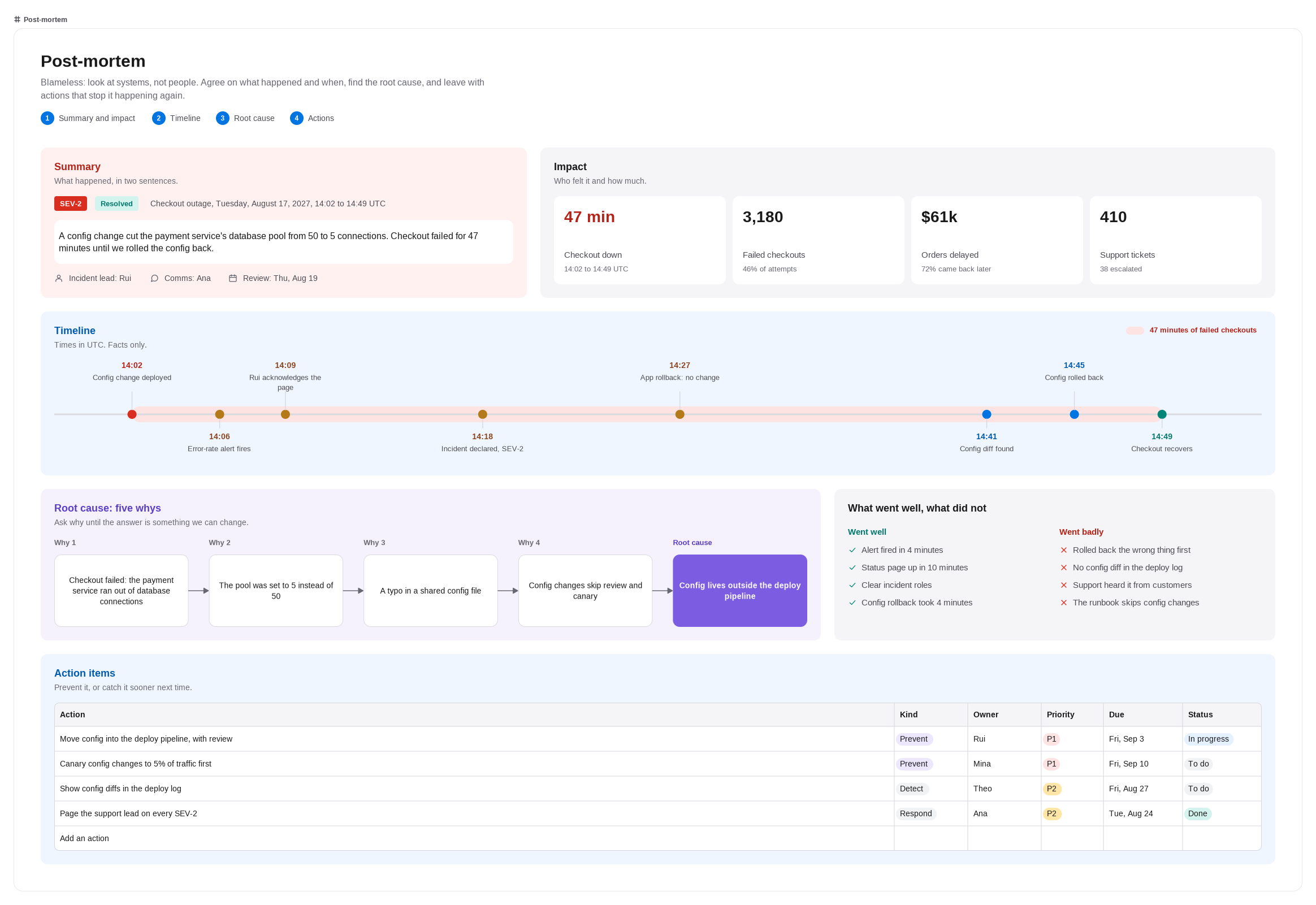
The top row answers the two questions every reader has first. The Summary says what happened in two sentences: a config change cut the payment service’s database pool from 50 to 5 connections, and checkout failed for 47 minutes until the config was rolled back. Under it sit the incident lead, Rui, the person on comms, Ana, and the review date.
Impact puts numbers on it in four cards: 47 minutes of checkout down, 3,180 failed checkouts (46% of attempts), $61k in orders delayed, of which 72% came back later, and 410 support tickets with 38 escalated. Numbers like these decide how much effort the fix deserves.
The timeline: facts only
The timeline lays the incident on one line, with a time and a few words for each event. All times are in UTC. It starts at 14:02, “Config change deployed”, and ends at 14:49, “Checkout recovers”. Between them: the error-rate alert fires at 14:06, Rui acknowledges the page at 14:09, the incident is declared at 14:18, an app rollback at 14:27 changes nothing, the config diff is found at 14:41, and the config is rolled back at 14:45.
Write what happened, not what people should have done. “App rollback: no change” is a fact. The fourteen minutes that followed it are where the review will find its lessons.
Root cause: five whys
The next panel asks “why” until the answer is something the team can change. It reads left to right:
- Why 1. Checkout failed: the payment service ran out of database connections.
- Why 2. The pool was set to 5 instead of 50.
- Why 3. A typo in a shared config file.
- Why 4. Config changes skip review and canary.
- Root cause. Config lives outside the deploy pipeline.
Stopping at the third why would have blamed whoever typed the 5. Going two steps further finds a cause that no amount of care would fix: config had no review at all. That is what blameless means in practice.
What went well, what did not
An incident is also a test of how the team responds, and parts of the response usually work. The panel beside the whys lists both sides. Went well: the alert fired in 4 minutes, the status page was up in 10, incident roles were clear, and the config rollback took 4 minutes once it started.
Went badly: the team rolled back the wrong thing first, there was no config diff in the deploy log, support heard about it from customers, and the runbook skips config changes. Keep each line to one observable fact. The good list tells you what to protect when you change the process.
Action items that prevent, detect or respond
The table at the bottom is the reason the meeting exists. Each action has a kind, an owner, a priority, a due date and a status. The Kind column is worth copying: it sorts actions into Prevent, Detect and Respond, so you can see whether you are only patching the last failure.
The example has two Prevent actions at P1: move config into the deploy pipeline with review, owned by Rui, and canary config changes to 5% of traffic first, owned by Mina. Showing config diffs in the deploy log is a Detect action. Paging the support lead on every SEV-2 is a Respond action, and it is already Done.
How to use the post-mortem template
- Open it as a new board. Within a day or two of the incident, replace the severity, the status and the date line in the Summary.
- Write the summary and impact. Two sentences, then four numbers. If you do not have a number yet, write who will get it.
- Build the timeline from logs. Paste times from alerts and chat before the meeting, so the group corrects a draft and does not rebuild it from memory.
- Ask why five times. Rewrite the five cards together. Stop when the last card names something you can change.
- Fill the action table. Tag each action Prevent, Detect or Respond and give it a priority and a date.
When a post-mortem fits, and what else to consider
Write one after any incident that customers noticed, any near miss that could have been serious, and any project that ended far from its plan. Hold the review within a week, while people remember.
The five whys panel here is compact. For a stubborn cause, dig deeper on a dedicated 5 whys board, or map many possible causes on a fishbone diagram. To describe how incidents should be handled from now on, draw the incident response flow. And before the next risky launch, a pre-mortem looks for the failure in advance.
Questions about the Post-mortem template
What does blameless mean in a post-mortem?
It means the review asks how the system let the mistake through, not who made it. In the example a typo started the outage, but the root cause is that config changes had no review. People speak openly only when they know they will not be punished for it.
How soon after an incident should the review happen?
Within a few days. The example outage was on a Tuesday and the review on Thursday. Wait longer and details fade; meet the same day and people are still tired and the numbers are incomplete.
Who should attend a post-mortem meeting?
Everyone who took part in the response, plus the owners of the systems involved and someone who speaks for affected customers, such as support. Keep it under ten people and share the finished board with everyone else.
How many action items are enough?
Few enough that all of them get done. The example has four. Aim for at least one action that prevents the cause and one that would catch it sooner, and give each a single owner.
Can I use this template for a project instead of an outage?
Yes. Replace the severity tag with the project name, use weeks in place of minutes on the timeline, and put budget, delay and scope numbers in the four impact cards. The whys and the action table work unchanged.