What is a How Might We question?
A How Might We question, HMW for short, is a problem rewritten as an invitation. “Forms ask for the same details twice” is a complaint. “How might we ask for each detail only once?” is something a team can answer in twenty different ways. The three words do the work: how assumes an answer exists, might allows answers that fail, and we makes it a shared job.
This template takes you from raw problems to one chosen question. The example is Northside Clinic, where a team talked to 12 patients and turned what they heard into questions about waiting, check-in and arrival.
Begin with the problems you heard
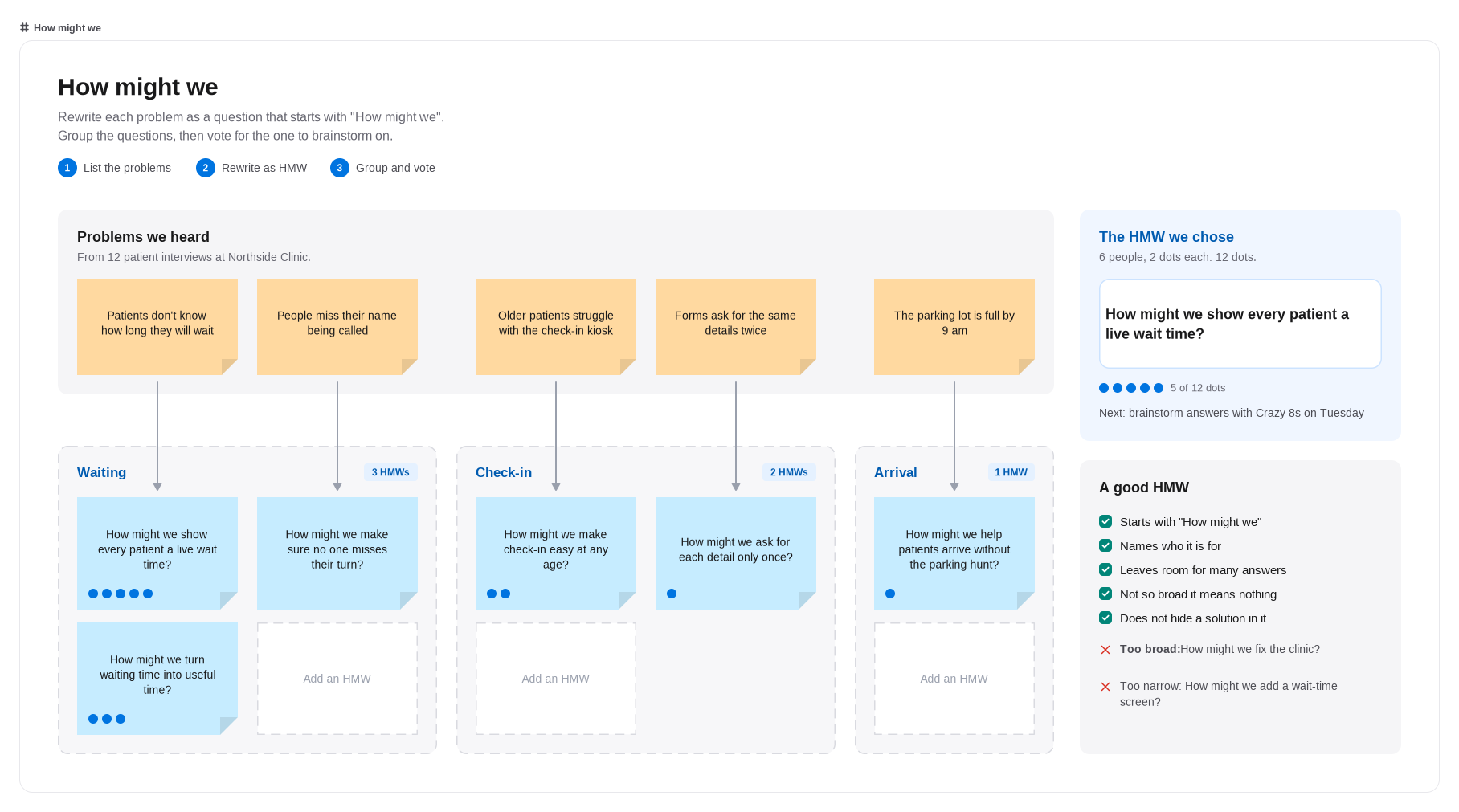
The top band is titled Problems we heard. It holds five notes from the clinic interviews, each one a plain statement of what goes wrong:
- Patients don't know how long they will wait
- People miss their name being called
- Older patients struggle with the check-in kiosk
- Forms ask for the same details twice
- The parking lot is full by 9 am
Notice that none of them proposes a fix. A problem note says what a person ran into, in words that person would recognize. The line under the title records where the notes came from, so anyone reading the board later knows the questions rest on interviews and not on guesses.
Rewrite each problem and group the questions
Below the problems sit three groups: Waiting with 3 HMWs, Check-in with 2 and Arrival with 1. Each question sits under the problem it grew from. The kiosk problem became “How might we make check-in easy at any age?” and the full parking lot became “How might we help patients arrive without the parking hunt?”
One problem can produce more than one question. The waiting notes led to a third question that no patient asked for directly: “How might we turn waiting time into useful time?” That is the point of the rewrite. It moves the team from the complaint to the space around it.
Every group ends with a dashed card labelled Add an HMW, so a late question has a place to go.
Check each question against the list
The panel called A good HMW lists five tests. The question starts with “How might we”, names who it is for, leaves room for many answers, is not so broad it means nothing, and does not hide a solution in it.
The last two are where teams slip, so the board shows one failure of each kind. Too broad: “How might we fix the clinic?” gives nobody a place to start. Too narrow: “How might we add a wait-time screen?” has already decided the answer is a screen. The question the team kept, about showing every patient a live wait time, sits between the two: it names the patient and the outcome but leaves the method open.
Vote for the one to brainstorm on
A brainstorm needs one question, not six. In the example 6 people got 2 dots each, 12 dots in all, and placed them on the notes. “How might we show every patient a live wait time?” collected 5 of the 12, so it moved to the panel named The HMW we chose.
The panel also records what happens next: brainstorm answers with Crazy 8s on Tuesday. Writing the next session on the board keeps the chosen question from becoming a poster nobody acts on.
How to use the How Might We template
- Open it as a new board. The clinic example comes with it, which helps a team that has never written an HMW.
- List the problems. Replace the five clinic notes with statements from your own interviews, support tickets or observations. Keep the source line honest.
- Rewrite as HMW. Take one problem at a time and write at least one question for it. Read each against the five tests before it stays.
- Group and vote. Rename the three groups to fit your questions, hand out two dots a person, and copy the winner into the panel on the right with a date for the brainstorm.
If you would rather start from a description of your project, FlowDraw AI can draft a first set of notes for you to edit.
When HMW questions help, and what to use instead
Use this board between research and ideas: after interviews, a usability test or a pile of support tickets, and before anyone sketches a solution. It is a bridge, so it produces no ideas on its own.
If your notes are still a heap of raw quotes, sort them on an affinity diagram first. If you already have a question and need to look at it from every angle, starbursting asks who, what, where, when, why and how about it.
Questions about the How might we template
How many How Might We questions should a team write?
More than it needs. Aim for at least one question per problem and two or three for the problems that matter most. The clinic example wrote six from five problems and then voted, which is a small session. Twenty questions from a larger study is normal.
What makes a How Might We question too narrow?
It names the solution. “How might we add a wait-time screen?” can only be answered with a screen. Remove the device and keep the outcome: patients know how long they will wait. Now text messages, staff updates and signs are all possible answers.
Do we need user research before writing HMWs?
You need real problems, and research is the most reliable source. If you have none, write down the problems the team believes exist, mark them as assumptions on the board, and check the most important ones with a few customers before you brainstorm.
Is the How Might We template free to use?
Yes. The board has 80 elements, well inside the 150 a Free board allows, and Free includes three boards. You can edit every note and export the result as PNG, SVG, PDF or JSON.