
What is starbursting?
Starbursting is brainstorming for questions instead of answers. You write an idea in the middle of a six-point star and ask everything you can think of from each point: who, what, where, when, why and how. Answers wait until the questions are all on the board.
It is a way to test an idea before anyone has grown attached to it. A plan that looks finished often has no answer to “who pays?” or “when does it end?”, and the star makes those gaps visible. This template has the star, six question panels, a rules card and a short list of what to answer first. The idea in the example is a monthly repair café at the Elm Street library.
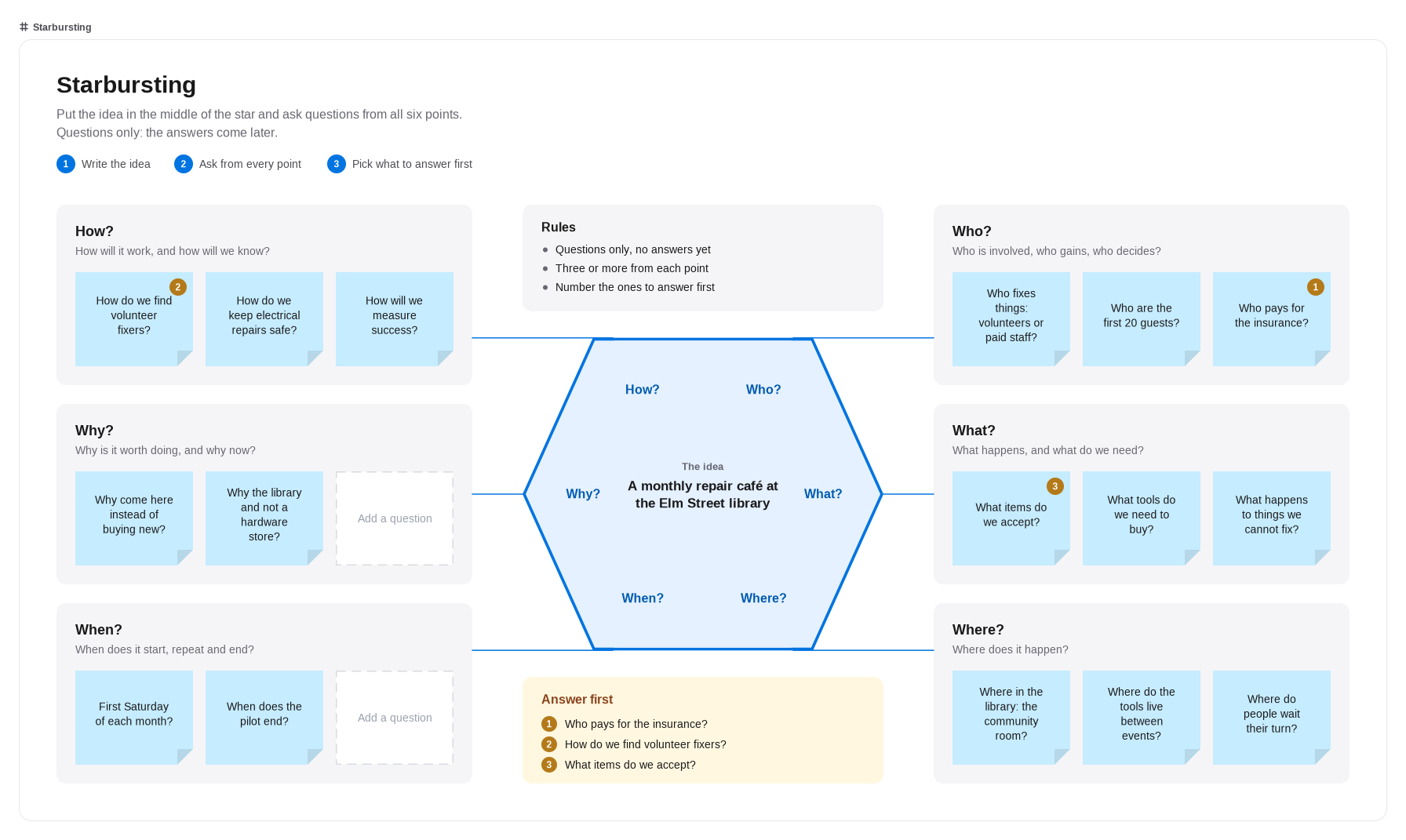
The star in the middle
The star holds two things. Its center says “The idea” with one line under it: “A monthly repair café at the Elm Street library”. Each of its six points carries one question word, going clockwise from the top right: Who, What, Where, When, Why, How.
Keep the idea to one line. If it takes a paragraph to describe, it is several ideas, and the questions will scatter across all of them. The repair café line says what it is, how often and where, and that is enough for people to start asking.
Six panels of questions
Each point of the star has a panel of its own, and each panel opens with a prompt that widens the question word. The Who? panel asks “Who is involved, who gains, who decides?” Its notes for the repair café:
- Who fixes things: volunteers or paid staff?
- Who are the first 20 guests?
- Who pays for the insurance?
The What? panel asks “What happens, and what do we need?”, and its notes include “What tools do we need to buy?” and “What happens to things we cannot fix?” The Where panel below them covers the room, the storage and the queue. On the other side of the star, the How, Why and When panels work the same way.
Questions only, and from every point
The rules card above the star has three lines: questions only, no answers yet; three or more from each point; number the ones to answer first.
The first rule is the hard one. When someone asks “How do we keep electrical repairs safe?”, the room wants to solve it. Write the question down and move on. Answering early ends the search for questions, and the ones nobody has asked yet are usually the costly ones.
The second rule shows where the thinking is thin. In the example, How has three notes, but Why has two: “Why come here instead of buying new?” and “Why the library and not a hardware store?” A dashed “Add a question” card marks the gap. Why and When are often the last panels a team fills, because they ask whether the idea should exist and when it stops.
Pick what to answer first
Sixteen questions cannot all be answered this week. The third rule asks the group to number the most important ones, and the card under the star lists them. For the repair café:
- 1. Who pays for the insurance?
- 2. How do we find volunteer fixers?
- 3. What items do we accept?
The same numbers appear as small badges on the notes in their panels, so you can trace each one back. The order makes sense: without insurance the library cannot host the event at all, and without fixers there is nothing to host. Good first questions are the ones whose answer could stop the idea.
How to use the starbursting template
- Open it as a new board. Replace the repair café line in the star with your own idea, in one sentence.
- Ask from every point. Go around the star one panel at a time, about three minutes each. Write every question on its own note and start it with the panel's word.
- Check the count. Any panel with fewer than three questions gets another minute before you move on.
- Pick what to answer first. Put a number badge on the three questions that could stop the idea, copy them to the Answer first card and give each to one person.
When starbursting helps, and when another template fits
Use it when an idea already exists and needs testing: a product launch, an event, a new service, a policy change. It also makes a good first half-hour for a project, since the numbered questions become the first tasks.
If there is no idea yet, start with a brainstorm session and bring the winner here. If the trouble is a fault you need to explain, not a plan you need to test, ask why five times in a row on a five whys board. And if the group struggles to ask anything at all, a question burst drops the six categories and simply counts questions against the clock.
Questions about the Starbursting template
How many questions should a starbursting session produce?
At least three for each of the six points, so 18 or more. The repair café example has 16 and two open cards, which is a normal state partway through. Past 40, stop and number the important ones.
When do we answer the questions?
After the session, and not all of them. Number the three that matter most, give each one an owner and a date, and meet again when those are answered. Many of the remaining questions answer themselves once the first three are settled.
What is the difference between starbursting and the five Ws?
They use the same question words. The five Ws are a checklist for describing something that happened, with one answer each. Starbursting uses the words, plus how, as prompts to generate many open questions about something that has not happened yet.