What is an interview guide?
An interview guide, also called a discussion guide, is the script a researcher brings to a user interview. It sets the order of topics, the wording of the main questions and the time each part gets. It is a guide and not a questionnaire: you keep the order but follow the person.
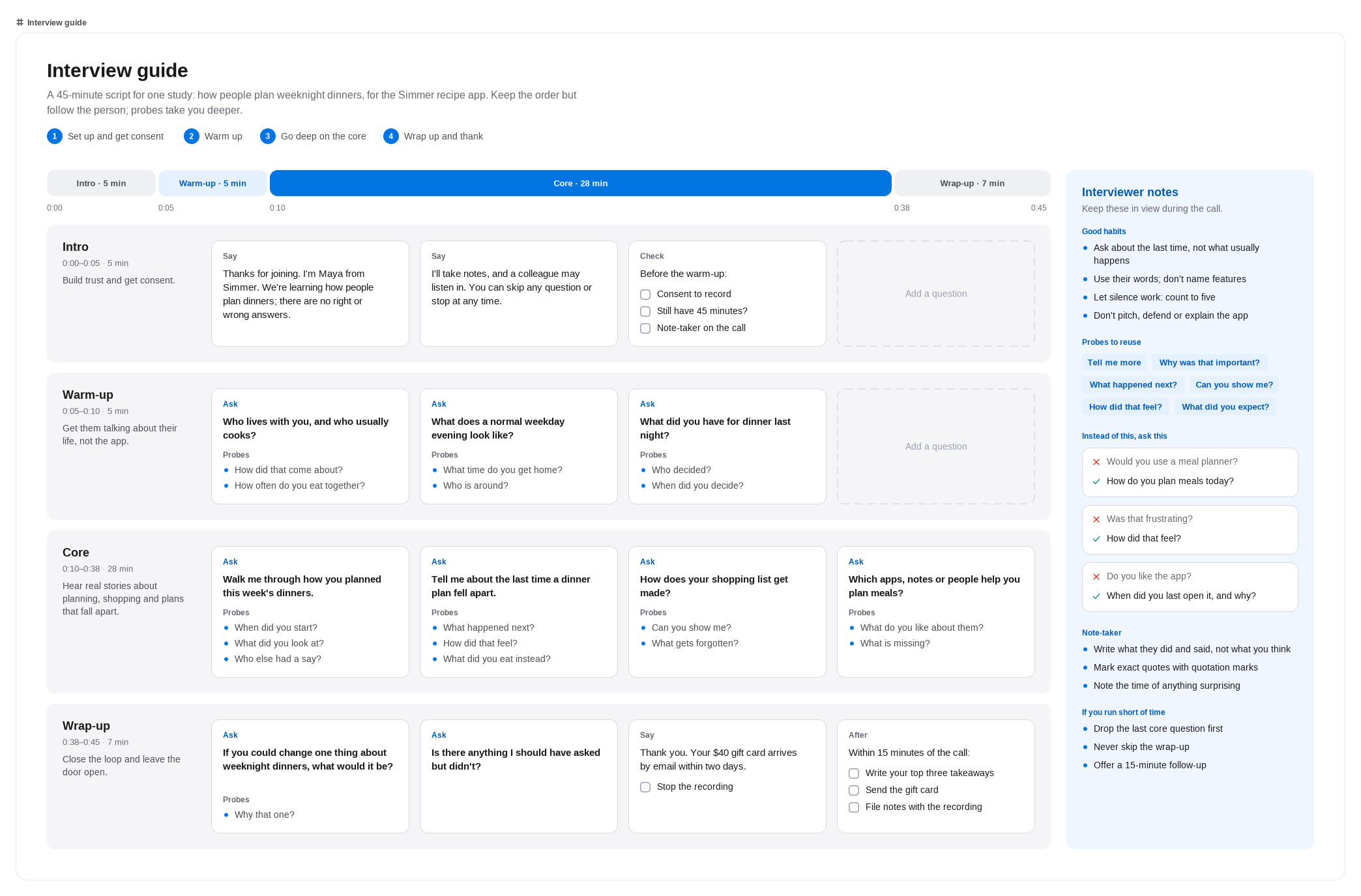
This template arranges a full session on one board. Four rows hold the four parts of the conversation, each question is a card, and a column on the right keeps the interviewer’s reminders in view. The example is one study for Simmer, a made-up recipe app: how people plan weeknight dinners.
A time bar and a careful start
A bar across the top divides the 45 minutes in proportion: Intro 5 minutes, Warm-up 5, Core 28 and Wrap-up 7, with clock marks at 0:00, 0:05, 0:10, 0:38 and 0:45. The core segment is the widest and the darkest, which is the point: nearly two thirds of the time belongs to the stories you came for.
The intro row has no questions at all. Its goal is to build trust and get consent. Two cards are marked Say, with words to speak aloud, such as “there are no right or wrong answers” and “You can skip any question or stop at any time.” A third card is a checklist before the warm-up: consent to record, still have 45 minutes, note-taker on the call.
Questions with probes underneath
The warm-up and core rows hold the questions. Every card is marked Ask, states one open question and lists its probes: short follow-ups to use if the answer stays on the surface.
The warm-up gets people talking about their life, not the app: “Who lives with you, and who usually cooks?” The core asks for real stories about planning, shopping and plans that fall apart:
- “Walk me through how you planned this week’s dinners.” Probes: When did you start? What did you look at? Who else had a say?
- “Tell me about the last time a dinner plan fell apart.” Probes: What happened next? How did that feel? What did you eat instead?
Each question points at something that happened, not at an opinion.
Ask about what happened, not what might
The notes column teaches the craft in a few lines. Under Good habits: ask about the last time, not what usually happens; use their words and don’t name features; let silence work by counting to five; don’t pitch, defend or explain the app.
The most useful part is Instead of this, ask this, three pairs that rewrite a weak question:
- “Would you use a meal planner?” becomes “How do you plan meals today?”
- “Was that frustrating?” becomes “How did that feel?”
- “Do you like the app?” becomes “When did you last open it, and why?”
The first of each pair invites a polite yes. The second gets a story. Test every question in your own guide against these pairs.
Wrap up on purpose
The last seven minutes close the loop and leave the door open. Two questions do most of the work: “If you could change one thing about weeknight dinners, what would it be?” and “Is there anything I should have asked but didn’t?” The second one often brings out the remark of the session.
Then a Say card thanks the person and confirms the incentive, a $40 gift card by email within two days, with a reminder to stop the recording. The final card is for after the call, within 15 minutes: write your top three takeaways, send the gift card and file notes with the recording. Memory fades quickly, so that card is part of the interview.
How to use the interview guide template
- Open it as a new board. At 185 elements it is bigger than the 150 a Free board holds, so use a Pro or Team workspace.
- Set your timing. Change the minutes on the bar and in each row label to fit your session length.
- Rewrite the Say cards. Put your own name, purpose and consent wording in the intro, and your incentive in the wrap-up.
- Write the core questions. Replace the dinner questions with three or four of your own, each about a recent event, and give each two or three probes.
- Rehearse once. Run it with a colleague and cut what does not fit. The notes say what to do if time runs short: drop the last core question first, never skip the wrap-up.
When an interview guide helps, and what comes before and after
Use it for any round of one-to-one interviews where several sessions must be comparable: discovery research, customer development, a study of people who stopped using the product. One guide serves the whole round; small edits between sessions are normal.
The guide covers the conversation only. Decide who to talk to and why in a research plan first. Afterwards, group what you heard with interview synthesis. If you will watch people try a product instead of talking about their habits, record the results in usability test findings.
Questions about the Interview guide template
How many questions fit in a 45-minute interview?
Fewer than you think. The example has nine questions in total, four of them in the 28-minute core. With probes and stories, each core question takes about seven minutes. A longer list pushes you to rush, which costs depth.
Do I have to follow the guide word for word?
No. Keep the order of the parts and the wording of the consent, and let the conversation move within each part. If a participant answers a later question early, follow them and skip it when you get there.
What is a probe?
A short follow-up that asks for more detail without steering the answer, such as “Tell me more” or “What happened next?” The board lists probes under each question and six general ones in the notes column to reuse anywhere.
Does the template work on the Free plan?
Not as it is. The board contains 185 elements and a Free board holds up to 150, so it opens on the Pro and Team plans. There you can edit, move or delete any card to fit your study.