What is a north star metric?
A north star metric is the one number that best captures the value customers get from a product. When it rises, customers are getting more of what they came for, and revenue tends to follow. Teams use it to point separate efforts in one direction.
A single number is hard to act on, so this template breaks it into four inputs that teams can move, lists the levers under each, and adds a counter-metric to keep the number honest. The example is Lingo Loop, a language app.
The north star and the reason for it
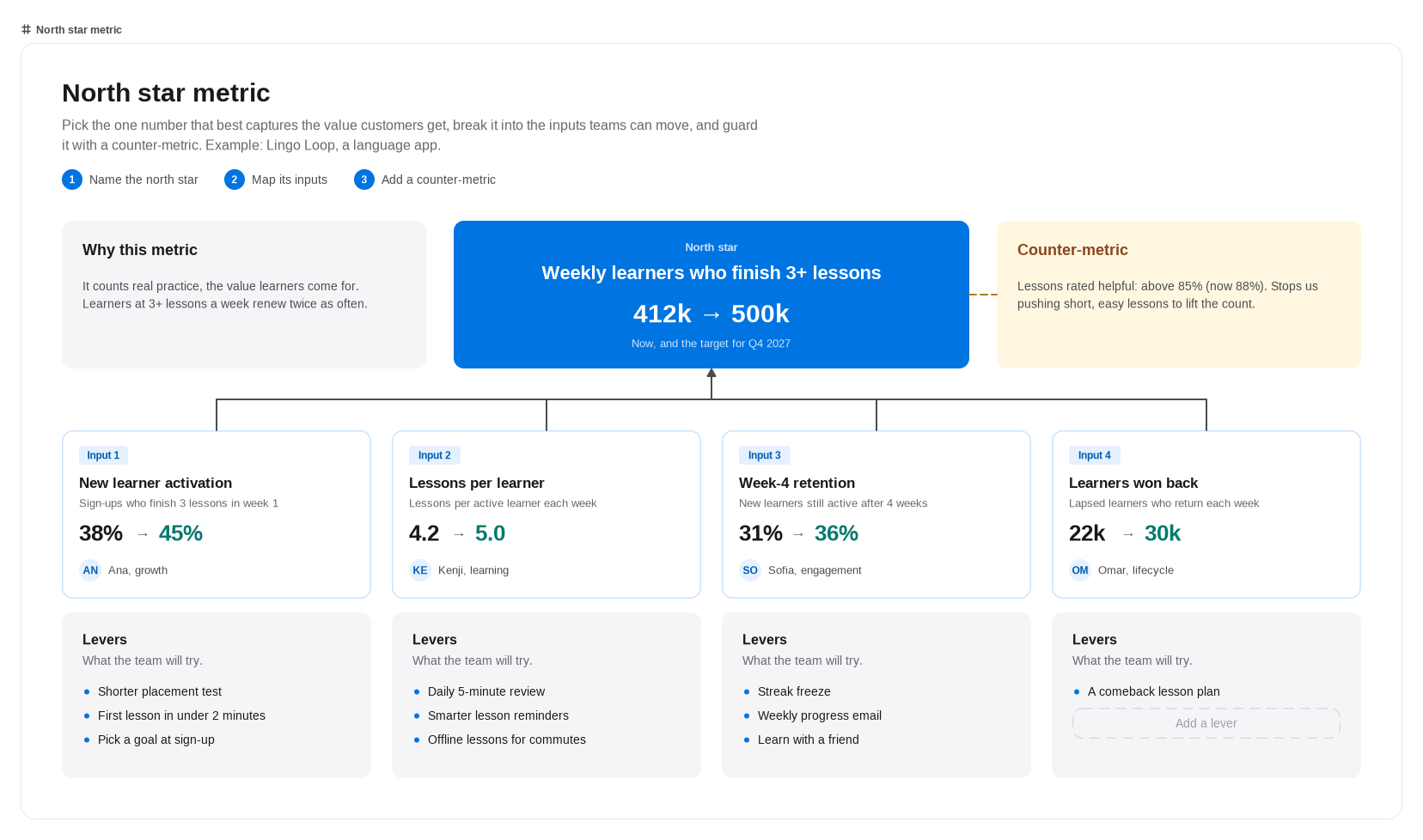
The center card states the metric in a full sentence: “Weekly learners who finish 3+ lessons”. Under it sit the current value and the goal, 412k to 500k, with the line “Now, and the target for Q4 2027”.
The card to its left, “Why this metric”, is the argument: “It counts real practice, the value learners come for. Learners at 3+ lessons a week renew twice as often.” Those two sentences are the two tests of a north star. It measures value from the customer’s side, and it predicts the business result you care about.
Notice what the metric is not. It is not sign-ups, which measure marketing, and it is not revenue, which arrives later.
Four inputs, each with an owner and levers
Below the top row, four cards break the north star into parts. Arrows run from each input up to the metric.
- New learner activation: sign-ups who finish 3 lessons in week 1, from 38% to 45%. Owner: Ana, growth.
- Lessons per learner: per active learner each week, from 4.2 to 5.0. Owner: Kenji, learning.
- Week-4 retention: new learners still active after 4 weeks, from 31% to 36%. Owner: Sofia, engagement.
- Learners won back: lapsed learners who return each week, from 22k to 30k. Owner: Omar, lifecycle.
Under every input is a “Levers” card, subtitled “What the team will try”. Levers are the work: “Daily 5-minute review”, “Streak freeze”, “A comeback lesson plan”.
Write inputs a team can move
An input earns its place when one team can change it within a quarter. Look at the first card. It has a precise definition (“Sign-ups who finish 3 lessons in week 1”), a starting point and a target (38% to 45%), and one person’s name. Its three levers are small enough to build and test: “Shorter placement test”, “First lesson in under 2 minutes” and “Pick a goal at sign-up”.
Compare that with an input like “better onboarding”. Nobody can say whether it moved. If you cannot write the definition line, the input is still a theme, and it needs another round of thought before it goes on the board.
Guard it with a counter-metric
Any single number can be gamed, often without anyone meaning to. The card on the right of the top row names the risk and the guard: “Lessons rated helpful: above 85% (now 88%). Stops us pushing short, easy lessons to lift the count.”
The counter-metric is a floor, not a second goal. Lingo Loop does not need to raise the helpful rating. It needs to notice if the rating falls below 85% while the lesson count climbs. To find yours, ask how a team in a hurry could raise the north star while making the product worse, then measure that.
How to use the north star metric template
- Open it as a new board. The language app’s numbers stay in place as a guide to how specific each card should be.
- Name the north star. Write the metric as a sentence, add today’s value and a dated target, and fill “Why this metric” with the value it counts and the result it predicts.
- Map its inputs. Rewrite the four input cards: definition, current value, target and owner. Then list two or three levers under each.
- Add a counter-metric. State the number that must not fall, its floor and where it stands now.
When a north star helps, and when another template fits
It helps a product company whose teams each chase their own number and need a shared one. It works best once the product has regular users whose behavior can be counted.
The north star gives direction, not a quarter’s plan. Turn the inputs into objectives with OKR planning. To see where users drop out on the way to the metric, use the AARRR funnel. To watch the north star and its inputs week by week, put them on a KPI dashboard.
Questions about the North star metric template
What makes a good north star metric?
It counts value the customer receives, it moves before revenue does, and teams can influence it. The example passes all three: finishing three lessons a week is real practice, learners who do it renew twice as often, and four teams each own an input.
Can revenue be the north star?
It can, but it is a weak choice for most products. Revenue shows what customers paid, not what they got, and it reacts late. A metric of use or value usually warns you earlier, and revenue follows it.
How many inputs should a north star have?
Three to five. The template has four. Each should be owned by one team and explain a distinct part of the metric: new users arriving, how much each one does, how many stay and how many come back.
How is a north star metric different from an OKR?
A north star stays the same for years and belongs to the whole company. OKRs change every quarter and belong to teams. In practice the two connect: an input such as week-4 retention from 31% to 36% can become a key result for the team that owns it.