What is an all-hands agenda?
An all-hands is a meeting for everyone in the company. It is the one hour when people hear the same news at the same time and can ask leadership anything. An agenda for it has to do more than list topics. It must keep six speakers to time, put the numbers where everyone can read them, and make sure questions are collected before the meeting, not improvised at the end.
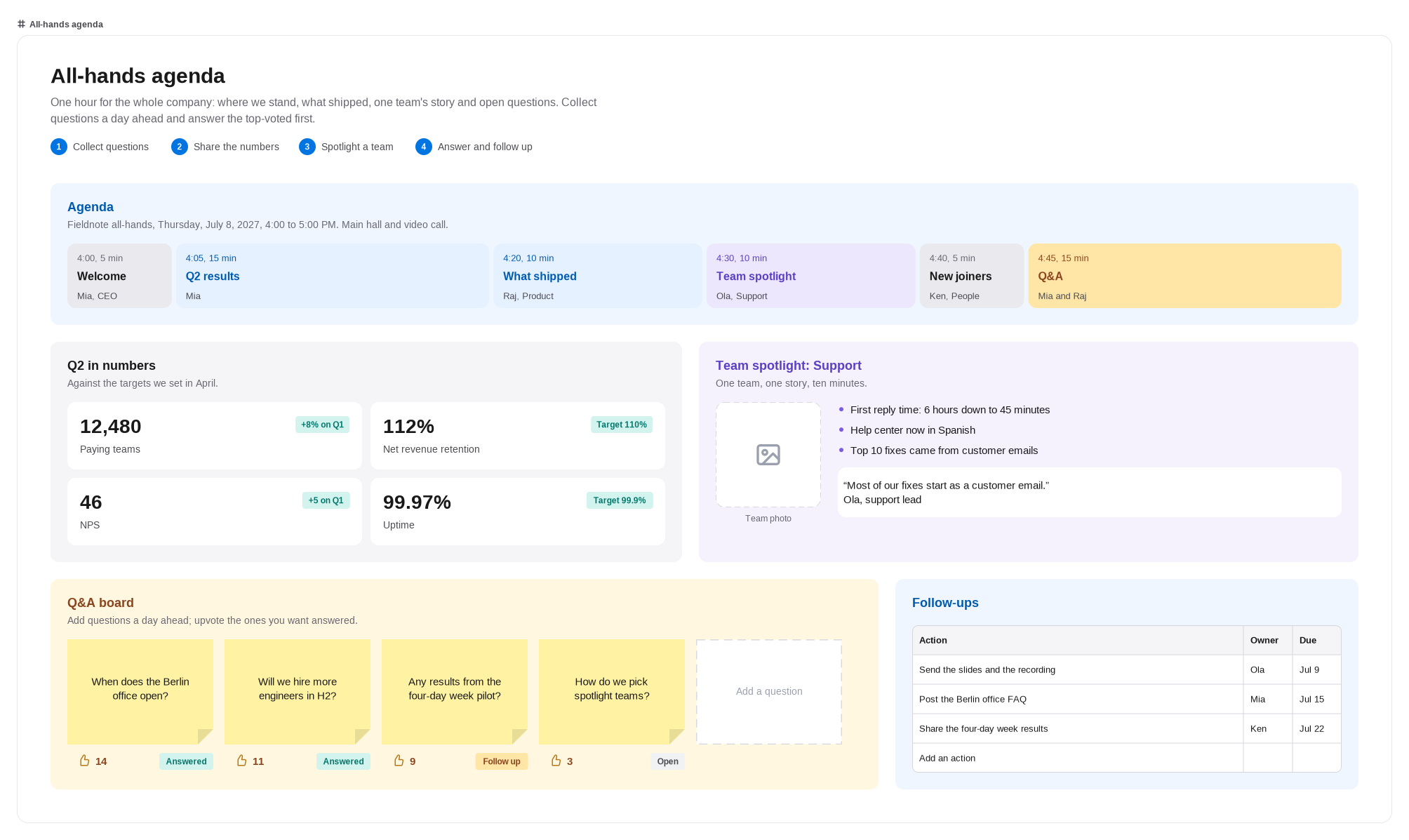
This template holds all of that: an agenda strip, a numbers panel, a team spotlight, a Q&A board and a follow-up table. The example is the Fieldnote all-hands on Thursday, July 8, 2027, from 4:00 to 5:00 PM, in the main hall and on a video call.
The agenda strip
The agenda runs across the top as six blocks, and each block is as wide as its share of the hour. You can see where the time goes without reading a single number:
- 4:00, 5 min. Welcome. Mia, CEO.
- 4:05, 15 min. Q2 results. Mia.
- 4:20, 10 min. What shipped. Raj, Product.
- 4:30, 10 min. Team spotlight. Ola, Support.
- 4:40, 5 min. New joiners. Ken, People.
- 4:45, 15 min. Q&A. Mia and Raj.
Results and Q&A get the two widest blocks, a quarter of the hour each. Every block names its speaker, so nobody wonders who is up next.
Q2 in numbers
The numbers panel shows four metrics, each as a big figure with a small tag that gives it meaning. The example reports 12,480 paying teams (+8% on Q1), net revenue retention of 112% against a target of 110%, an NPS of 46 (+5 on Q1) and uptime of 99.97% against a target of 99.9%.
The tag is what makes a number readable for someone outside the team that owns it. 12,480 means little alone. “+8% on Q1” tells an engineer or a new hire whether to be pleased. Hold yourself to four numbers and compare each one either to the last quarter or to its target, as the subtitle says: against the targets we set in April.
One team, one story, ten minutes
The spotlight is the part of an all-hands people remember. One team gets ten minutes to show what it did and why it mattered. This quarter it is Support. The panel has room for a team photo, three results and a quote.
The three results are concrete: first reply time went from 6 hours down to 45 minutes, the help center is now in Spanish, and the top 10 fixes came from customer emails. The quote from Ola, the support lead, ties it together: “Most of our fixes start as a customer email.” A spotlight with one number, one thing shipped and one sentence in a person’s own voice is enough.
A Q&A board that is ready before the meeting
The Q&A board is a row of sticky notes, one question each, with a count and a status under every note. Its instruction reads: add questions a day ahead; upvote the ones you want answered. Leadership then answers from the highest count down.
In the example, “When does the Berlin office open?” leads with 14 and is marked Answered, as is “Will we hire more engineers in H2?” with 11. The question about the four-day week pilot, with 9, is marked Follow up: there was no full answer in the room, and that is fine as long as it is tracked. “How do we pick spotlight teams?” has 3 and stays Open. Good questions are short and specific, and a status on each one shows that none was ignored.
How to use the all-hands agenda template
- Open it as a new board. Set the date, the place and the six blocks. Stretch or shrink a block when you change its minutes.
- Collect questions. Share the board a day ahead and ask people to add notes to the Q&A board and raise the count on the ones they care about.
- Share the numbers. Replace the four cards the morning of the meeting, each with its comparison tag.
- Spotlight a team. Ask the team lead for a photo, three results and one quote a week before.
- Answer and follow up. After Q&A, turn every Follow up note into a row with an owner and a date, as the example does with “Share the four-day week results”.
When to use it, and when a smaller agenda fits
Use this board for monthly or quarterly company meetings, town halls and large department meetings, anywhere one group presents to many and takes questions.
For a working meeting of a handful of people, the simpler meeting agenda with goals, topics and owners is a better fit. A team that wants a regular look at its own wins, metrics and risks can run a weekly team sync. If the hour is mostly about results against targets for one function, build a quarterly business review and bring its headline to the all-hands.
Questions about the All-hands agenda template
How long should an all-hands meeting be?
An hour is the common length and the one this template is built for. Under 45 minutes there is no room for questions; over an hour attention drops, most of all for people on the video call.
How much time should Q&A get?
At least a quarter of the meeting. The example gives it 15 of 60 minutes, the same as the results. If questions regularly run out of time, shorten the updates, not the Q&A.
How do you get people to ask questions?
Collect them in writing a day ahead, let people add to the count on questions they share, and answer the top one first even when it is uncomfortable. Marking each note Answered, Follow up or Open shows that asking leads somewhere.
What should the team spotlight include?
A photo of the team, two or three results with numbers, and one sentence in the lead’s own words. Pick a different team each time, and include teams whose work the rest of the company rarely sees.