What is the Ansoff matrix?
The Ansoff matrix, from Igor Ansoff, sorts ways to grow by two questions: are the products existing or new, and are the markets existing or new? The four combinations are four paths to growth, and they differ mainly in risk. The further an idea moves from today’s products and customers, the more can go wrong.
This template is the two-by-two grid with idea cards in every quadrant, a risk label on each, and a side column that adds up the chosen ideas. The example is Tidewater Brewing, a craft brewery planning its growth for 2027.
Four paths to growth
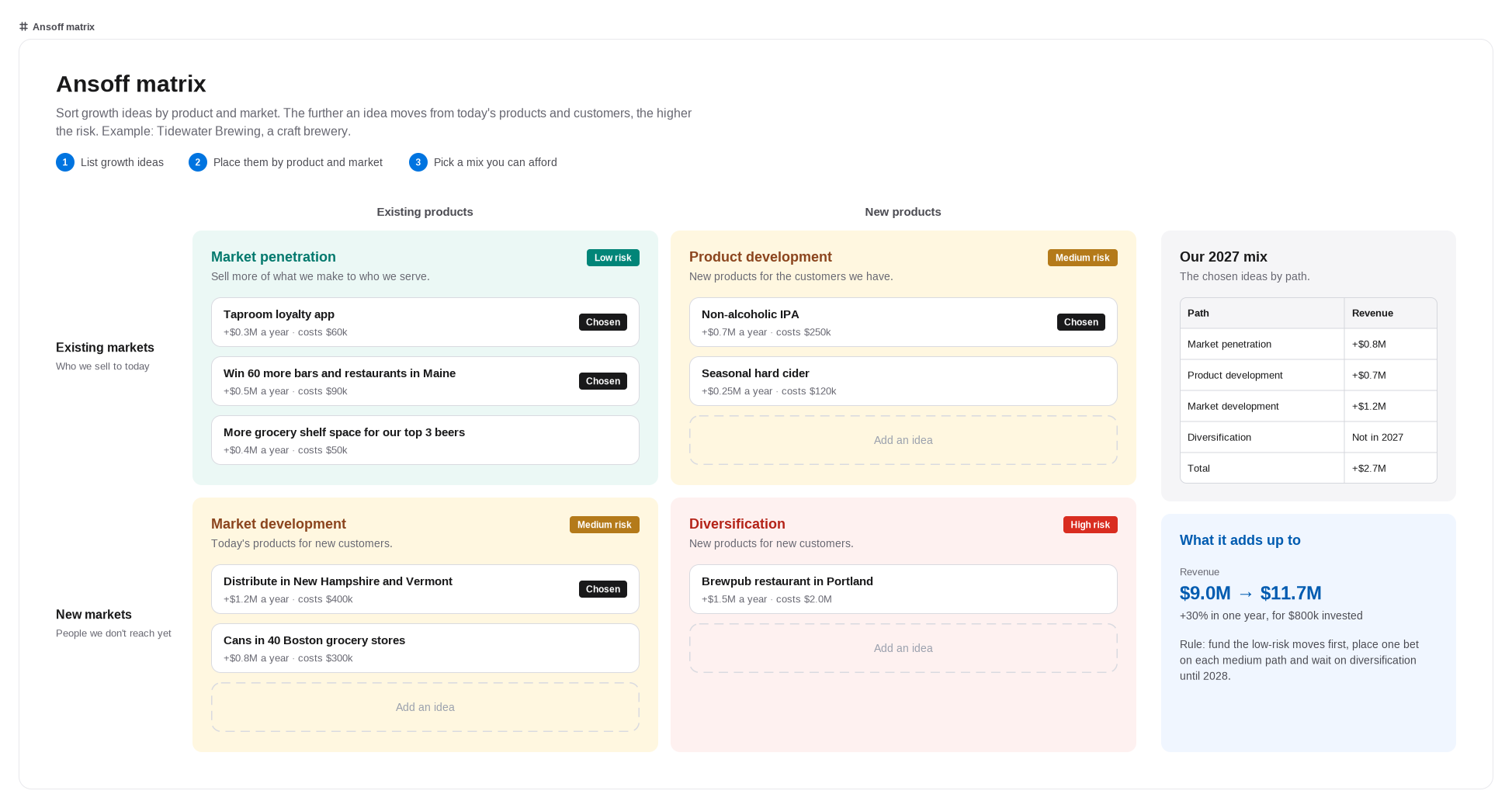
Columns are “Existing products” and “New products”. Rows are “Existing markets”, glossed as “Who we sell to today”, and “New markets”, “People we don’t reach yet”.
- Market penetration (low risk): “Sell more of what we make to who we serve.” Example: “Taproom loyalty app”.
- Product development (medium risk): “New products for the customers we have.” Example: “Non-alcoholic IPA”.
- Market development (medium risk): “Today’s products for new customers.” Example: “Distribute in New Hampshire and Vermont”.
- Diversification (high risk): “New products for new customers.” Example: “Brewpub restaurant in Portland”.
Every quadrant except the first ends with a dashed “Add an idea” card.
Put a gain and a cost on every idea
An idea card in this template has three parts: a name, a line with the yearly revenue it could add and what it costs, and a “Chosen” tag if it made the plan. In the market penetration quadrant, “Taproom loyalty app” reads “+$0.3M a year · costs $60k”, and “Win 60 more bars and restaurants in Maine” reads “+$0.5M a year · costs $90k”. Both are chosen.
The third card, “More grocery shelf space for our top 3 beers”, promises +$0.4M for $50k and is not chosen. That is worth copying. Keep the ideas you turned down on the board with their numbers, so the next planning round starts from them.
The two figures do not need to be precise. They need to be comparable, so that a $60k idea and a $2.0M idea are not discussed as if they were the same size.
Risk rises as you move away from today
The bottom row shows how the stakes change. Market development takes the beer the brewery already makes to people it does not reach yet: “Distribute in New Hampshire and Vermont” could add $1.2M a year for $400k, and “Cans in 40 Boston grocery stores” $0.8M for $300k. The gains are larger than in the top-left quadrant, and so are the costs.
Diversification changes both things at once. “Brewpub restaurant in Portland” has the biggest promise on the board, +$1.5M a year, and by far the biggest bill, $2.0M. A restaurant is a different business from a brewery, with different customers. The quadrant’s “High risk” label says the same in two words.
Pick a mix you can afford
The column on the right turns the grid into a decision. “Our 2027 mix” is a table of the chosen ideas by path: market penetration +$0.8M, product development +$0.7M, market development +$1.2M and diversification “Not in 2027”, for a total of +$2.7M.
Below it, “What it adds up to” gives the consequence: revenue from $9.0M to $11.7M, “+30% in one year, for $800k invested”. The card ends with the rule the brewery followed: fund the low-risk moves first, place one bet on each medium path and wait on diversification until 2028.
Write your own rule in a sentence before you tag anything “Chosen”. It keeps the choice from sliding toward whichever idea was argued for most loudly.
How to use the Ansoff matrix template
- Open it as a new board. The brewery’s ideas show the level of detail to aim for: a name and two figures per card.
- List growth ideas. Collect them without sorting. Ask sales, product and operations separately, since each tends to think in one quadrant.
- Place them by product and market. For each idea, decide whether the product exists and whether you already sell to those customers, then add its yearly gain and cost.
- Pick a mix you can afford. Tag the chosen ideas, fill the mix table by path and check the total cost against your budget.
When the Ansoff matrix helps, and when another template fits
Use it in annual planning, when a company has more growth ideas than budget, or when a team keeps debating one bold idea without comparing it with the modest ones.
It compares ideas for growth, not the products you already have. To decide which existing products deserve investment, use a BCG matrix. To check that a new market is worth entering before you place an idea there, run Porter’s five forces. Once an idea is chosen, a go-to-market plan covers audience, message and launch.
Questions about the Ansoff matrix template
What are the four strategies in the Ansoff matrix?
Market penetration, product development, market development and diversification. They are the four combinations of existing or new products with existing or new markets, and the template labels them low, medium, medium and high risk.
What is the difference between market penetration and market development?
Both sell the products you already have. Penetration sells more of them to the customers and places you already serve, like more bars in the brewery’s home state. Development takes them somewhere new, like two neighboring states.
Why is diversification the riskiest path?
Because nothing carries over. You do not know the product and you do not know the customers, so two sets of assumptions can fail at once. In the example the diversification idea also costs more than all four chosen ideas together.
How many ideas should be chosen?
As many as the budget and the team can carry, weighted toward lower risk. The example chooses four of eight: two low-risk moves and one from each medium-risk path, and it postpones the high-risk one by a year.