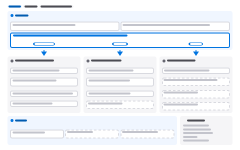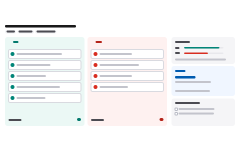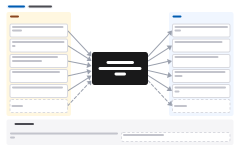
What is an argument map?
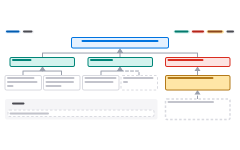
An argument map is a diagram of an argument’s structure. The claim sits at the top. Below it are the reasons that support it, and under each reason the evidence that makes the reason believable. On the other side are the objections, and under them the rebuttals that answer them. Drawing an argument this way shows at a glance which parts are supported and which are only asserted.
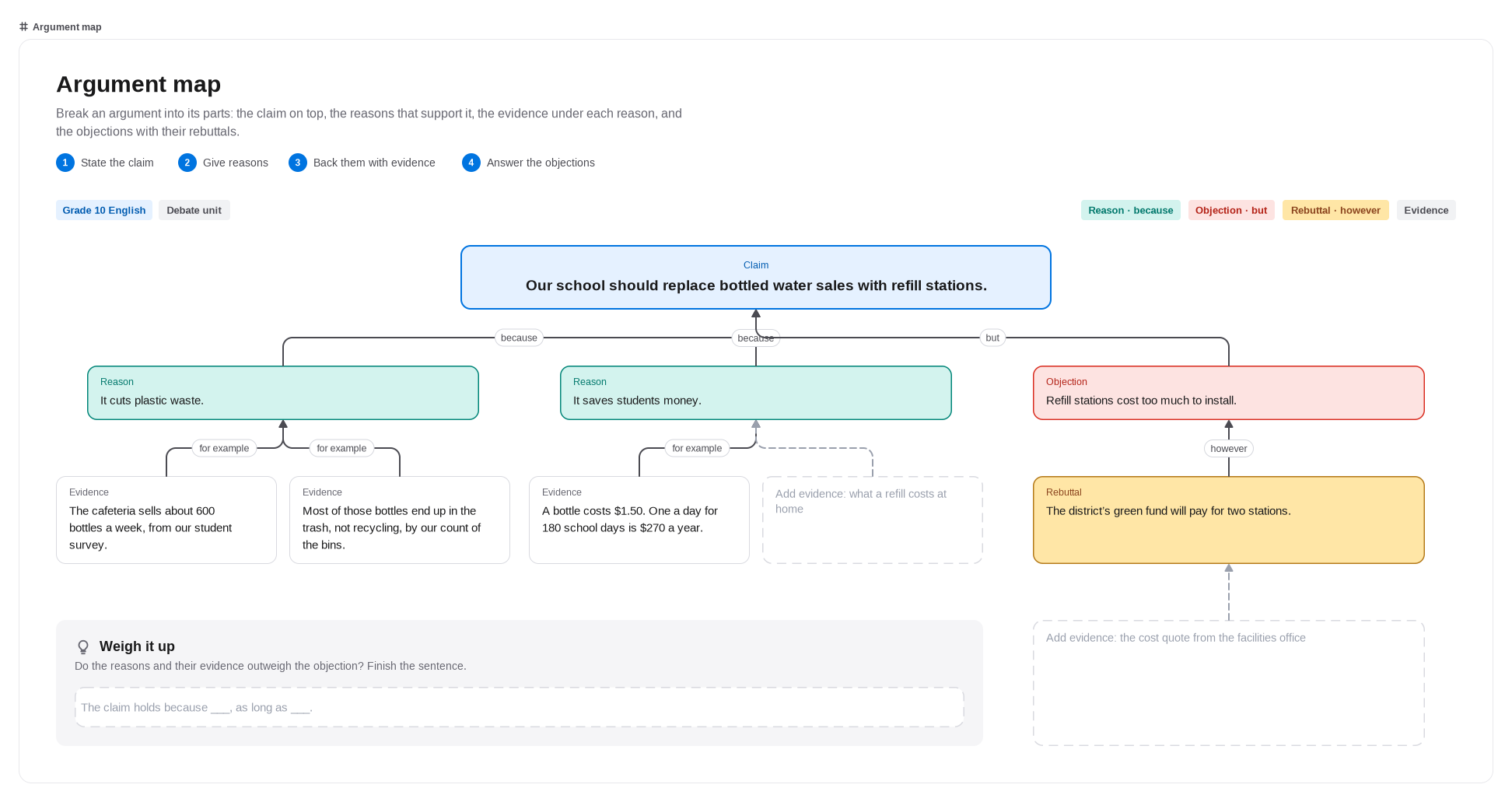
This template is a small tree of that kind, with a panel at the bottom for the final judgment. A key in the top right corner names the four kinds of box and the linking word for each: “Reason · because”, “Objection · but”, “Rebuttal · however” and “Evidence”. The example is from a Grade 10 English debate unit.
The claim and the three boxes under it
The claim in the example is one sentence that someone could disagree with: “Our school should replace bottled water sales with refill stations.” That is what makes it a claim. “Plastic is bad” is too vague to argue, and “the cafeteria sells water” is a fact.
Three lines drop from the claim, and each line has a word on it. Two say because and lead to reasons: “It cuts plastic waste” and “It saves students money”. One says but and leads to an objection: “Refill stations cost too much to install.” Read from top to bottom, each branch makes a sentence: the school should replace bottled water sales because it cuts plastic waste. If the sentence sounds wrong, the box is in the wrong place.
Evidence under each reason
A reason is still an opinion until something backs it. Under “It cuts plastic waste” hang two evidence cards, each joined by the words for example:
- “The cafeteria sells about 600 bottles a week, from our student survey.”
- “Most of those bottles end up in the trash, not recycling, by our count of the bins.”
Both cards say where the information came from: a survey and a count. That is the habit to build. Evidence without a source is one more assertion, and in a debate the other side will ask.
The two cards also work as a pair. The first shows the size of the problem and the second shows that recycling does not already solve it. Together they close a gap an opponent would find.
Show the arithmetic, and mark what is missing
The second reason, “It saves students money”, has one finished evidence card: “A bottle costs $1.50. One a day for 180 school days is $270 a year.” The calculation is written out, so anyone can check it and nobody can call the number made up.
Next to it is an empty card: “Add evidence: what a refill costs at home”. The saving is only real if refilling is cheaper, and the map admits that the comparison has not been made yet. Marking a hole like this is better than hiding it. It tells the student what to research before the debate.
The objection and its rebuttal
The right branch argues against the claim. The objection, “Refill stations cost too much to install”, is the strongest thing a sensible opponent would say. Under it, joined by however, is the rebuttal: “The district’s green fund will pay for two stations.”
A rebuttal needs evidence as much as a reason does, so below it sits another prompt: “Add evidence: the cost quote from the facilities office”. Without the quote, the rebuttal is a hope.
Students often want to leave objections out because they seem to weaken the case. They do the opposite. An argument that has already answered its best objection is much harder to knock down than one that pretends there is none.
Weigh it up
The panel at the bottom asks the question the whole map leads to: “Do the reasons and their evidence outweigh the objection? Finish the sentence.” The sentence is a frame: “The claim holds because ___, as long as ___.”
The second blank is the clever part. It makes the student state the condition the conclusion depends on. For the example, a fair answer would end with something like “as long as the green fund really covers the cost”. A conclusion with its condition attached is more honest, and more persuasive, than a flat “so I am right”.
How to use the argument map template
- Open it as a new board. Clear the water example or keep it beside your own as a model.
- State the claim. One sentence, one position. Test it by asking whether a classmate could reasonably say no.
- Give reasons. Two or three, each finishing the sentence “because…”. Combine reasons that overlap.
- Back them with evidence. Add at least one card per reason and write its source on the card. Use an empty card for evidence you still need to find.
- Answer the objections. Ask a partner for their best objection, write it in, and rebut it. Then complete the sentence under Weigh it up.
For debate practice, pairs can swap boards and add objections to each other’s maps as comments.
When an argument map helps, and what to use otherwise
Use it to prepare a debate, plan a persuasive essay, or take apart an editorial or a speech to see how it is built. It is also a quick way to mark an argument: a reason with no evidence under it is visible from across the room.
When the map is solid, an essay outline turns it into paragraphs. If the task is a personal decision and not a case to win, a pros and cons list is simpler. To look at one question from several angles before taking a side, try six thinking hats.
Questions about the Argument map template
What is the difference between a reason and evidence?
A reason is a statement that supports the claim: “It saves students money.” Evidence is a fact, figure or source that supports the reason: a bottle costs $1.50, so one a day for 180 school days is $270. Reasons answer “why?”; evidence answers “how do you know?”
How many reasons does a good argument need?
Two or three strong ones beat five thin ones. Each reason needs its own evidence, and a reason you cannot support weakens the rest. The example uses two reasons and one objection, which is enough for a short speech or essay.
Do I have to include an objection?
Yes, at least one. Choose the strongest objection you can think of, not the easiest to beat. If you cannot rebut it, narrow the claim until you can. That is the map doing its job.
Can I add more branches to the map?
Yes. Every box and line on your copy can be duplicated, moved or deleted. The board uses 59 of the 150 elements a Free board holds, so there is room for more reasons, objections and evidence cards.