What is a pros and cons list?
A pros and cons list is the oldest decision tool there is: one column for what speaks for a choice, one for what speaks against it. Its weakness is just as old. Ten small advantages can outvote one problem that should have settled the matter.
This template fixes that by giving every point a weight from 1 to 5 and comparing the totals, not the counts. It also asks for a written decision and for the evidence that would confirm it. The example is Atlas Design, a studio asking whether to move to a four-day week.
Frame the question first
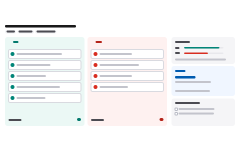
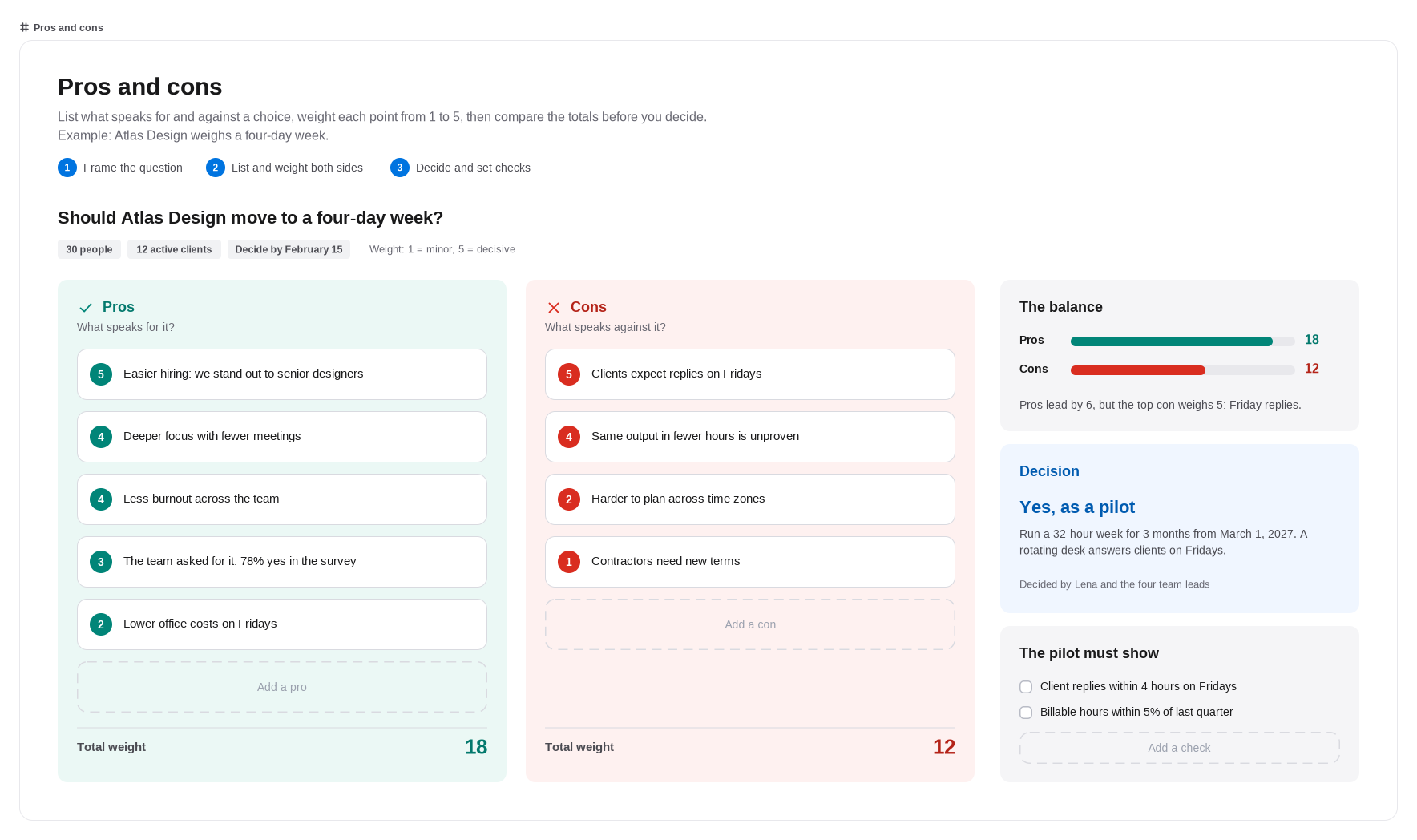
A list is only as clear as the question above it. The board opens with one: "Should Atlas Design move to a four-day week?" It can be answered yes or no, which is what this format needs. "What should we do about working hours?" would produce two columns nobody can compare.
Next to the question are the facts that set the stakes: 30 people, 12 active clients, Decide by February 15. A small note explains the scale used below: weight 1 is minor, weight 5 is decisive.
Two columns, one point per card
The left column asks "What speaks for it?" and the right one "What speaks against it?". Every point is a card of its own with a number in a circle in front.
Atlas has five pros, from "Easier hiring: we stand out to senior designers" down to "Lower office costs on Fridays", and four cons, led by "Clients expect replies on Fridays". The cards are sorted by weight, heaviest first, so the top of each column is the argument that matters most. A dashed card closes each column, Add a pro and Add a con, and a Total weight line sums the circles: 18 for, 12 against.
Weigh each point honestly
The weights are where the thinking happens. Look at the cons. "Clients expect replies on Fridays" gets a 5, because losing a client would undo every benefit. "Contractors need new terms" gets a 1: real, but an afternoon of paperwork.
Two habits keep the numbers honest. Weigh a point by what happens if it turns out true, not by how loudly someone argued it. And prefer points with evidence in them. "The team asked for it: 78% yes in the survey" can be checked; "people will be happier" cannot. Where a con is a guess, say so on the card, as "Same output in fewer hours is unproven" does.
The balance and the decision
The first card on the right draws the two totals as bars, 18 and 12, and adds one sentence of reading: "Pros lead by 6, but the top con weighs 5: Friday replies." That sentence matters more than the bars. A lead in total weight does not cancel a decisive point on the other side.
So the Decision card does not say yes. It says "Yes, as a pilot": run a 32-hour week for 3 months from March 1, 2027, with a rotating desk that answers clients on Fridays. The plan is built around the heaviest con. The card ends with who decided: Lena and the four team leads.
How to use the pros and cons template
- Open it as a new board. Your copy starts with the four-day-week example, ready to overwrite.
- Frame the question. Rewrite the headline as one yes-or-no question and change the three tags to your own numbers and deadline.
- List and weight both sides. Write one point per card, then give each a number from 1 to 5. Do the cons first if the room already leans toward yes.
- Add up and read the balance. Update both totals and the bars, and write one sentence about the heaviest point on the losing side.
- Decide and set checks. Fill in the Decision card, then list what must be true afterwards. Atlas wrote two: client replies within 4 hours on Fridays, and billable hours within 5% of last quarter.
When a pros and cons list is enough, and when it is not
It suits one choice with two outcomes: adopt the policy or not, take the offer or not, launch now or wait. It is quick enough for a thirty-minute meeting and plain enough to share with people who were not there.
With three or more options, the columns stop working; score them in a decision matrix. When the argument is really about money, a cost-benefit analysis puts amounts on both sides. And if the group wants to look at a proposal from several angles before judging it, try six thinking hats.
Questions about the Pros and cons template
Why weight the points instead of counting them?
Because points are not equal. On the example board the pros have five entries and the cons four, yet one con, Friday replies, weighs as much as the strongest pro. Counting would hide that. Weights let a single serious risk stand against a pile of small gains.
What if the totals come out equal?
A tie usually means the question is too broad or a key fact is missing. Look at the heaviest card on each side and ask what you would need to know to change its weight. Often the answer is a small trial, like the three-month pilot in the example.
How many pros and cons should I list?
Four to six a side is plenty. Past that, people pad the column they favor with weight-1 points. If you have more, merge the ones that say the same thing and keep the wording of the strongest.
Can I use this for a personal decision?
Yes. Change the question to your own, such as a job offer or a move, and drop the tags you do not need. The weights help most here, since personal lists tend to mix deal-breakers with nice-to-haves.