What are the six thinking hats?
The six thinking hats are a way to discuss one topic from six angles, one angle at a time. Edward de Bono introduced the method in his book of the same name. Each hat has a color and a job: white for facts, red for feelings, black for risks, yellow for benefits, green for new ideas and blue for the process.
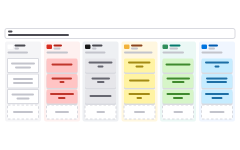
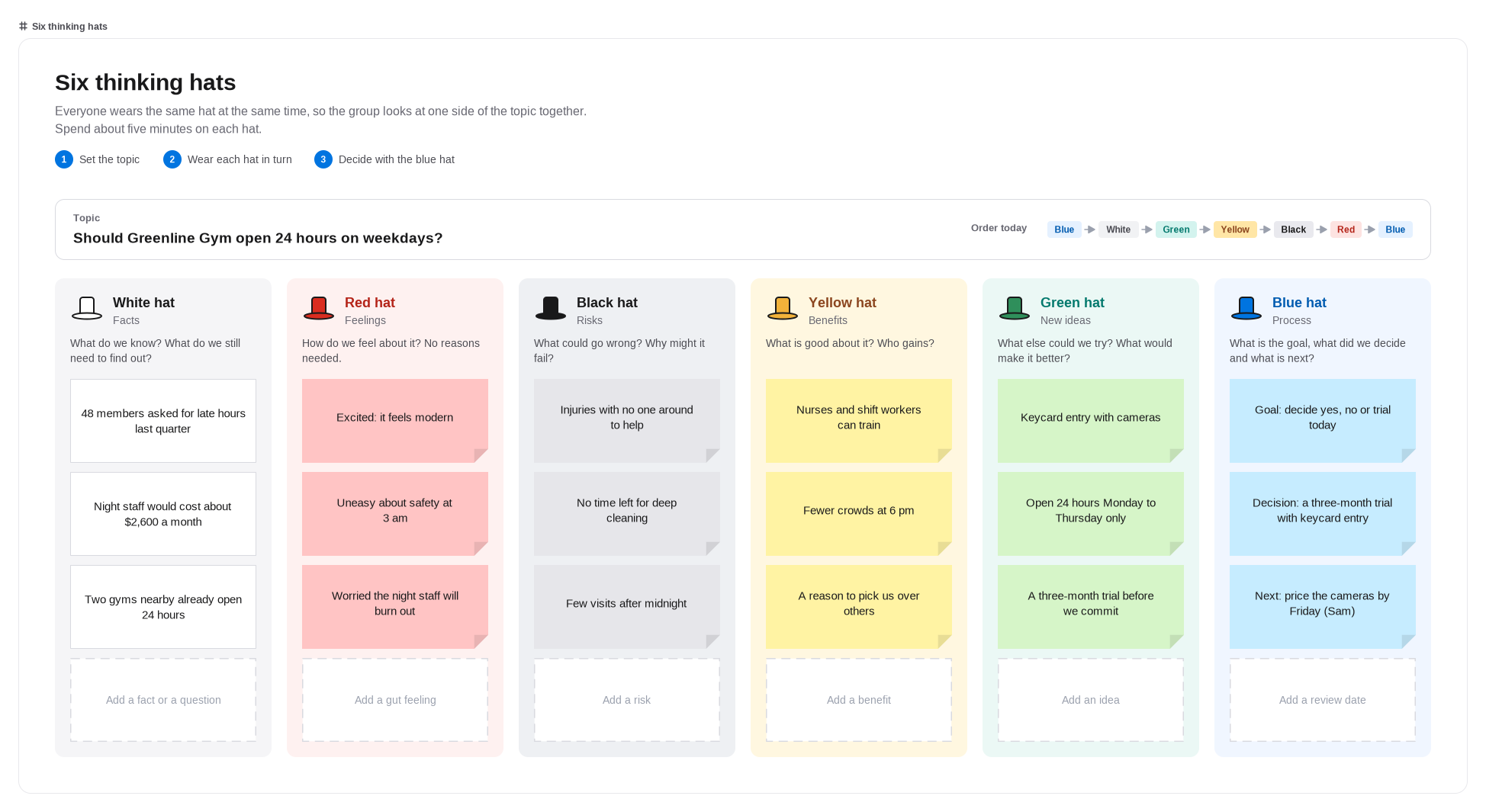
The rule that matters is that everyone wears the same hat at the same moment. Nobody defends a position, because for five minutes the whole room is looking for risks, and for the next five the whole room is looking for benefits. This template gives each hat a column and puts the topic and the order of hats in a strip across the top. The example topic: “Should Greenline Gym open 24 hours on weekdays?”
Six hats, six questions
Each column opens with a hat, a one-word job and a question to answer. The three in the middle of the board show the range:
- Black hat, risks. “What could go wrong? Why might it fail?” The gym's notes: injuries with no one around to help, no time left for deep cleaning, few visits after midnight.
- Yellow hat, benefits. “What is good about it? Who gains?” Nurses and shift workers can train, fewer crowds at 6 pm, a reason to pick us over others.
- Green hat, new ideas. “What else could we try? What would make it better?” Keycard entry with cameras, open 24 hours Monday to Thursday only, a three-month trial before we commit.
Read the three together and the method shows its use. The green notes and the black notes meet. Keycards and cameras speak to safety, and a trial limits the cost if few people come after midnight. Because each column was filled on its own, nobody had to win an argument for these to end up on the same board.
Keep facts and feelings apart
The first two columns are the ones groups mix up most. The white hat takes only what is known or needs finding out. The gym wrote three facts, each with a number:
- 48 members asked for late hours last quarter
- Night staff would cost about $2,600 a month
- Two gyms nearby already open 24 hours
The red hat takes gut reactions, and its question adds “No reasons needed.” So the notes are short and personal: “Excited: it feels modern”, “Uneasy about safety at 3 am”, “Worried the night staff will burn out”.
Giving feelings a column of their own has a practical effect. In a normal meeting, “I'm uneasy about 3 am” gets dressed up as a fact so that it will be taken seriously. Here it can be said as it is, and the white column stays clean. If a white note has no number or source, ask whether it is really a red one.
The blue hat opens and closes
The strip at the top ends with “Order today” and seven steps: Blue, White, Green, Yellow, Black, Red, Blue. Blue appears twice because it manages the meeting. It starts by stating the goal and ends by recording the result.
The blue column shows both. Its first note is the opening: “Goal: decide yes, no or trial today”. The next two are the close: “Decision: a three-month trial with keycard entry” and “Next: price the cameras by Friday (Sam)”. A dashed card asks for a review date.
The decision is built from the other columns. The trial and the keycards come straight from the green hat. The order of hats is yours to set for each topic, and the columns do not have to be filled left to right. This session put the red hat late, so that feelings were heard after the facts and options were on the board.
How to use the six thinking hats template
- Open it as a new board. Write your topic in the strip as a question that can be decided, and set the order of hats for today.
- Start with blue. Put the goal of the meeting on the first note of the blue column so everyone knows what a finished session looks like.
- Wear each hat in turn. About five minutes a hat. Everyone adds notes to that one column only. If a risk comes up during yellow, hold it until black.
- Decide with the blue hat. Return to the last column and write the decision, the next step with a name and a day, and a date to review it.
Six hats at five minutes each, plus a few minutes to close, fits in a 40-minute meeting.
When the six hats help, and when they are more than you need
Use the method for a decision that people already have opinions about, where a normal discussion would turn into two camps. It is also useful alone, as a check that you have looked at a choice from every side and not only your favorite one.
For a simple yes or no with little emotion in it, a pros and cons list covers the yellow and black hats and is quicker. When several options compete on measurable criteria, a decision matrix gives each a score. And if the group mainly wants to explore what could go wrong with a plan it has already chosen, a pre-mortem is a black hat session with more room.
Questions about the Six thinking hats template
What does each of the six hats mean?
White is facts and missing information. Red is feelings and instinct, with no need to justify them. Black is risks and reasons for caution. Yellow is benefits. Green is new ideas and alternatives. Blue manages the process: the goal, the order and the decision.
In what order should the hats be used?
There is no single correct order. Blue normally comes first and last. The gym example runs blue, white, green, yellow, black, red, blue. For a topic with strong emotions, some groups put red near the start to clear the air.
Does each person wear a different hat?
No, and this is the most common misreading. The whole group wears the same hat at once and changes together. Assigning one person to be the permanent critic brings back the argument the method is meant to remove.
Is the black hat the negative one?
It is the careful one. Black hat thinking finds the flaws while they are still cheap to fix, and in the example its notes on injuries and empty night hours are what the trial is there to test. A session without it is cheerleading. One with only it goes nowhere.