What is assumption mapping?
Every new product idea rests on beliefs nobody has checked yet. Assumption mapping makes them visible. The team writes down what must be true for the idea to work, then places each belief on a grid by two measures: how important it is and how much evidence exists for it. The beliefs that are important and unproven are the ones to test before building anything.
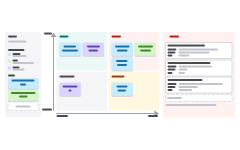
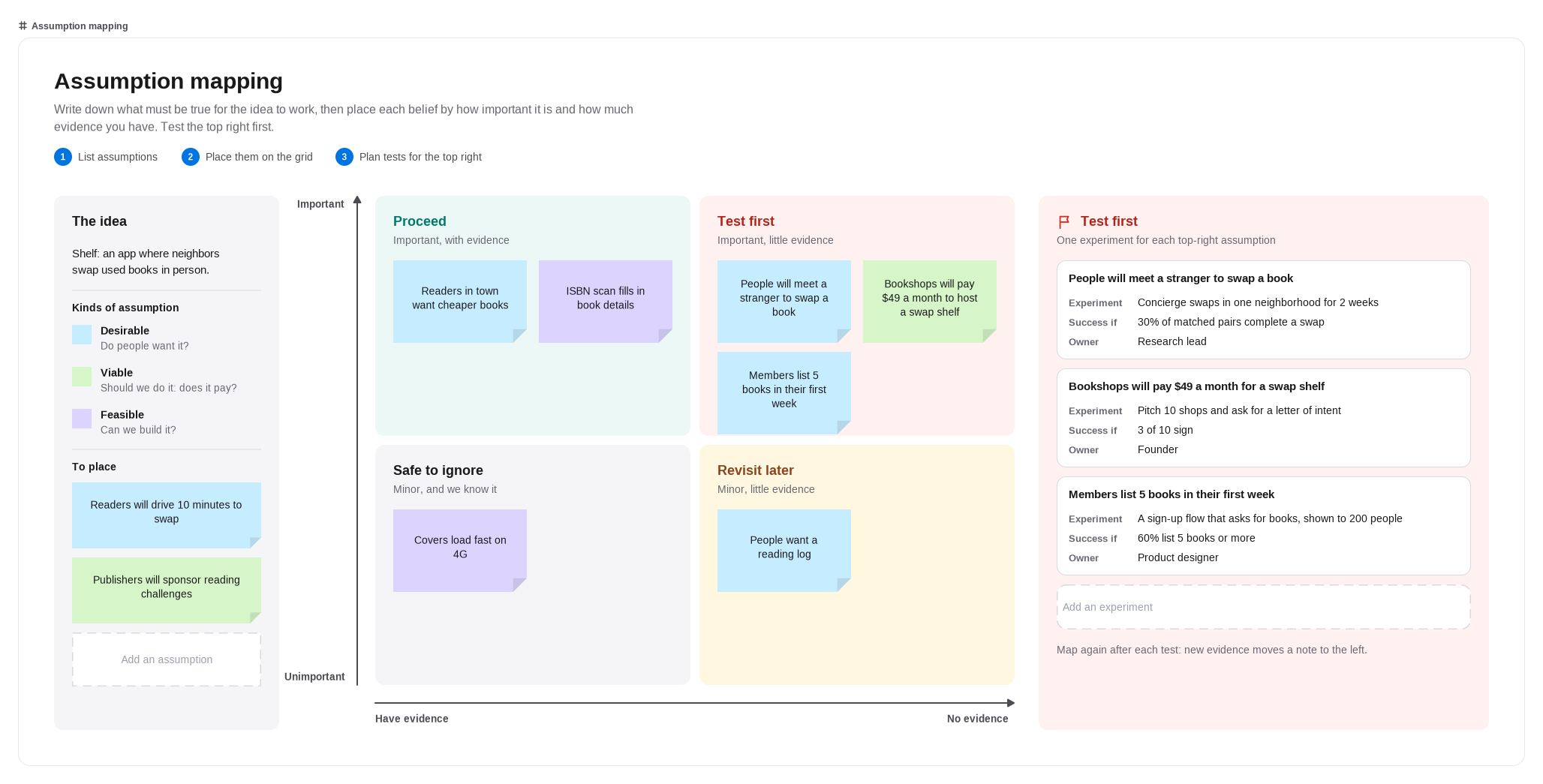
This template has three parts: a side panel for the idea and the unsorted notes, the grid in the middle, and a column of experiments on the right. The example is an app where neighbors swap used books in person.
The idea and three kinds of assumption
The side panel starts with the idea in one sentence. Below it, a key names three kinds of assumption, each with the question it answers:
- Desirable. Do people want it?
- Viable. Should we do it: does it pay?
- Feasible. Can we build it?
Use the three as a checklist while you list. Teams tend to write only the first kind and forget the money and the technology. On the grid, “People will meet a stranger to swap a book” is about desire, “Bookshops will pay $49 a month to host a swap shelf” is about viability, and “ISBN scan fills in book details” is about feasibility.
The grid: importance against evidence
The vertical axis runs from Important at the top to Unimportant at the bottom. The horizontal axis runs from Have evidence on the left to No evidence on the right. That gives four quadrants, each with a name and a description.
- Proceed. Important, with evidence. “Readers in town want cheaper books” sits here.
- Test first. Important, little evidence. The example has three notes in it.
- Safe to ignore. Minor, and we know it: “Covers load fast on 4G”.
- Revisit later. Minor, little evidence: “People want a reading log”.
Important means the idea fails if the belief is false. Evidence means data or observed behavior, not agreement in the room.
Write assumptions you can prove wrong
Two notes wait in the “To place” area of the side panel: “Readers will drive 10 minutes to swap” and “Publishers will sponsor reading challenges”. Both are good models. Each names who, does what, and often how much. The first has a number you could measure.
Compare that with a vague note such as “people like sharing”. Nobody can tell where it belongs on the grid or how to check it. Write each assumption as a statement that a test could show to be false. If it cannot fail, it is a hope.
One experiment for each top-right assumption
The column on the right repeats the name of the risky quadrant, Test first, and holds one card per note in it. Each card has the assumption, an experiment, a success measure and an owner.
For “People will meet a stranger to swap a book”, the experiment is concierge swaps in one neighborhood for 2 weeks, a success if 30% of matched pairs complete a swap. For the bookshop fee, the founder pitches 10 shops and asks for a letter of intent, and 3 of 10 signing counts as success. The third card shows a sign-up flow to 200 people and looks for 60% listing 5 books or more.
Set the success number before the test runs. Afterwards, the line under the cards applies: new evidence moves a note to the left.
How to use the assumption mapping template
- Bring the template into your workspace. Use this template copies it with the book swap example.
- List assumptions. Write your idea in one sentence, then add a note for every belief behind it. Check that you have desirable, viable and feasible ones.
- Place them on the grid. Take one note at a time and settle importance first, then evidence. When two people disagree about evidence, the note moves right.
- Plan tests for the top right. Fill an experiment card for each note in Test first, with a success measure and an owner.
When to map assumptions, and what to pair it with
Map assumptions at the very start of an idea, before a roadmap or a design exists, and again after each round of tests. It suits founders, product trios and anyone about to spend real money on something unproven.
If you have not yet framed the idea, a lean canvas gives you the pieces to question. To run and log the experiments over several weeks, keep a hypothesis tracker. And when the tests point toward particular solutions, an opportunity solution tree links them back to the outcome you are after.
Questions about the Assumption mapping template
What are the three types of assumptions?
Desirability, viability and feasibility. Desirable asks whether people want it. Viable asks whether it pays for the business. Feasible asks whether the team can build it. A complete list has notes of all three kinds.
Which assumptions should be tested first?
The ones in the top right of the grid: important to the idea and backed by little evidence. If one of these turns out to be false, the idea does not work, so learning that early saves the most time and money.
What counts as evidence?
Something you observed or measured: interview patterns, usage data, a signed letter of intent, a completed test. Opinions, even confident ones from senior people, do not count. When in doubt, place the note further toward No evidence.
How often should the map be updated?
After every experiment. A passed test moves its note left into Proceed. A failed one changes the idea, which usually creates new assumptions to place. The board stays useful only while it reflects what the team has learned.