What is a lean canvas?
A lean canvas is a one-page plan for a product that does not exist yet, or has only just started. Ash Maurya adapted it from the business model canvas for founders, replacing the blocks an early team cannot fill with ones it must: problem, solution, key metrics and unfair advantage.
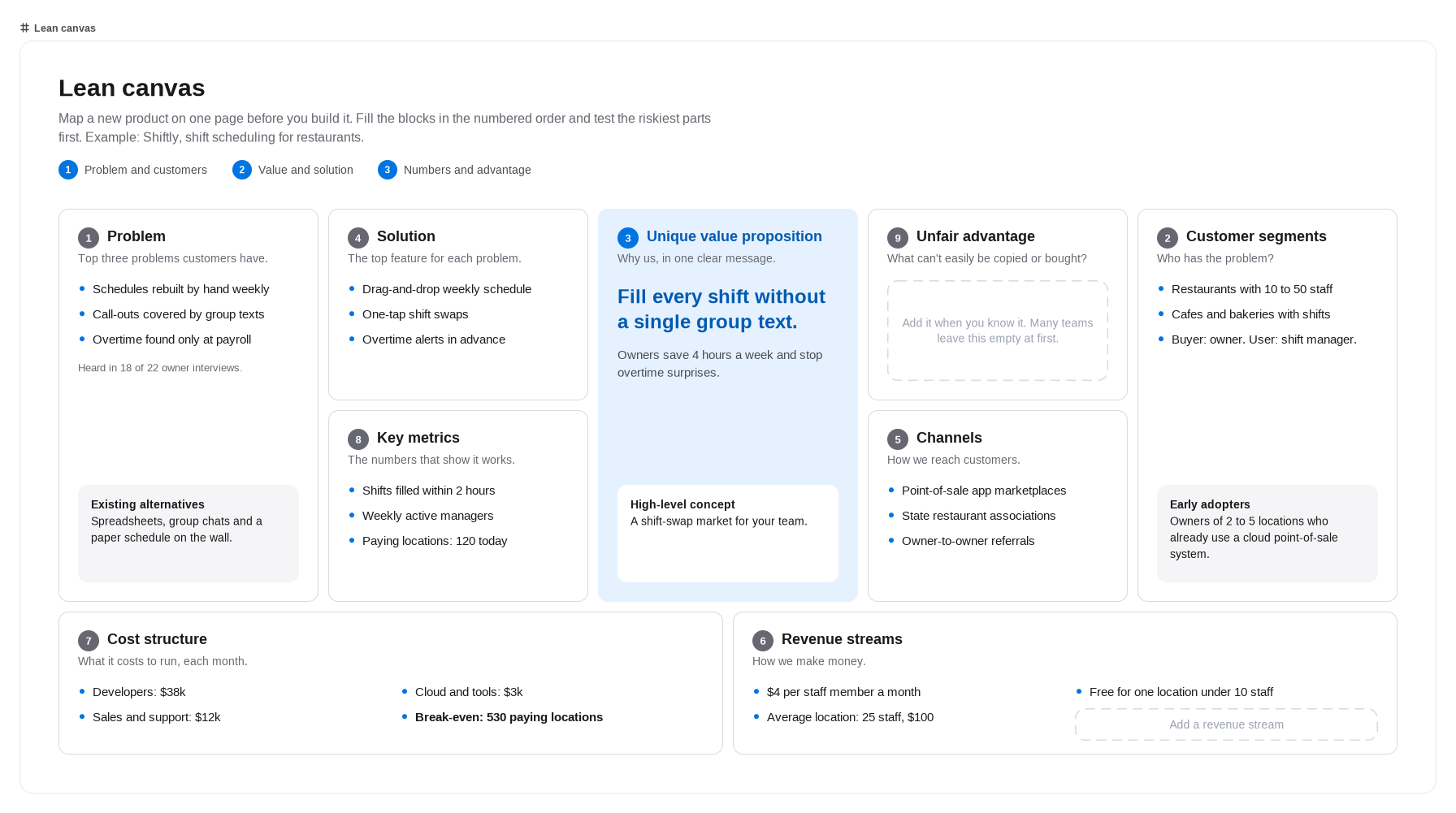
This template numbers its nine blocks in the order to fill them and prints a prompt under each title. The example is Shiftly, shift scheduling software for restaurants, with 120 paying locations so far.
Problem first, solution fourth
The left side of the canvas pairs the problem with its answer. Block 1, Problem, asks for the “Top three problems customers have”. Shiftly’s are concrete: “Schedules rebuilt by hand weekly”, “Call-outs covered by group texts” and “Overtime found only at payroll”. A line below gives the evidence: “Heard in 18 of 22 owner interviews.”
A card inside the block lists “Existing alternatives”: spreadsheets, group chats and a paper schedule on the wall. Those are the real competition for a new product.
The Solution block is numbered 4, not 2, and that is deliberate. It holds one feature per problem: a drag-and-drop weekly schedule, “One-tap shift swaps” and “Overtime alerts in advance”. Below it, block 8 holds the key metrics, such as “Shifts filled within 2 hours”.
Customers, the promise and the way to reach them
The right side of the canvas describes the market.
- 2. Customer segments: “Who has the problem?” Restaurants with 10 to 50 staff, plus cafes and bakeries with shifts. One line separates buyer from user: “Buyer: owner. User: shift manager.”
- Early adopters: a card inside the segment block narrows it to the first people to sell to, “Owners of 2 to 5 locations who already use a cloud point-of-sale system.”
- 3. Unique value proposition: “Why us, in one clear message.” Shiftly’s reads “Fill every shift without a single group text.”
- 5. Channels: “Point-of-sale app marketplaces”, “State restaurant associations” and “Owner-to-owner referrals”.
- 9. Unfair advantage: left open, with the note “Add it when you know it. Many teams leave this empty at first.”
Under the value proposition, a “High-level concept” card compresses the idea into a phrase a stranger can repeat: “A shift-swap market for your team.”
Make the numbers add up
The bottom row is a small business case. Revenue streams, block 6, states the price: “$4 per staff member a month”, which for the “Average location: 25 staff” comes to $100. Cost structure, block 7, lists what it costs to run each month: “Developers: $38k”, “Sales and support: $12k” and “Cloud and tools: $3k”.
The last cost line does the arithmetic: “Break-even: 530 paying locations”. That is $53k of monthly cost divided by $100 a location. Set beside “Paying locations: 120 today” in key metrics, it tells the team how far there is to go.
Aim for the same on your canvas: a price, a typical customer and the costs, so that one line can say how many customers the product needs to pay for itself.
How to use the lean canvas template
- Open it as a new board. The copy comes with Shiftly’s entries, which you replace block by block in numbered order.
- Problem and customers. Fill blocks 1 and 2, including existing alternatives and early adopters. Note how many interviews back each problem.
- Value and solution. Write the one-sentence promise in block 3, then one feature per problem in block 4 and your channels in block 5.
- Numbers and advantage. Add revenue, costs and key metrics, and work out the break-even. Fill block 9 when you have a true answer.
Then pick the block you are least sure of and test it before building more.
When a lean canvas fits, and when another template is better
Use it at the start: a new product, a new startup, or a new line inside a company, when most of what you would write is still a guess. It is quick to redo, which is the point.
Once the business runs and has partners, resources and customer relationships worth mapping, move to the business model canvas. To dig into one segment’s jobs, pains and gains, use the value proposition canvas. To decide which guess on the canvas to test first, sort them with assumption mapping.
Questions about the Lean canvas template
What is the difference between a lean canvas and a business model canvas?
Both have nine blocks. The lean canvas replaces key partners, key activities, key resources and customer relationships with problem, solution, key metrics and unfair advantage. That makes it better for an untested idea, where the main risk is building something nobody needs.
In what order should the blocks be filled?
Follow the numbers printed on the template: problem, customer segments, unique value proposition, solution, channels, revenue streams, cost structure, key metrics and unfair advantage. The order keeps the solution from being written before the problem is clear.
What counts as an unfair advantage?
Something a competitor cannot easily copy or buy, such as exclusive data, a hard-won community or a unique distribution deal. A feature rarely qualifies. The template suggests leaving the block empty until you know, and many early teams do.
Is the lean canvas template free?
Yes. It has 103 elements, under the Free plan’s limit of 150 per board. Use this template puts a copy in your workspace, where each line can be rewritten, moved or removed.