What is an opportunity solution tree?
An opportunity solution tree is a diagram that connects a product outcome to the work meant to reach it. Teresa Torres made it known as a tool for product discovery. The outcome sits at the top. Under it come opportunities, which are customer needs, pains and wishes. Under each opportunity come solutions, and under each solution the tests that check its riskiest beliefs.
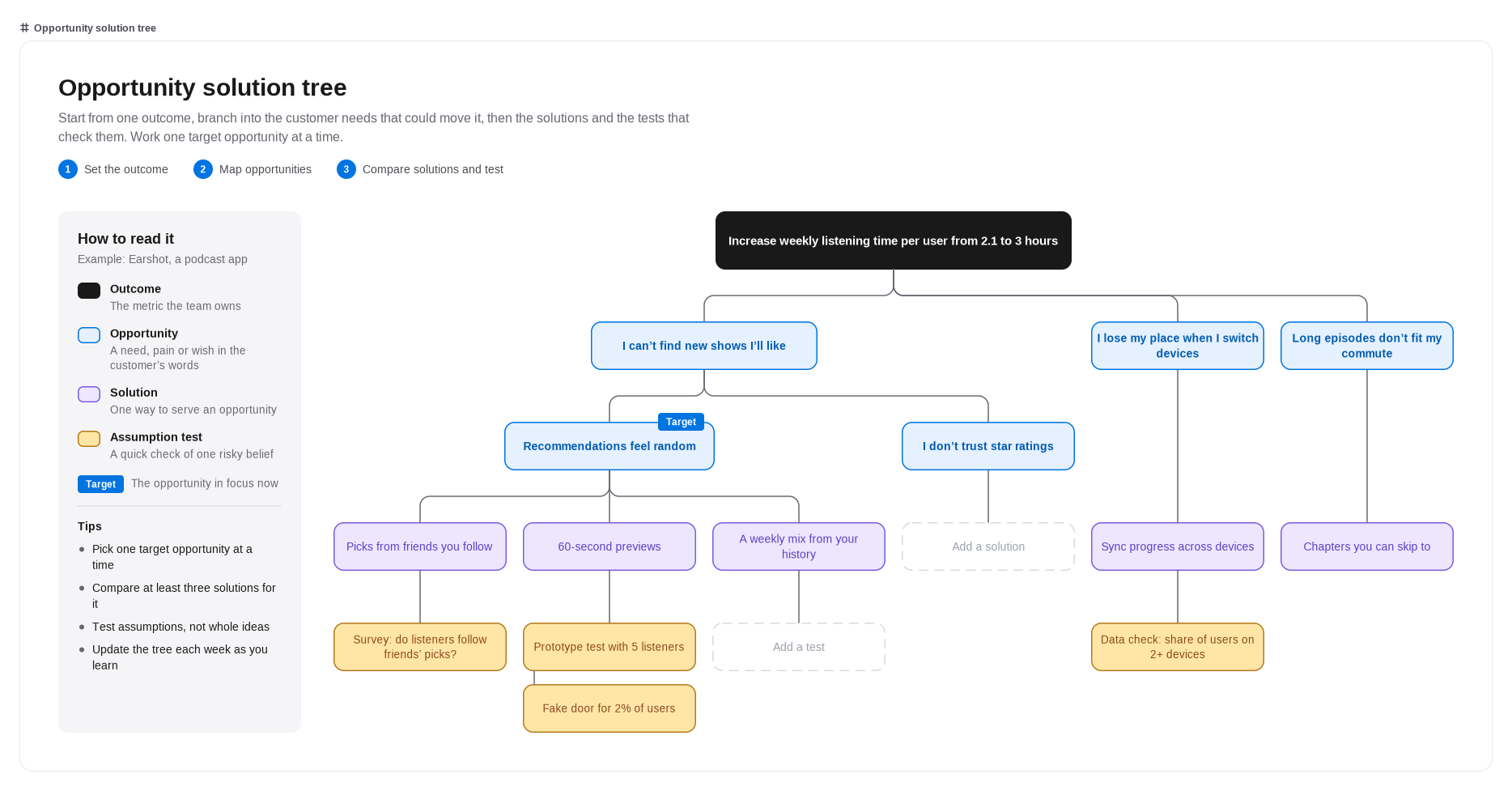
This template draws the full tree for a podcast app. Its outcome is to increase weekly listening time per user from 2.1 to 3 hours, and every box below traces back to that number. A panel on the left explains the colors and gives four tips.
Four kinds of box, one color each
The panel titled How to read it names the four levels and gives each one a line of explanation:
- Outcome. The metric the team owns.
- Opportunity. A need, pain or wish in the customer’s words.
- Solution. One way to serve an opportunity.
- Assumption test. A quick check of one risky belief.
A fifth entry, Target, marks the opportunity in focus now. On the tree that label sits on “Recommendations feel random”, so anyone who opens the board sees where the team is working this week.
Write opportunities the way customers say them
The first row under the outcome holds three opportunities: “I can’t find new shows I’ll like”, “I lose my place when I switch devices” and “Long episodes don’t fit my commute”. Each one is a sentence a listener could say in an interview. None of them mentions a feature.
That is the test for this level. If a box reads like something you would build, it is a solution and belongs lower down. When an opportunity is too broad to act on, split it. The first one breaks into two smaller needs: “Recommendations feel random” and “I don’t trust star ratings”.
Compare solutions and test what they assume
Below the target opportunity sit three solutions: “Picks from friends you follow”, “60-second previews” and “A weekly mix from your history”. Three is on purpose. With one idea the team argues about whether to build it. With three it compares them.
Each solution then gets a test sized to its risk. The friends idea starts with a survey that asks whether listeners follow friends’ picks. The previews idea gets a prototype test with 5 listeners, followed by a fake door for 2% of users. The dashed boxes, “Add a solution” and “Add a test”, show where the tree is still open.
How to use the opportunity solution tree template
- Copy the board. Use this template puts the podcast example in your workspace, ready to edit.
- Set the outcome. Replace the listening-time goal with one metric your team owns, written with its start and target value.
- Map opportunities. Add a box for each need you heard in interviews, quoting the customer where you can. Split the broad ones.
- Compare solutions and test. Move the Target label to one opportunity, add at least three solutions under it, and attach one assumption test to each.
The tips in the panel say to update the tree each week as you learn. Delete solutions a test has ruled out instead of leaving them to pile up. If you would rather start from a description, FlowDraw AI can draw a first tree that you then correct.
When the tree helps, and what to use beside it
The tree fits a team that owns an outcome and runs discovery every week. It shows why each idea exists and which need it serves, which makes it easy to say no to an idea with no opportunity above it.
It is not a schedule. Once a solution has passed its tests, place it on a now next later roadmap. To sort the beliefs behind a solution before you choose a test, use assumption mapping. And if you have not yet talked to enough customers to fill the opportunity row, start with a jobs to be done board.
Questions about the Opportunity solution tree template
Who created the opportunity solution tree?
Teresa Torres introduced it as part of her continuous discovery practice. The idea is to keep a visible line from a business or product outcome to the customer needs, ideas and experiments a team is working on.
What is the difference between an opportunity and a solution?
An opportunity is something the customer needs, struggles with or wishes for, such as “I lose my place when I switch devices”. A solution is something you could build in response, such as syncing progress across devices. Opportunities come from research. Solutions come from the team.
How many outcomes can one tree have?
One. A tree with two outcomes at the top becomes two trees tangled together, and opportunities stop pointing clearly at a number. If your team owns two metrics, make a second board from the template.
Is the opportunity solution tree template free to use?
Yes. It opens on the Free plan and fits within a Free board. You can change every box, add branches and export the tree as PNG, SVG or PDF.