What goes into a book report?
A book report tells someone who has not read a book what it is, what happens in it and whether it is worth their time. It has two halves. The first is fact: title, author, setting, plot, characters. The second is judgment: what the book means and what the reader thought of it. A report with only the first half is a summary; the second half is what makes it a report.
This template gives each part its own panel so nothing is skipped. The example was written by a Grade 5 reader named Nora, due Friday, April 9, 2027, on The Secret Garden by Frances Hodgson Burnett.
The book: details and setting
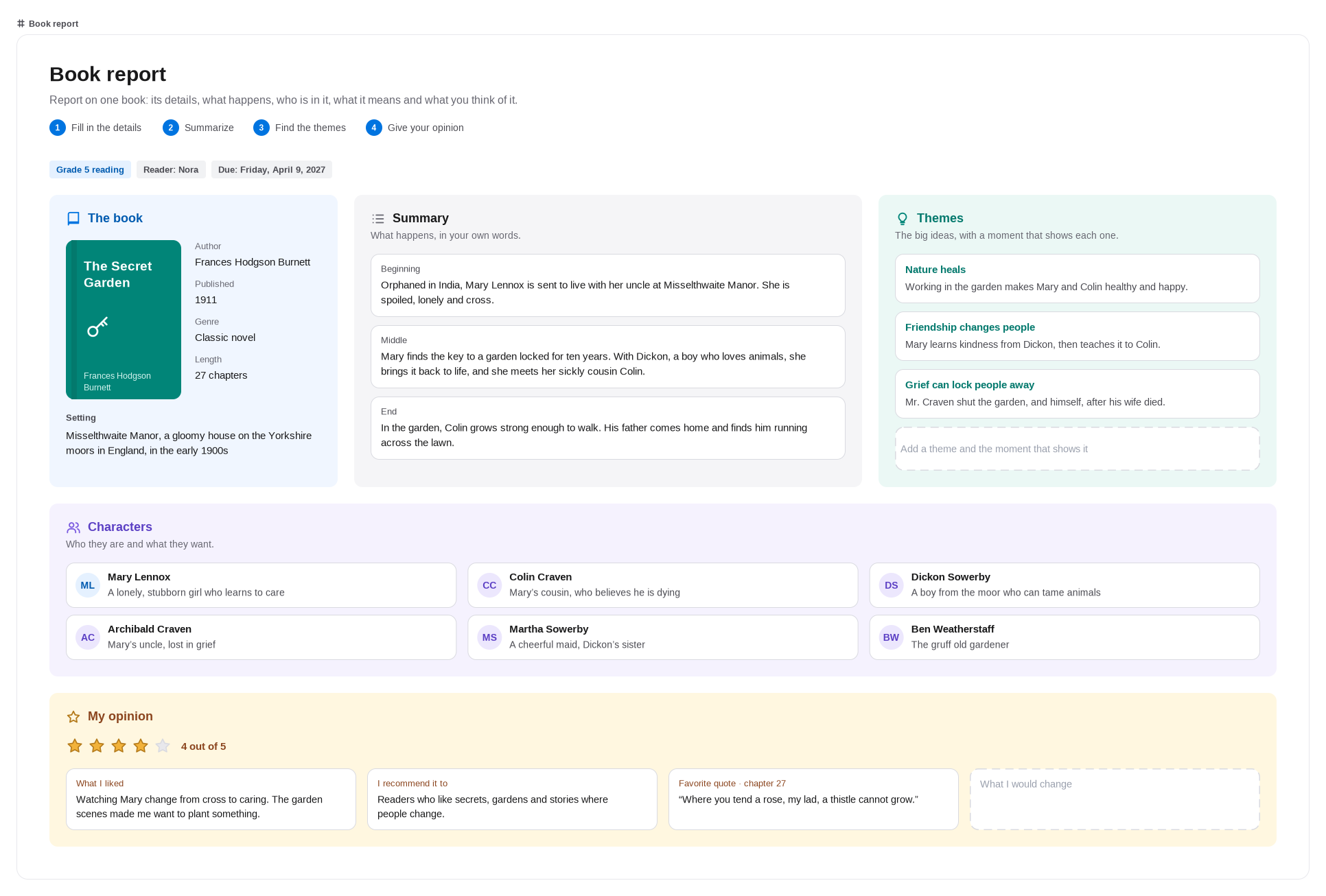
The first panel is the book’s identity card. A small cover shows the title and the author’s name. Beside it are four labeled facts: Author, Frances Hodgson Burnett; Published, 1911; Genre, Classic novel; Length, 27 chapters.
Under the cover is the Setting: “Misselthwaite Manor, a gloomy house on the Yorkshire moors in England, in the early 1900s”. That one line covers place, time and atmosphere. A student who writes only “England” has named a country, not a setting. Ask for the kind of place and the feeling of it, as “gloomy” does here.
Summary in three cards
The Summary panel says “What happens, in your own words” and limits the answer to three cards.
- Beginning. Orphaned in India, Mary Lennox is sent to live with her uncle at Misselthwaite Manor. She is spoiled, lonely and cross.
- Middle. Mary finds the key to a garden locked for ten years. With Dickon, a boy who loves animals, she brings it back to life, and she meets her sickly cousin Colin.
- End. In the garden, Colin grows strong enough to walk. His father comes home and finds him running across the lawn.
Twenty-seven chapters in six sentences. The limit is the lesson: a young reader’s first summary usually retells every chapter in order. Three cards make the student pick the events the story turns on. Note that the Beginning card also says what Mary is like, which sets up the change the rest of the report describes.
Themes, each with a moment that shows it
The Themes panel asks for “The big ideas, with a moment that shows each one.” Each card has the idea on top and the proof under it:
- Nature heals. Working in the garden makes Mary and Colin healthy and happy.
- Friendship changes people. Mary learns kindness from Dickon, then teaches it to Colin.
- Grief can lock people away. Mr. Craven shut the garden, and himself, after his wife died.
Each theme is a short statement with a verb in it, not a single word like “nature”. And each has a moment from the book attached, so the teacher can see the student did not borrow it from the back cover. A fourth card waits with the prompt “Add a theme and the moment that shows it”.
Characters: who they are and what they want
Six characters get a card each, with initials, a name and one line. Mary Lennox is “A lonely, stubborn girl who learns to care”. Colin Craven is “Mary’s cousin, who believes he is dying”. Dickon Sowerby is “A boy from the moor who can tame animals”. Archibald Craven, Martha Sowerby and Ben Weatherstaff, “The gruff old gardener”, complete the set.
The best lines here carry a small story inside them. “Learns to care” tells you Mary changes. “Believes he is dying” tells you Colin may be wrong. One line is enough when it says what the person is like and where they are headed.
My opinion
The last panel is the reader’s own. It opens with a rating, “4 out of 5”, and four cards. What I liked: “Watching Mary change from cross to caring. The garden scenes made me want to plant something.” I recommend it to: “Readers who like secrets, gardens and stories where people change.” Favorite quote · chapter 27: “Where you tend a rose, my lad, a thistle cannot grow.” The fourth card, What I would change, is empty.
An opinion needs a reason. “I liked it” earns nothing; “the garden scenes made me want to plant something” shows the book did its work on this reader. The recommendation card is a good exercise too: the student has to think about who the book is for, not only whether they enjoyed it.
How to use the book report template
- Open it as a new board. Write the reader’s name and the due date in the labels at the top.
- Fill in the details. Do this before reading: title, author, year, genre and length are all on the cover or the first pages.
- Summarize. When the book is finished, write the End card first, then the Beginning, then choose what belongs in the Middle.
- Find the themes. Ask what the book wants readers to believe, and attach a moment to each answer. List the characters alongside.
- Give your opinion. Set the rating, then explain it. Copy the favorite quote exactly and note its chapter.
Export the finished board as a PDF to hand in.
When a book report fits, and when to choose another template
Use it for independent reading, summer reading, book clubs and class libraries where students recommend books to each other. It suits fiction best, though a biography fits with small changes to the labels.
While the class is still reading, a story map is lighter and tracks the plot as it unfolds. For a close look at one person in the book, use a character map. When the report has to become a written essay, move the themes and quotes into an essay outline.
Questions about the Book report template
What is the difference between a book report and a book review?
A book report shows that you read and understood the book: it covers details, plot, characters and themes, and ends with your opinion. A book review is mostly opinion and argument, written to help others decide whether to read it.
How long should the summary be?
About six sentences for a novel, two in each of the three cards. If the summary is longer than the rest of the report put together, cut it. The reader wants to know what kind of story it is, not every event.
Should a book report give away the ending?
For a teacher, yes: the End card proves you finished the book. If you will present the report to classmates who might read it, keep the End card short and let the recommendation card do the persuading.
Does the template work for nonfiction?
Yes, with new labels. Rename Summary’s cards to the book’s main sections, turn Themes into main ideas with a fact for each, and use the Characters panel for the key people or terms. The opinion panel stays the same.
Is the book report template free?
It is. The board holds 107 elements, under the 150 allowed on the Free plan, so a student can open a copy, replace the example and export it without paying.