
What is a character map?
A character map is a one-page study of a single character. It collects what the character is like, the lines in the text that prove it, the people around them and the way they change between the first page and the last. Students use it to prepare for a character essay or a class discussion; teachers use it to see whether a claim about a character is backed by the book.
This template places the character on a card at the center, with lines out to a column of traits and a column of relationships, and a three-step strip of change underneath. The example comes from a Grade 8 English class reading A Christmas Carol by Charles Dickens, 1843.
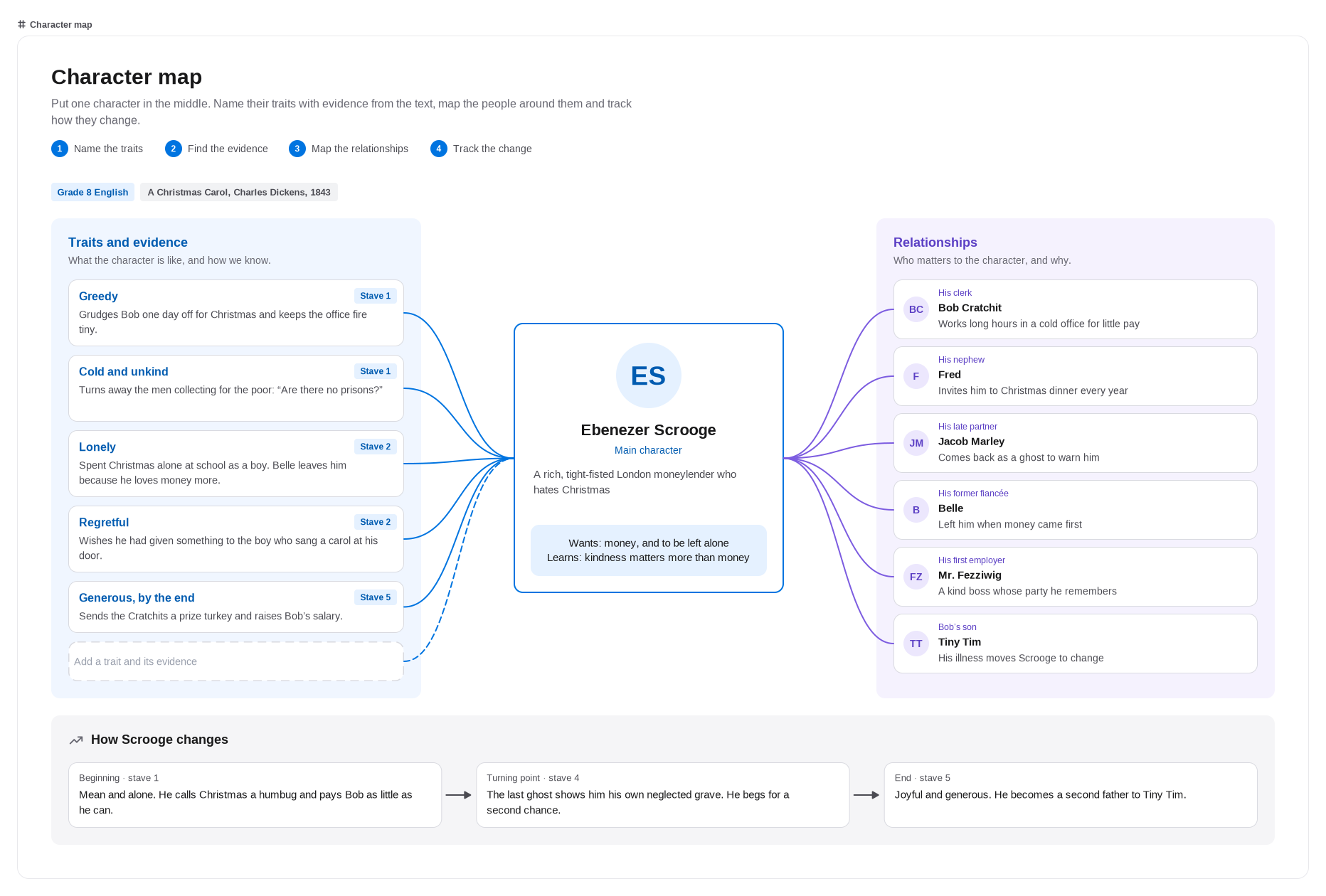
The character at the center
The center card holds five things: initials, the name “Ebenezer Scrooge”, the role “Main character”, a one-line description, “A rich, tight-fisted London moneylender who hates Christmas”, and a small card with two lines:
- Wants: money, and to be left alone
- Learns: kindness matters more than money
Those two lines are the shortest possible summary of a character arc. If a student can fill in Wants and Learns, they have understood the book. If Learns stays empty, the character may be a flat one, and that is worth saying too.
Traits, each with evidence
The left column is headed “What the character is like, and how we know.” Each card has a trait in bold, a line of evidence and a tag for where in the book it comes from. A Christmas Carol is divided into staves, so the tags read Stave 1, Stave 2 and Stave 5.
- Greedy. Grudges Bob one day off for Christmas and keeps the office fire tiny. Stave 1.
- Cold and unkind. Turns away the men collecting for the poor: “Are there no prisons?” Stave 1.
- Lonely. Spent Christmas alone at school as a boy. Stave 2.
- Regretful. Wishes he had given something to the boy who sang a carol at his door. Stave 2.
- Generous, by the end. Sends the Cratchits a prize turkey and raises Bob’s salary. Stave 5.
The rule the column teaches is simple: no trait without a moment from the text. Evidence can be something the character does, as with the tiny fire, or something he says, as with the question about prisons. The last card, “Add a trait and its evidence”, keeps the two together by its wording.
Relationships: who matters, and why
The right column lists six people. Each card states the relationship first, then the name, then one line on why that person matters to Scrooge:
- His clerk, Bob Cratchit. Works long hours in a cold office for little pay.
- His nephew, Fred. Invites him to Christmas dinner every year.
- His late partner, Jacob Marley. Comes back as a ghost to warn him.
- His former fiancée, Belle. Left him when money came first.
- His first employer, Mr. Fezziwig. A kind boss whose party he remembers.
- Bob’s son, Tiny Tim. His illness moves Scrooge to change.
Writing the relationship from the main character’s side (“his clerk”, “his nephew”) keeps the map about one person. The third line is where the thinking happens: it should say what the person shows us about the character, not retell their own story.
Track how the character changes
The strip at the bottom, “How Scrooge changes”, has three cards in order. Beginning · stave 1: “Mean and alone. He calls Christmas a humbug and pays Bob as little as he can.” Turning point · stave 4: “The last ghost shows him his own neglected grave. He begs for a second chance.” End · stave 5: “Joyful and generous. He becomes a second father to Tiny Tim.”
The middle card matters most. Many students can describe a character before and after; fewer can point to the scene where the change happens. Naming the stave makes them find it.
How to use the character map template
- Open it as a new board. Put your character on the center card and change the book line at the top.
- Name the traits. Start with three. Use precise words: “tight-fisted” says more than “bad”.
- Find the evidence. Go back to the text for each trait and tag the chapter, act or page in place of the stave.
- Map the relationships. Add the people who affect the character most, and write why each one matters.
- Track the change. Fill the three cards last, then write the Wants and Learns lines on the center card.
In class, split the columns between groups: one hunts for traits, one for relationships, and the whole class agrees on the turning point.
When a character map helps, and when to choose another board
Use it when one character carries the question: a character essay, a comparison of a hero at the start and the end, preparation for a role in a school play. It also suits biography, with a real person in the middle and sources as evidence.
For the whole story, with setting, plot and theme, start with a story map. To set two characters side by side, such as Scrooge and Fred, a compare and contrast chart is clearer. If the relationships are family ties across generations, a family tree shows them better than a list.
Questions about the Character map template
What should a character map include?
At least the character’s traits and proof for each from the text. A fuller map, like this one, adds what the character wants, the people around them and how they change from the beginning to the end of the story.
What counts as evidence for a trait?
Something the character says, does or thinks, or what others say about them, taken from a specific place in the text. A short quotation is strongest. A paraphrase works if you note the chapter, as the stave tags do in the example.
How many traits should I list?
Four to six. The example has five and an empty card for a sixth. Include at least one trait that shows a different side of the character, as “Lonely” does for Scrooge, so the map is not a list of synonyms.
Can I use it for a character who does not change?
Yes. Keep the three cards and use them to show that the character stays the same at the beginning, the middle and the end. Then say what effect that steadiness has on the other characters.