What is a story map?
A story map is a graphic organizer that breaks a story into its elements: who is in it, where and when it happens, what goes wrong, what the characters do about it and how it ends. Filling one in shows whether a reader followed the story, and it gives young writers a plan before they draft their own.
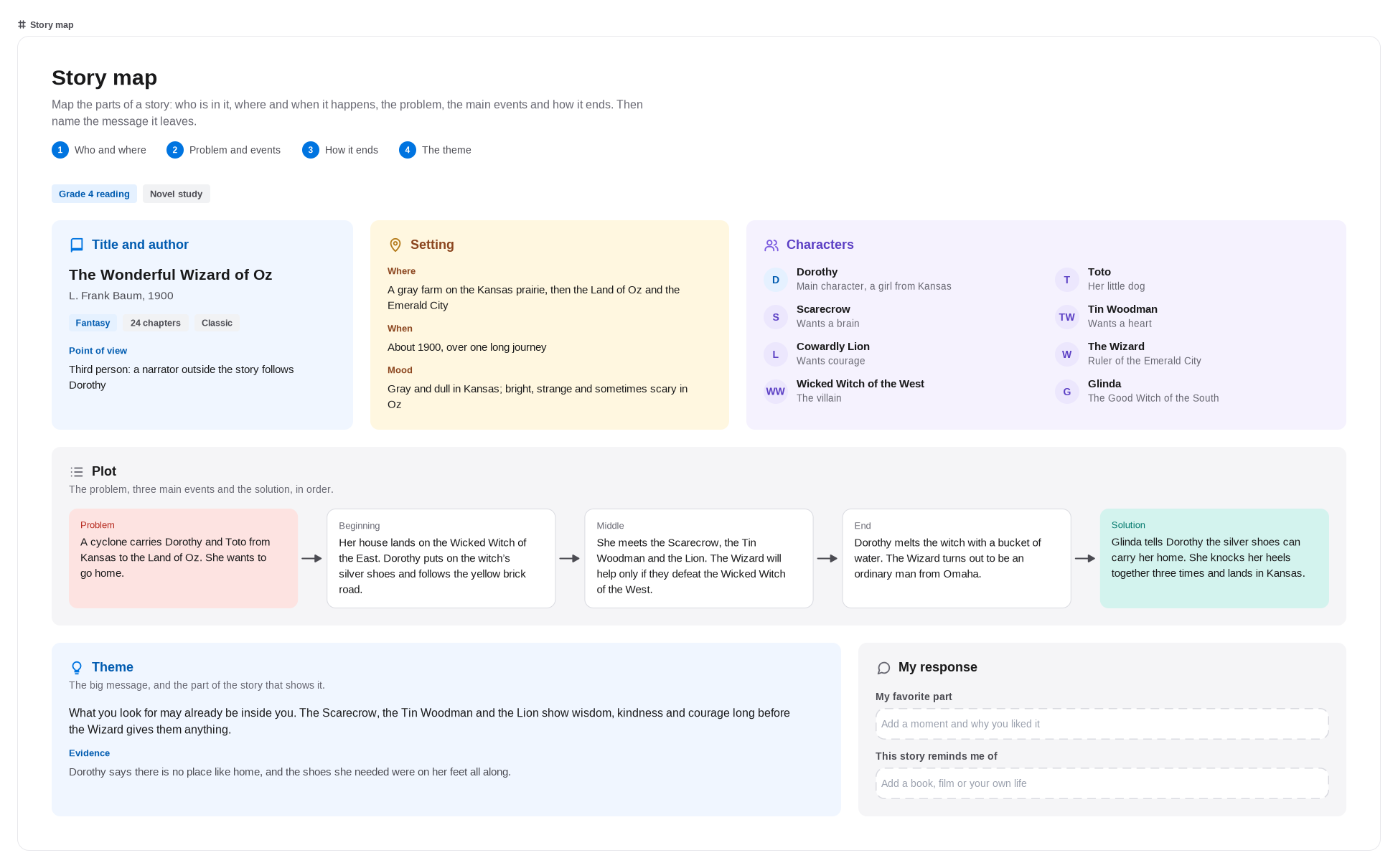
This template has six areas. The top row holds the title and author, the setting and the characters. A plot strip runs across the middle. The bottom row asks for the theme and a personal response. The example comes from a Grade 4 novel study of The Wonderful Wizard of Oz by L. Frank Baum, published in 1900.
Title, author and setting
The first card records the book: its title, “L. Frank Baum, 1900”, and three small tags, “Fantasy”, “24 chapters” and “Classic”. It also has a line for point of view, which most story maps skip: “Third person: a narrator outside the story follows Dorothy”.
The Setting card splits into three questions so that “Oz” is not the whole answer:
- Where. A gray farm on the Kansas prairie, then the Land of Oz and the Emerald City.
- When. About 1900, over one long journey.
- Mood. Gray and dull in Kansas; bright, strange and sometimes scary in Oz.
The mood line is worth teaching. It asks how the place feels, and in this book the contrast between the two places is part of the story.
Characters and what each one wants
The Characters card lists eight people in two columns, each with an initial badge, a name and one line. The line says the character’s role or, better, what the character wants: the Scarecrow “Wants a brain”, the Tin Woodman “Wants a heart”, the Cowardly Lion “Wants courage”. Dorothy is the “Main character, a girl from Kansas”, the Wicked Witch of the West is “The villain”, and Glinda is “The Good Witch of the South”.
Asking for a want instead of a description is a small change that pays off later. A reader who knows what each character is after can explain the plot instead of just listing it.
Plot: the problem, three events and the solution
The plot strip holds five cards joined by arrows: Problem, Beginning, Middle, End and Solution. The problem in the example fits in two sentences: “A cyclone carries Dorothy and Toto from Kansas to the Land of Oz. She wants to go home.” The Beginning card has her put on the witch’s silver shoes and follow the yellow brick road. In the Middle she meets the Scarecrow, the Tin Woodman and the Lion, and the Wizard will help only if they defeat the Wicked Witch of the West.
Five cards force choices. A 24-chapter book has far more than three events, so the student has to decide which ones the story cannot do without. Two sentences per card is the right size; a card that needs a third is usually two events.
How it ends, and the difference between End and Solution
The last two cards separate things that students often blur. End is the final big event: Dorothy melts the witch with a bucket of water, and the Wizard turns out to be an ordinary man from Omaha. Solution answers the Problem card directly: Glinda tells Dorothy the silver shoes can carry her home, so she knocks her heels together three times and lands in Kansas.
Read the first and last cards together as a check. If the Solution does not settle the Problem, one of the two is wrong.
Theme and evidence
The Theme area asks for “The big message, and the part of the story that shows it.” The example states the message as a sentence, not a single word: “What you look for may already be inside you.” It then backs it up: the three companions show wisdom, kindness and courage long before the Wizard gives them anything. An Evidence line adds the moment that proves it: the shoes Dorothy needed were on her feet all along.
“Friendship” is a topic. A theme is what the story says about it. Having the evidence line right under the message keeps students from choosing a theme the book does not support.
How to use the story map template
- Open it as a new board. Replace the grade and unit labels and clear the Oz notes, or keep them as a model for the first lesson.
- Who and where. After the first chapters, fill in the book card, the setting and the characters you have met. Add characters as they appear.
- Problem and events. Write the Problem card as soon as it is clear. Leave Beginning, Middle and End until the book is finished, then pick one event for each.
- How it ends. Fill in Solution and check it against Problem.
- The theme. Write the message, then the evidence. Finish with My response: “My favorite part” and “This story reminds me of”, which takes a book, a film or your own life.
When a story map fits, and when to use something else
Use it for a first full read of a novel, a short story, a picture book or a film, from about Grade 2 up. It also works backwards: a student planning a story fills the map before writing a line.
It covers everything lightly. To study how tension rises and falls, move to a plot diagram. To go deep on one person, such as how the Lion changes, use a character map. When the map is done and the student has an opinion to share, a book report is the next step.
Questions about the Story map template
What are the five parts of a story map?
Most story maps cover characters, setting, problem, events and solution. This template keeps those five and adds a card for the title and author, a theme with evidence and a space for the reader’s own response.
What grade level is a story map for?
It is common from Grade 2 to Grade 6, and the example is a Grade 4 novel study. Older students can use the same board with harder texts by asking more of the theme and point of view lines.
Should students fill it in while reading or after?
Both. Characters and setting can go in after the first few chapters, and the problem as soon as it appears. The event cards, the solution and the theme are better left until the last page, when the student knows which events mattered.
Can each student have their own copy?
Yes. Use this template makes a copy in the workspace of whoever opens it. The board has 97 elements, so it fits on the Free plan, and each student can export the finished map as a PDF or PNG to hand in.