What is a brain dump?
A brain dump is what it sounds like: you take every task, worry and half-idea out of your head and put it where you can see it. You do not sort or judge while you write. Sorting comes second, as a separate step, once nothing is left to remember.
Splitting the two steps is what makes it work. Trying to list and prioritize at once is slow, and the small nagging items never get written down. This template gives the dump a wide strip at the top and the sort four lanes underneath. The example is Rosa, owner of Dough & Co. bakery, two weeks before the holiday rush.
Empty your head first
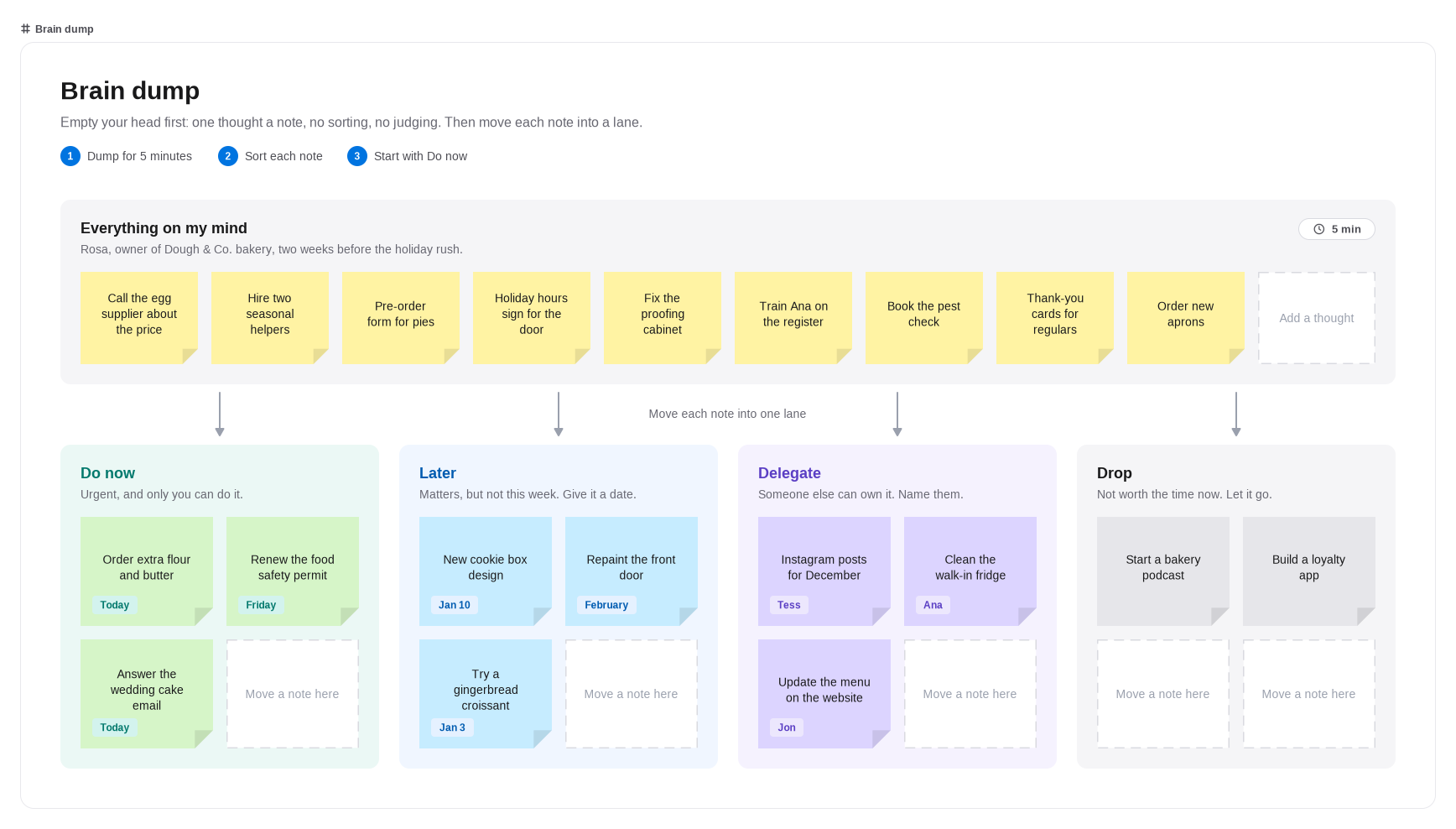
The top strip is titled “Everything on my mind” and carries a “5 min” label. Five minutes is short on purpose. It is long enough to get past the obvious items and short enough that you do not start organizing.
Nine of Rosa's notes are still in the strip, and they are a real mix: “Call the egg supplier about the price”, “Hire two seasonal helpers”, “Fix the proofing cabinet”, “Book the pest check”, “Thank-you cards for regulars”, “Order new aprons”. Big and small, urgent and not, all side by side. That is how a dump should look.
Each note starts with a verb where it can and holds one thought. “Staff” would be a topic. “Train Ana on the register” is something that can be done, handed over or dropped, which is exactly what the next step asks of it.
Do now and Later
Under the strip, a line gives the one instruction for the second step: “Move each note into one lane”. The first two lanes hold what stays with you.
- Do now. “Urgent, and only you can do it.” Rosa has three: order extra flour and butter (Today), answer the wedding cake email (Today) and renew the food safety permit (Friday).
- Later. “Matters, but not this week. Give it a date.” Her three are a new cookie box design (Jan 10), trying a gingerbread croissant (Jan 3) and repainting the front door (February).
Every note in these lanes has a small tag with a day or a date. In Later the tag is the whole point. A note without a date is not scheduled, only postponed, and it will be back in your head by next week.
Delegate and Drop
The other two lanes are for what leaves your list.
- Delegate. “Someone else can own it. Name them.” The December social media posts go to Tess, cleaning the walk-in fridge to Ana and updating the menu on the website to Jon.
- Drop. “Not worth the time now. Let it go.” Rosa dropped two: “Start a bakery podcast” and “Build a loyalty app”.
A delegated note carries a name the way a later note carries a date. Without the name it is still yours.
Drop is the lane people skip, and it is the one that frees the most attention. A podcast and an app are not bad ideas. They are ideas a bakery owner cannot afford to carry in the two weeks before the holidays. Putting them in a lane, instead of deleting them, makes the decision visible and easy to revisit in January.
How to use the brain dump template
- Open it as a new board. Remove Rosa's notes and keep the dashed cards as placeholders.
- Dump for 5 minutes. One thought a note in the top strip. Work, home, errands, worries: everything goes in, in whatever order it surfaces.
- Sort each note. Pick up the notes one at a time and ask two questions. Does it matter this week? Does it have to be me? The answers choose the lane.
- Tag and start. Add a day, a date or a name to every note outside Drop, then begin with the first note in Do now.
If Do now ends up with more than five notes, sort that lane again. Some of them are Later in disguise.
When a brain dump helps, and what to use next
Do one when your head feels full: before a busy season, after a holiday, at the start of a project, on a Sunday evening. It works for one person and for a small team that shares a workload.
The four lanes are a quick sort, not a schedule. To spread the Do now and Later notes over actual days, move them to a weekly planner. If you sort by urgency and importance more strictly, the Eisenhower matrix uses a similar four-way split on two axes. And when the dump is not tasks but research notes or ideas that need themes, an affinity diagram groups them by likeness instead of by action.
Questions about the Brain dump template
How often should I do a brain dump?
Whenever you notice you are keeping lists in your head. Many people do one weekly, and an extra one before any crowded stretch. The board is reusable: clear the lanes you have finished and dump into the top strip again.
What is the difference between a brain dump and a to-do list?
A to-do list holds only tasks you have already decided to do. A brain dump takes everything, including worries, ideas and things you will never do, and decides afterwards. Do now is the only lane that resembles a to-do list.
What if most of my notes land in Do now?
Test each one against the lane’s own line: urgent, and only you can do it. If it can wait a week, it is Later with a date. If someone else could do it acceptably, it is Delegate. Few notes pass both tests.
Can a team do a brain dump together?
Yes. Everyone adds notes to the strip, then the group sorts them, and the Delegate lane becomes a list of who takes what. Editing the same board at once needs the Team plan; otherwise one person types for the group.