What is brainwriting 6-3-5?
Brainwriting 6-3-5 is brainstorming on paper, in silence. Six people each write three ideas in five minutes. Then every sheet moves to the next person, who reads what is there and adds three more. After the first round and five passes each sheet has been through all six people and holds 18 ideas, so the group ends with 108 in half an hour. The method is credited to the German marketing consultant Bernd Rohrbach.
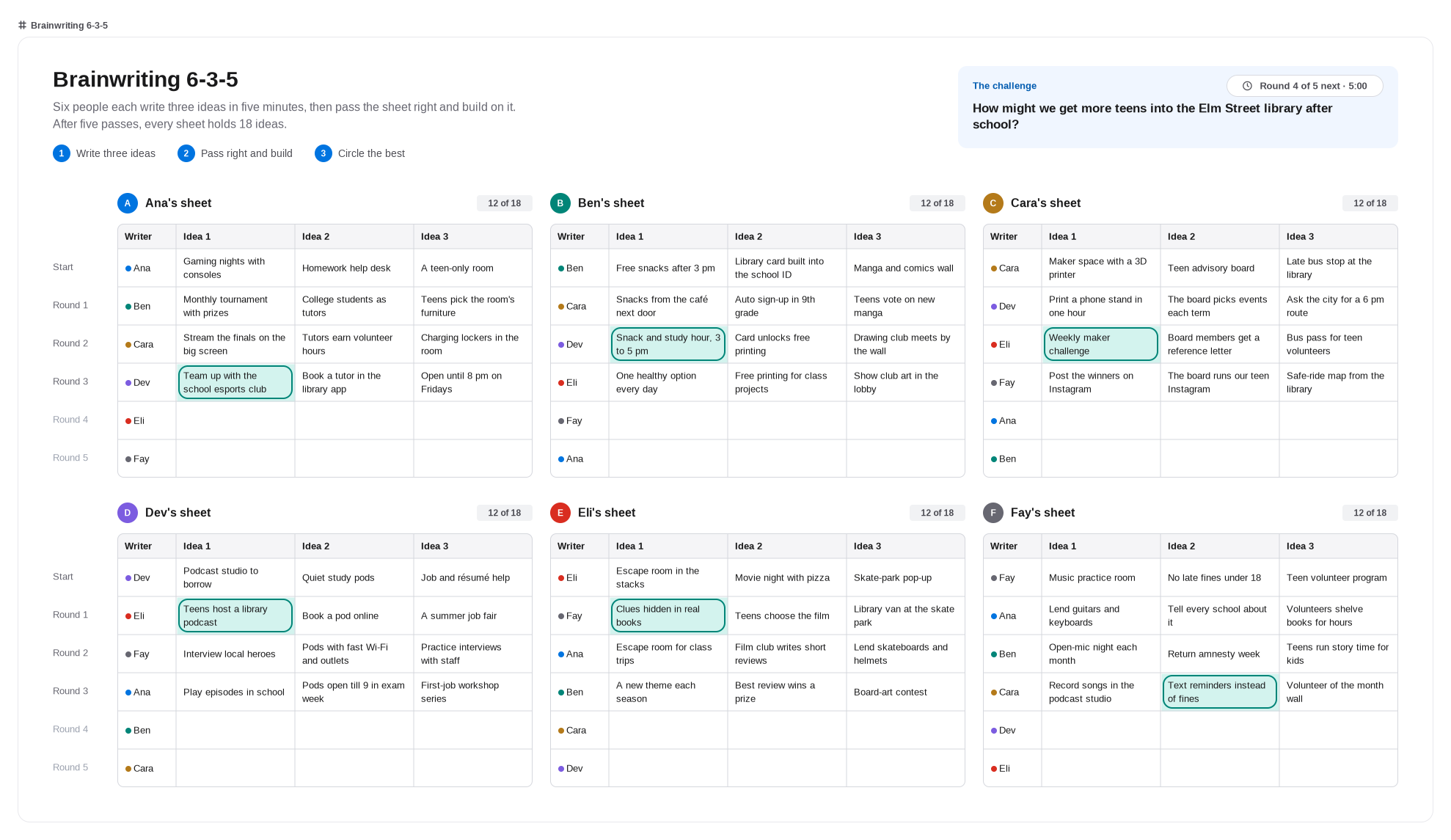
Because everyone writes at once, nobody waits for a turn to speak and nobody's idea is talked over. This template lays out the six sheets as tables, with the challenge and the round counter at the top. The example asks: “How might we get more teens into the Elm Street library after school?”
One sheet, three columns, six rows
Every sheet is a table with a Writer column and three idea columns. Labels down the left margin name the rows: Start, then Round 1 to Round 5. The owner fills the Start row, and each pass adds a row below it.
Ana's sheet begins with her three ideas: “Gaming nights with consoles”, “Homework help desk” and “A teen-only room”. Ben wrote the next row, then Cara, then Dev. The rows for Eli and Fay are still empty, and the counter above the sheet reads “12 of 18”.
The writer's name at the start of each row matters more than it seems. It shows the order the sheet traveled in, and afterwards it tells you whom to ask when an idea needs explaining.
Read down a column to see an idea grow
You may add anything in your three cells, but the method pays off when you build on the cell above. Read the first column of Ben's sheet from top to bottom:
- Ben: Free snacks after 3 pm
- Cara: Snacks from the café next door
- Dev: Snack and study hour, 3 to 5 pm
- Eli: One healthy option every day
A vague perk became a named event with a time slot and a supplier. On Cara's sheet, the second column does the same with a teen advisory board: the board picks events each term, board members get a reference letter, and finally the board runs the library's social account for teens.
Not every column has to be a chain. If the cell above gives you nothing, write a fresh idea. An honest new thought is worth more than a forced variation.
Circle the best on each sheet
Step three on the board is “Circle the best”. Each sheet in the example has one cell outlined. On Dev's sheet it is Eli's “Teens host a library podcast”, which grew out of Dev's “Podcast studio to borrow”. On Eli's sheet it is Fay's “Clues hidden in real books”, her build on an escape room in the stacks.
Notice that neither circled idea is from the Start row. The first row tends to hold what people walked in with. The cells that get circled are usually second or third builds, where one person's raw idea met another's practical twist.
One circle a sheet gives six candidates out of 108 cells. That is a list a group can discuss in ten minutes.
How to use the brainwriting 6-3-5 template
- Open it as a new board. Write your challenge in the card at the top right and put your six names on the sheets.
- Write three ideas. Everyone fills the Start row of their own sheet. Five minutes, no talking.
- Pass right and build. Move to the next sheet, read every row on it and add yours underneath. Update the round chip, which in the example reads “Round 4 of 5 next · 5:00”. Repeat until all six rows are full.
- Circle the best. Outline one cell on each sheet and compare the six.
Six people writing on one board at the same moment needs the Team plan. On a plan with one editor, treat the board as the record: people write on paper or send their rows as comments, and the editor fills in the tables between rounds.
When 6-3-5 fits, and when it does not
Choose it when you want many ideas quickly and the group includes quiet people, a wide range of seniority or anyone joining remotely. Writing levels all of that out. It also leaves a complete record, which a spoken session never does.
It is less suited to problems that need discussion to be understood, since nobody talks until the end. If you want fewer, deeper ideas, a round robin passes one idea at a time. If energy and conversation are what the team needs, run a spoken brainstorm session. And with 108 cells on the board, an affinity diagram helps to find the themes that repeat across sheets.
Questions about the Brainwriting 6-3-5 template
What do the numbers 6-3-5 mean?
Six people, three ideas each, five minutes a round. With six rows on a sheet, that is six rounds of five minutes, so the writing takes 30 minutes and produces up to 6 × 3 × 6 = 108 ideas.
Does it work with fewer or more than six people?
Yes. With four people each sheet gets four rows and 12 ideas; delete the unused sheets and rows. With more than six, either split into two groups or stop after six rows, since late rows on a crowded sheet repeat earlier ones.
What if I cannot think of three ideas in five minutes?
Leave a cell empty and keep the sheet moving. Reading the rows above usually triggers something, which is the purpose of the pass. The example treats an empty cell as normal: a sheet shows its count, such as 12 of 18, and nothing more.
Is the brainwriting 6-3-5 template free?
Yes. Its 105 elements fit within the 150 a board on the Free plan allows, and the Free plan includes three boards. You can export the filled sheets as PNG, SVG, PDF or JSON.