What is round robin brainstorming?
In round robin brainstorming, ideas move around the table. Each person writes one idea, then passes it to a neighbor, who adds to it. After a few passes every starting idea has grown into a chain that several people have shaped, and everyone has contributed the same amount.
That equal turn is the reason to use it. Nobody can dominate and nobody can sit out. This template sets the session up as a grid, one row for each person's starting idea and one column for each round, with a panel for the chains the group picks. The example is the Lincoln Middle School student council: 5 people, one minute a turn, and the question “How might we cut food waste in the cafeteria?”
Rows are starters, columns are rounds
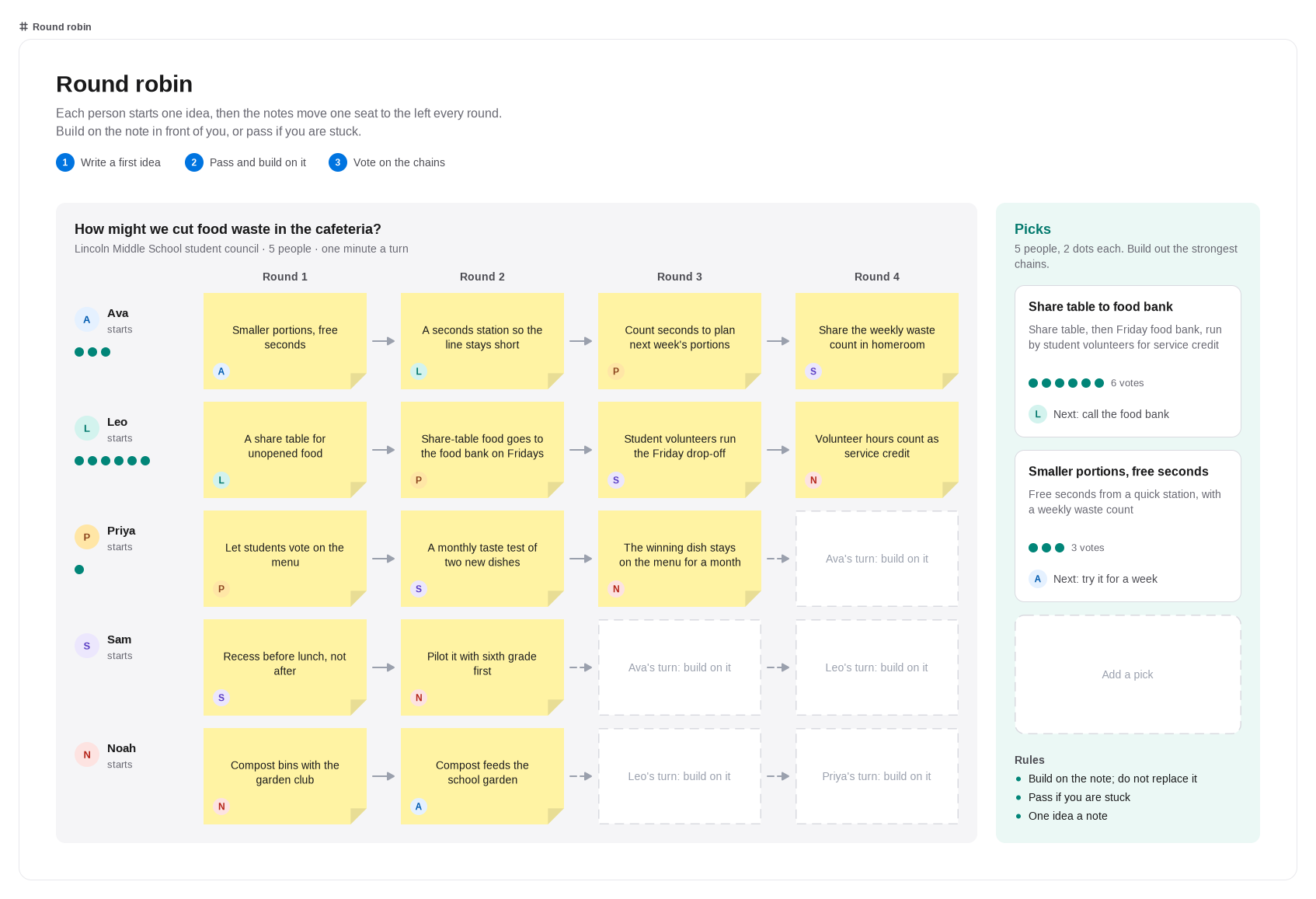
Down the left side are the five people who start a row: Ava, Leo, Priya, Sam and Noah. Across the top are Round 1 to Round 4. A note sits where a row meets a round, and a small initial in its corner shows who wrote it.
Follow Ava's row. In round 1 she writes “Smaller portions, free seconds”. Leo gets it in round 2 and adds “A seconds station so the line stays short”. Priya turns that into data, “Count seconds to plan next week's portions”, and Sam takes it to the whole school: “Share the weekly waste count in homeroom”.
The initials run A, L, P, S along the row. The board's instruction explains why: the notes move one seat to the left every round, so each row passes through the group in the same order.
Build on the note, do not replace it
The first rule in the corner of the board is “Build on the note; do not replace it”. Leo's row shows what building means. He starts with “A share table for unopened food”. Then:
- Priya gives the food somewhere to go: “Share-table food goes to the food bank on Fridays”.
- Sam adds who does it: “Student volunteers run the Friday drop-off”.
- Noah adds a reason to volunteer: “Volunteer hours count as service credit”.
Each note answers a question the one before it left open: where, who, why would they. By round 4 a loose idea has become something the council could start next week. A reply like “or we could compost instead” would have been a new idea, not a build, and it belongs in its own row.
The row below is one step behind. Priya's “Let students vote on the menu” has reached “The winning dish stays on the menu for a month”, and the last cell reads “Ava's turn: build on it”.
Open cells show whose turn it is
The grid is not finished, and it says so plainly. Sam's row stops after round 2: “Recess before lunch, not after”, then Noah's “Pilot it with sixth grade first”, then two dashed cells marked “Ava's turn: build on it” and “Leo's turn: build on it”. Noah's row, about compost bins with the garden club, has the same two cells waiting for Leo and Priya.
A named empty cell is better than a blank one. It tells the next person exactly where to write and makes a skipped turn visible. Skipping is allowed, though: the second rule is “Pass if you are stuck”. A forced note weakens a chain more than a gap does. The third rule, “One idea a note”, keeps each step small enough for the next person to build on.
Vote on chains, not single notes
When the rounds end, the group votes on whole rows. The picks panel sets the budget, 5 people with 2 dots each, and says what the vote is for: “Build out the strongest chains.”
The winner has 6 votes. Its card gives the chain a name, “Share table to food bank”, and sums up all four notes in one line: share table, then Friday food bank, run by student volunteers for service credit. Leo owns the next step: call the food bank. Second, with 3 votes, is Ava's chain on smaller portions with free seconds, and its next step is to try it for a week.
Writing that one-line summary is a good test. If four notes cannot be said as one sentence, they were four ideas and not a chain.
How to use the round robin template
- Open it as a new board. Put your question above the grid and the names of your group down the left, one row each.
- Write a first idea. Everyone fills the Round 1 cell of their own row. One minute, one idea.
- Pass and build on it. Each round, move up one row (from the top row, go to the bottom one) and add a note that makes the idea before it more concrete. Mark your initial on it. Pass if nothing comes.
- Vote on the chains. Two dots each on rows, not notes. Copy the top two into Picks with a summary and a next step.
With five people and four rounds at a minute a turn, the writing takes about four minutes. Add or delete rows to match the size of your group.
When round robin helps, and when to choose something else
It suits groups where a few voices usually lead, new teams, and any session where you want ideas developed and not just listed. Four to eight people is a comfortable size.
If you want volume instead of depth, brainwriting 6-3-5 uses the same passing idea with three ideas a turn and up to 108 at the end. If the group is at ease speaking up and the question is wide open, a plain brainstorm session is quicker to run. And once a chain is picked, a pre-mortem is a good way to ask what could make it fail before work starts.
Questions about the Round robin template
How many rounds should a round robin have?
One fewer than the number of people gives every person a turn on every idea. The example plans four rounds for five people. With a larger group, three or four rounds are still enough: chains rarely improve after the fourth build.
What is the difference between round robin and brainwriting?
Both pass ideas between people in silence. In round robin each person adds one build to one idea a turn, which gives a few deep chains. Brainwriting 6-3-5 asks for three ideas a turn on a sheet, which gives many more ideas with less depth.
What if I cannot think of anything to add?
Pass. The rule is printed on the board. You can also ask yourself what the idea still lacks: who would do it, when, where, with what, or how you would know it worked. Any one of those is a build.
Can round robin be done without a meeting?
Yes. The grid shows whose turn each open cell is, so people can add their note when they have a minute. On the Free and Pro plans one person edits the board, so others can send their note as a comment for the editor to place.