What is a brainstorm session?
A brainstorm session is a short, timed meeting in which a group answers one question with as many ideas as it can and judges none of them until the end. The method goes back to the advertising executive Alex Osborn, and its core rule has not changed: collect first, choose later.
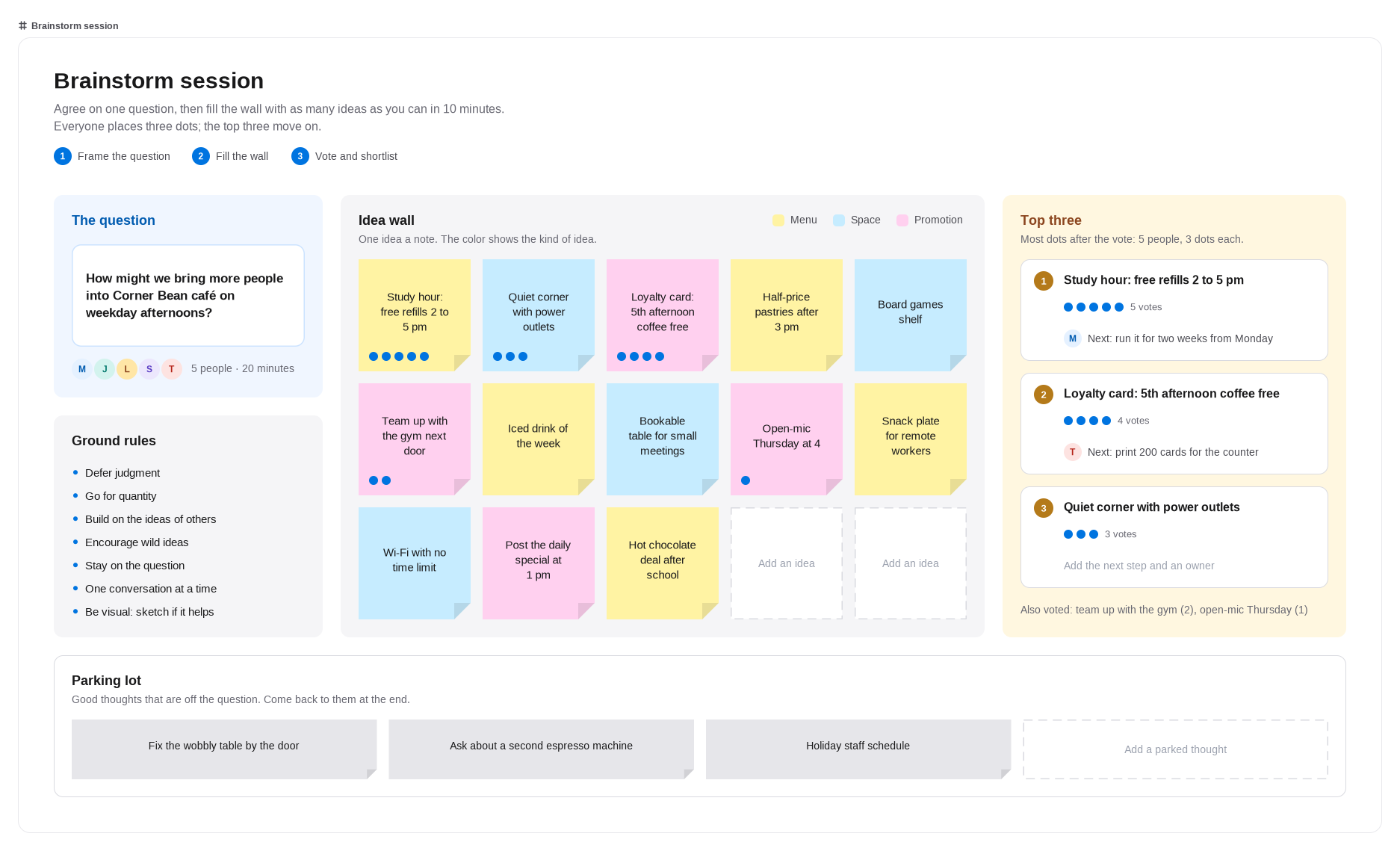
This template holds the whole session on one board: the question, seven ground rules, a wall for ideas, a vote and a parking lot. The example is Corner Bean, a café that wants more customers on weekday afternoons. A team of five ran it in 20 minutes.
Start with one question and seven rules
The card at the top left holds the question, and the question decides how useful the ideas will be. The café wrote: “How might we bring more people into Corner Bean café on weekday afternoons?” It names a place, a time of day and a result, so any idea can be tested against it. A question like “How do we grow?” gives the group nothing to aim at.
Under the question sit the ground rules, in view for the whole session:
- Defer judgment
- Go for quantity
- Build on the ideas of others
- Encourage wild ideas
- Stay on the question
- One conversation at a time
- Be visual: sketch if it helps
When someone starts to pick an idea apart, point at the first rule instead of arguing.
The idea wall
The wall in the middle is a grid of sticky notes, one idea a note. The café filled 13 of them: “Study hour: free refills 2 to 5 pm”, “Board games shelf”, “Team up with the gym next door”, “Hot chocolate deal after school”. Two dashed cards at the end wait for more.
A legend above the wall names three kinds of idea: Menu, Space and Promotion. Coloring notes by kind shows where the group has been thinking and where it has not. If nearly every note is a promotion, ask for five ideas about the space.
Keep each note short enough to read without zooming in. “Quiet corner with power outlets” is an idea. “Improve the atmosphere” is only a wish.
Vote and name the top three
When the time is up, each person places three dots on the ideas they would back. With five people that makes 15 dots. The panel on the right lists the three ideas with the most: the study hour took 5 votes, the loyalty card with a free fifth afternoon coffee took 4, and the quiet corner took 3. A line underneath records what came close: teaming up with the gym got 2 and open-mic Thursday got 1.
Every winner gets a next step and an owner on the spot. The study hour reads “Next: run it for two weeks from Monday”. The loyalty card reads “Next: print 200 cards for the counter”. The third card still says “Add the next step and an owner”, and that is the gap to close before people leave.
Use the parking lot
Thoughts that are good but do not answer the question go in the strip at the bottom. During the café's session someone remembered the wobbly table by the door, someone wanted to ask about a second espresso machine, and the holiday staff schedule came up. None of these brings in afternoon customers, so they were parked and not discussed.
The parking lot keeps the session on its question without telling anyone their point is unwelcome. Read it out at the end and agree who takes each item.
How to run a session with this template
- Open it as a new board. Use this template copies the board, café example included, into your workspace.
- Frame the question. Replace the café's question with yours, write the number of people and minutes under it, and read the ground rules aloud once.
- Fill the wall. Give the group 10 minutes and one idea a note. On the Team plan everyone adds notes at once; with a single editor, one person types while the others call ideas out.
- Vote and shortlist. Three dots each. Copy the three ideas with the most dots into Top three and write a next step and an owner on each.
- Empty the parking lot. Assign or delete every parked thought before you close the board.
Want something on the wall before the group arrives? FlowDraw AI can draft a first board from a description of your question, and the team edits it from there.
When a brainstorm session fits, and when it does not
Use it when the question is open and several answers could be right: a campaign, a feature, a name, a way to fill quiet hours. It works best with three to eight people. Split a larger group in two and compare walls.
It suits loud groups less well, because the fastest talkers fill the wall. For a team like that, brainwriting 6-3-5 has everyone write in silence. If the wall ends with 40 notes, sort them on an affinity diagram, and if three winners are still too many to build, place them on an impact effort matrix.
Questions about the Brainstorm session template
How long should a brainstorm session take?
Twenty to thirty minutes is enough for one question. The café example ran 20 minutes with five people: about 10 for filling the wall and the rest for the vote and the next steps. If you need more ideas, run a second short round on a narrower question.
What makes a good brainstorming question?
It is narrow enough to check an idea against. Name who or what it is about, the situation and the result you want, as the café did with weekday afternoons. Starting with “How might we” keeps it open without making it vague.
Is the brainstorm session template free?
Yes. The board has 114 elements, which fits the 150 a Free board can hold, and the Free plan includes three boards. You can edit every note and export the result as PNG, SVG, PDF or JSON.
What do we do with the ideas that did not win?
Leave them on the wall. The board keeps every note, so a later session can start from them, and the “Also voted” line records the ideas that came close. Only the top three need a next step now.