What is a history timeline?
A history timeline places the events of a period along a line, in the order they happened and spaced by date. It answers the questions a list of dates cannot: what came first, how long the gaps were, and what was happening at the same time. For students it turns a chapter of names into a sequence they can see.
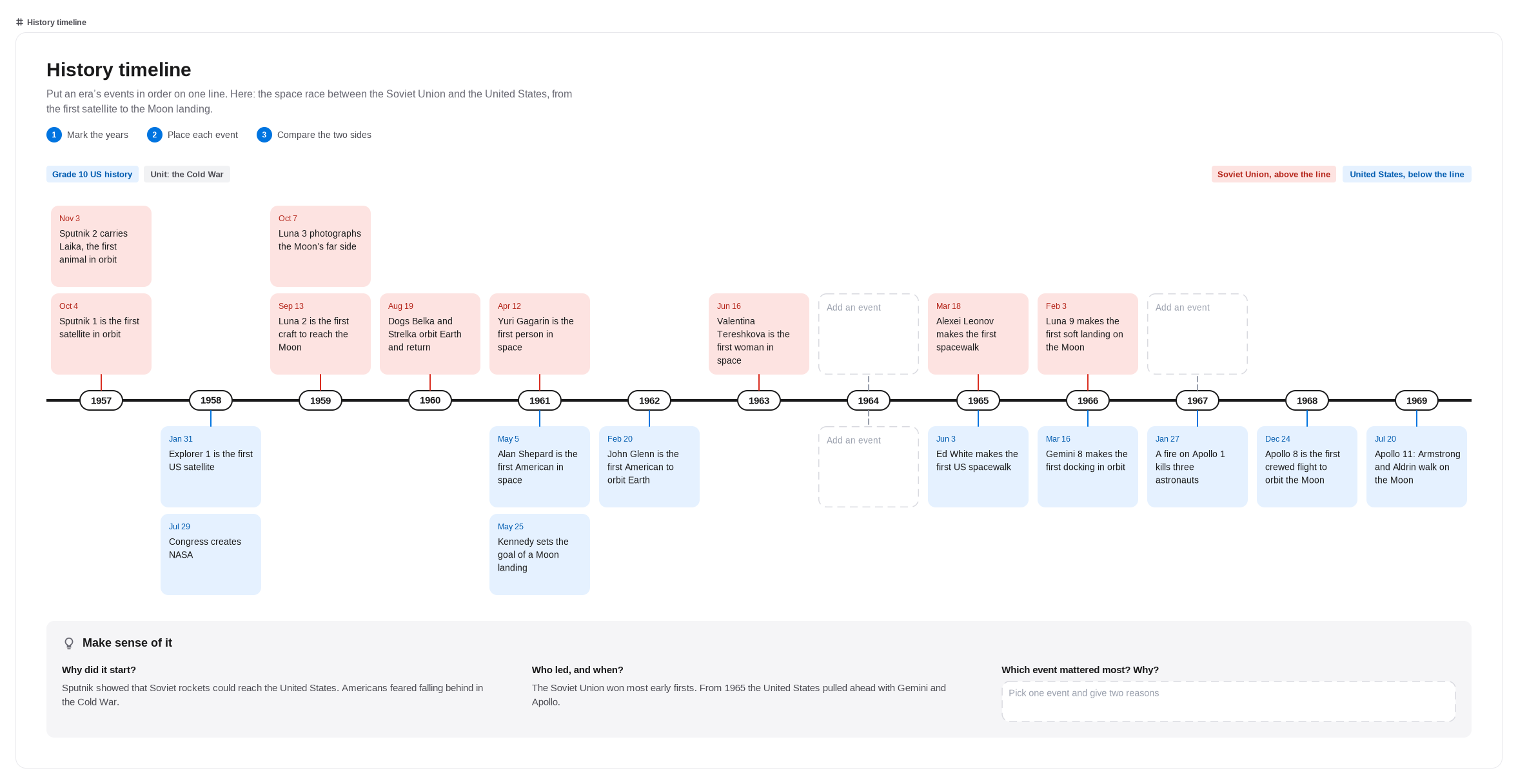
This template is a two-sided timeline. Thirteen year markers, 1957 to 1969, run across the middle of the board. Event cards for one side sit above the line and cards for the other side sit below it. The example comes from a Grade 10 US history unit on the Cold War and follows the space race “from the first satellite to the Moon landing”. A key in the top right corner reads “Soviet Union, above the line” and “United States, below the line”.
Two sides on one line
Each event card is tied to its year marker by a short line, and cards stack when a year has more than one event. Look at the first five years. Above the line, 1957 holds two Soviet cards: “Oct 4, Sputnik 1 is the first satellite in orbit” and “Nov 3, Sputnik 2 carries Laika, the first animal in orbit”. In 1959 there are two more, Luna 2 and Luna 3, and in 1960 the dogs Belka and Strelka orbit Earth and return.
Below the line, the United States has nothing in 1957. Its first cards hang under 1958: “Jan 31, Explorer 1 is the first US satellite” and “Jul 29, Congress creates NASA”.
That empty space is information. A student can see without reading a paragraph that one side started ahead and the other reacted a few months later. A single-row timeline would mix the two countries together and hide it.
Write each event as a date and one fact
Every card follows the same pattern: a short date on top, then one sentence in the present tense that says who did what. The year 1961 shows it well, with three events in about six weeks:
- Apr 12. Yuri Gagarin is the first person in space.
- May 5. Alan Shepard is the first American in space.
- May 25. Kennedy sets the goal of a Moon landing.
The month and day are on the card because the year is already on the line. Each sentence names a first or a decision, which is why the event earned a place. And the third card is not a flight at all: a speech can be a turning point too. Keep cards to ten or twelve words. Detail belongs in the essay the timeline prepares for.
Read the pattern across the line
Step back to the right half of the board and the balance has moved. In 1965 and 1966 both sides still trade firsts: Alexei Leonov makes the first spacewalk on Mar 18 and Ed White makes the first US spacewalk on Jun 3; Luna 9 makes the first soft landing on the Moon and Gemini 8 makes the first docking in orbit. After that the cards above the line stop. Below it they continue: a fire on Apollo 1 kills three astronauts in January 1967, Apollo 8 orbits the Moon on Dec 24, 1968, and on Jul 20, 1969, “Apollo 11: Armstrong and Aldrin walk on the Moon”.
Three cards say “Add an event”: one above and one below 1964, and one above 1967. They mark years the example leaves thin and give students a research task: find what belongs there.
Make sense of it
A timeline shows order. It does not explain anything by itself, so the panel at the bottom asks three questions. Two are answered in the example.
- Why did it start? “Sputnik showed that Soviet rockets could reach the United States. Americans feared falling behind in the Cold War.”
- Who led, and when? “The Soviet Union won most early firsts. From 1965 the United States pulled ahead with Gemini and Apollo.”
- Which event mattered most? Why? Left open, with the prompt “Pick one event and give two reasons”.
The second answer is the one the layout makes possible: it is read straight off the picture of cards above and below the line. The third has no single right answer, which makes it a good closing discussion.
How to use the history timeline template
- Open it as a new board. Rename the two key labels in the top right corner for your two sides, or delete one side for a simple timeline.
- Mark the years. Retype the thirteen markers. They can be decades or centuries; keep the steps even so distance on the line means time.
- Place each event. One card per event, attached to its marker, with the date and one sentence. Stack cards that share a year.
- Compare the two sides. Look for empty stretches, clusters and moments where one side answers the other.
- Answer the questions. Rewrite the three prompts for your era and have students answer the last one alone.
Groups can each research one side and then meet on the same board to compare.
When this timeline fits, and when to pick another
Two sides on one line suit any rivalry or parallel story: two countries in a war, two parties, science and politics in the same century, events in a novel beside events in its author’s life. It also works with one side only.
For a single sequence with no comparison, the general timeline is simpler. To dig into why one event on the line happened and what it led to, move it to a cause and effect map. For people and generations instead of dates, such as a royal house, a family tree is the better picture.
Questions about the History timeline template
How many events should a history timeline have?
Enough to show the shape of the era and no more. The example has 19 events across 13 years. For a class timeline, 10 to 20 is a good range; past that, cards crowd each other and the turning points get lost.
Does the spacing between dates matter?
Yes. Equal distances should stand for equal time, so that a long quiet stretch looks long. The template spaces its year markers evenly for that reason. If you change the scale, change every marker to match.
Can I use it for a timeline with one side only?
Yes. Delete the cards below the line, or use above and below for two kinds of event, such as political events on top and inventions underneath. The year markers and the question panel work the same way.
Is there room to add more events on the Free plan?
Some. The board has 120 elements and a Free board holds up to 150. Each new event adds a few elements, a card, its text and its line, so replace the “Add an event” cards first, then add others.