What is an idea funnel?
An idea funnel is a picture of how a group gets from many ideas to one choice without skipping the middle. It starts wide, with every idea the team can write. Then it narrows in stages: similar ideas are grouped, the strongest are voted on and scored, and one person decides. The shape makes a promise visible. The final decision rests on many options, not on the first good one somebody said out loud.
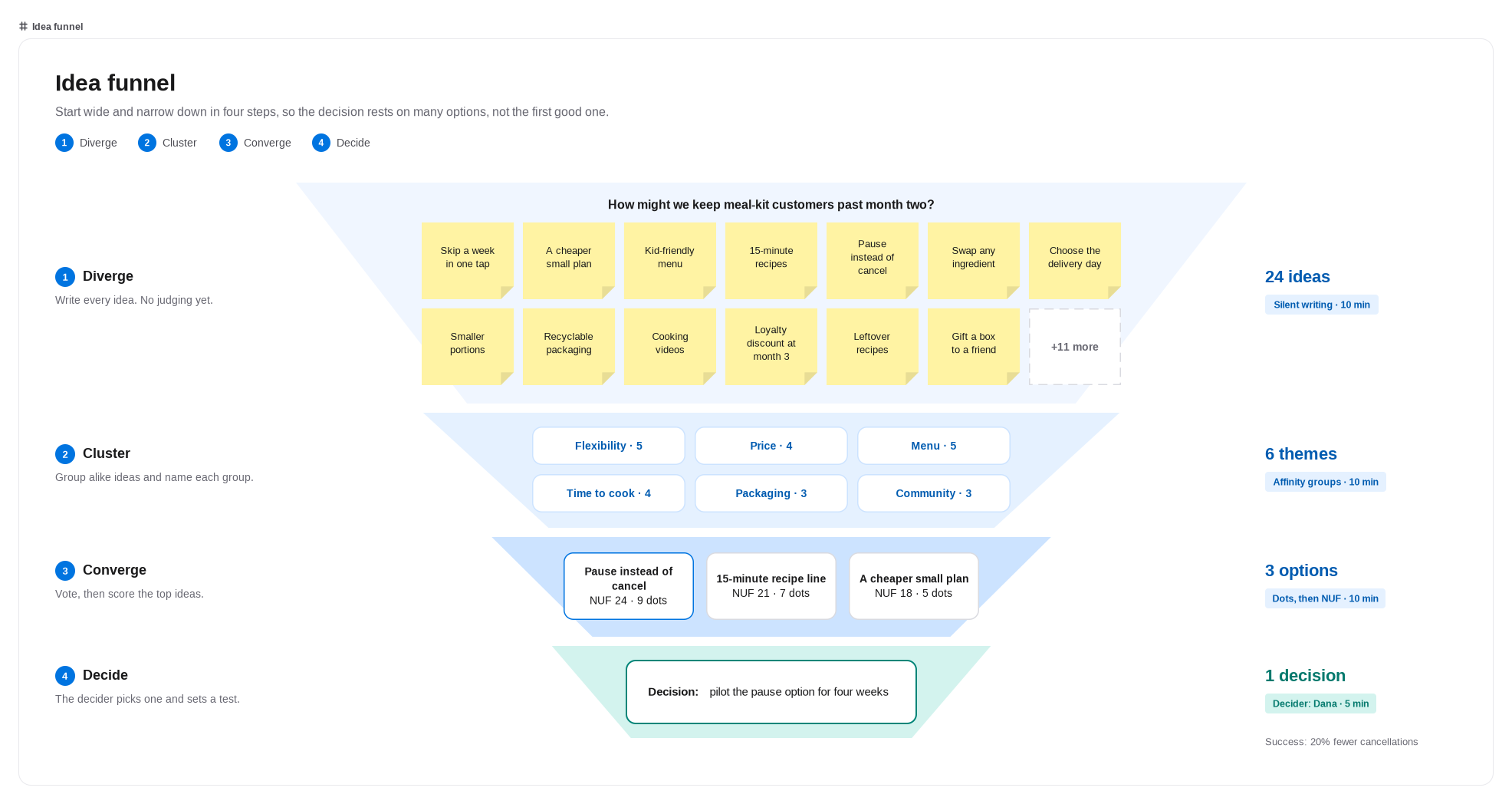
The template draws four bands that get narrower toward the bottom, named Diverge, Cluster, Converge and Decide. Instructions for each step run down the left side and a count runs down the right. The example question is printed at the top of the funnel: “How might we keep meal-kit customers past month two?”
Diverge: fill the wide band
The top band is the widest because it has the easiest rule: write every idea, no judging yet. In the example that took ten minutes of silent writing and produced 24 ideas. Thirteen are shown as notes, and a last card reads “+11 more”.
Look at the range. “Skip a week in one tap” and “Pause instead of cancel” are about flexibility. “A cheaper small plan” and “Loyalty discount at month 3” are about price. “Recyclable packaging”, “Cooking videos” and “Gift a box to a friend” go somewhere else again. Nobody stopped to ask whether an idea was affordable. That question belongs two bands further down.
Keep notes to a few words, as the example does. A note that needs a paragraph is usually two ideas.
Cluster: name the themes
The second band turns a pile of notes into something a group can talk about. Alike ideas are grouped and every group gets a name and a count. The meal-kit team ended with six themes: Flexibility with 5 ideas, Price with 4, Menu with 5, Time to cook with 4, Packaging with 3 and Community with 3. The counts add up to the 24 ideas from the band above, so nothing was quietly dropped.
Clustering does more than tidy. It shows where the team's attention went. Ten of the 24 ideas sit under Flexibility and Menu, which already says something about why customers leave after the second month.
Converge and decide
The third band holds three cards, and each one shows two numbers. “Pause instead of cancel” has NUF 24 and 9 dots. “15-minute recipe line” has NUF 21 and 7 dots. “A cheaper small plan” has NUF 18 and 5 dots. The dots come from a quick vote. The NUF number is a score out of 30 for how new, useful and feasible the idea is. Using both keeps a popular idea from winning if it cannot be built.
The narrowest band has one line: “Decision: pilot the pause option for four weeks”. Beside it the board names the decider, Dana, and the measure of success, 20% fewer cancellations. A funnel that ends in “we liked these three” has not finished. This one ends with a test, a length and a target.
Keep the count beside every step
Down the right edge of the funnel runs a column that is easy to overlook: 24 ideas, 6 themes, 3 options, 1 decision. Next to each number is the method and the time it took: silent writing, affinity groups, dots then NUF, and the decider, with 10, 10, 10 and 5 minutes.
Fill this column in honestly when you run your own session. If the first number is 7, the group did not diverge, and the decision at the bottom is weaker than the tidy shape suggests. If the third number is 6, the group has not converged yet and the decider is being asked to do the team's work.
How to use the idea funnel template
- Open it as a new board and replace the meal-kit question at the top of the funnel with your own.
- Diverge. Clear the notes in the wide band and give everyone ten quiet minutes. Write the total on the right when time is up.
- Cluster. Drag similar notes together, then rename the six chips in the second band after your groups and put the number of ideas on each.
- Converge. Vote, carry the top three into the third band and score each from 1 to 10 on new, useful and feasible.
- Decide. Name the decider before the session starts. That person writes one sentence in the last band, with a time span and a success measure next to it.
For a thin first band, ask FlowDraw AI to add ideas for your question, then treat them like anyone else's notes.
When the funnel fits, and when a single step is enough
Use the whole funnel when one session has to go from a blank page to a decision: a retention problem, a campaign theme, the next feature to test. It gives a facilitator the agenda and gives people who missed the meeting a record of how the choice was made.
Each band is also a technique with a board of its own. If you only need to group research notes, use an affinity diagram. For a vote alone, dot voting is enough. And when the shortlist is long and the scoring deserves a full table, the NUF test has one.
Questions about the Idea funnel template
What do diverge and converge mean?
To diverge is to widen: produce as many different ideas as possible and hold back judgment. To converge is to narrow: compare, vote, score and drop. Mixing the two in the same minute is the usual reason a brainstorm ends with three safe ideas.
How long does an idea funnel session take?
The example ran 35 minutes: ten each for writing, grouping and converging, and five for the decision. With more than eight people or a hard question, plan an hour and give the extra time to clustering, which is where discussion is most useful.
What is the NUF number on the option cards?
It is a score out of 30. Each option is rated from 1 to 10 on three questions: is it new, is it useful, and is it feasible. The three ratings are added. In the example the pause option scored 24, the highest of the three.
Who should be the decider?
The person who will answer for the result, usually whoever owns the budget or the product area. Name them on the board before the session. The group advises through votes and scores, and the decider may still pick the second-ranked option if they explain why.