What is dot voting?
Dot voting is a fast way for a group to choose among many options. Everyone gets the same small number of dots and places them on the options they prefer. Then you count. The options with the most dots win, and nobody has had to argue a case in front of the room.
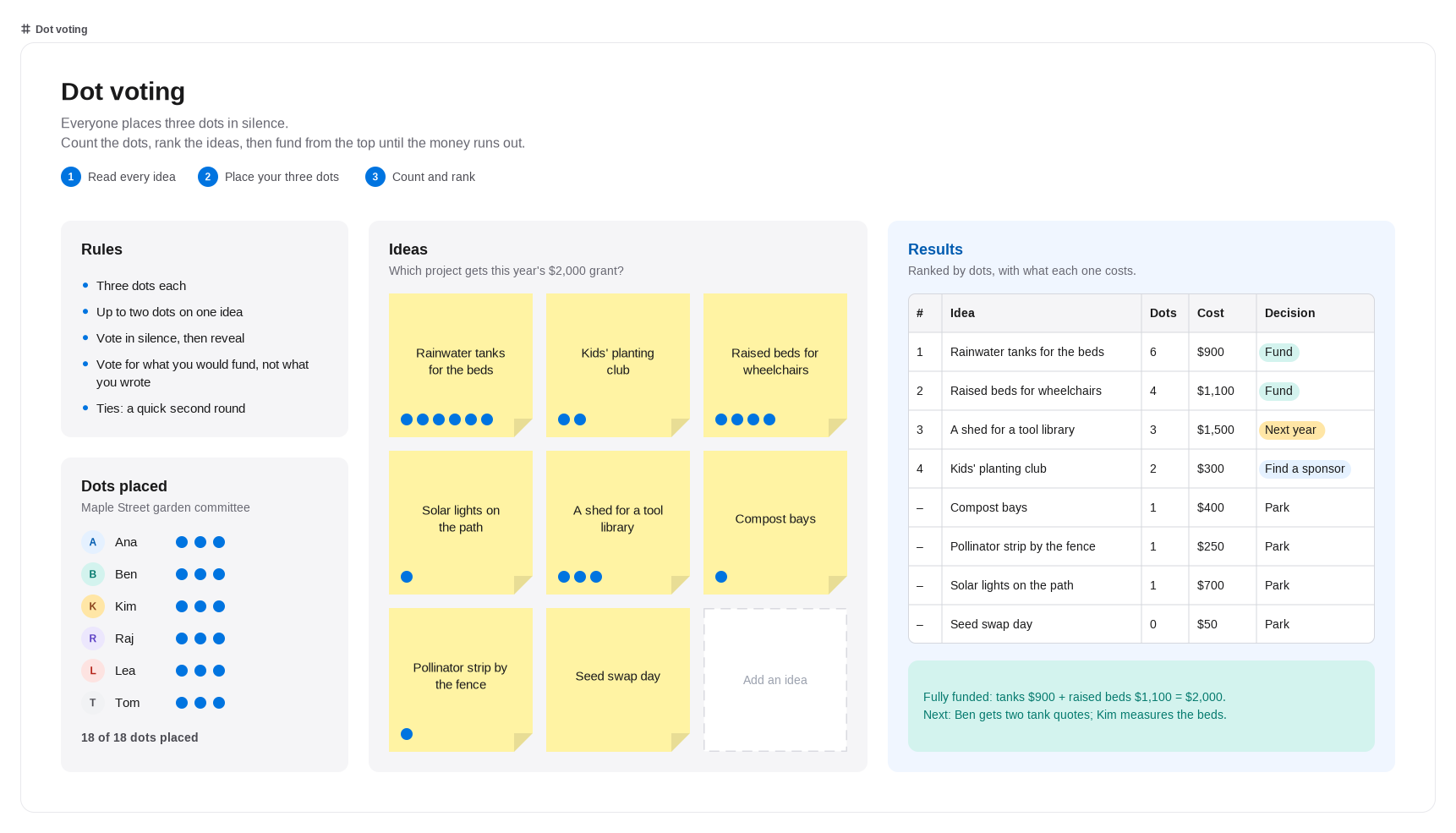
It is also called dotmocracy or multi-voting. This template holds the full round on one board: the rules, the ideas, a tally showing who has voted and a table that ranks the results. In the example, the six members of the Maple Street garden committee decide which project gets this year's $2,000 grant.
Five rules that keep the vote fair
The rules panel is short, and each line prevents a known problem:
- Three dots each. Few enough to force a choice.
- Up to two dots on one idea. You can show a strong preference, but one person cannot carry an idea alone.
- Vote in silence, then reveal. People who see where dots are piling up tend to follow them.
- Vote for what you would fund, not what you wrote. The author of an idea is its least neutral judge.
- Ties: a quick second round. Agreed in advance, so a tie does not become a debate.
Read them aloud before the first dot goes down. Changing a rule after the count looks like changing the result.
The ideas, under one question
A vote needs a question, and the wall states it: “Which project gets this year's $2,000 grant?” Eight ideas sit below it, one a note, each short enough to judge at a glance: rainwater tanks for the beds, a kids' planting club, raised beds for wheelchairs, solar lights on the path, a shed for a tool library, compost bays, a pollinator strip by the fence and a seed swap day.
Before the vote, step one on the board is “Read every idea”. This is the moment to merge duplicates and clear up anything vague. If two notes mean the same thing they will split their dots, and both may lose to a weaker idea.
The dots land along the bottom edge of each note. The tanks note carries six. The seed swap note carries none.
Check that every dot is placed
The tally at the lower left lists the committee by name: Ana, Ben, Kim, Raj, Lea and Tom, each with a row of three dots. Under the list a line confirms the total: “18 of 18 dots placed”.
This small panel answers the two questions that spoil a vote afterwards. Did everyone vote? Did anyone vote twice? Six people with three dots each must make 18. If the notes on the wall add up to 17, someone is still thinking, and you wait.
From a count to a decision
The results table ranks the ideas by dots and adds two columns a plain count lacks: cost and decision.
- Rainwater tanks for the beds: 6 dots, $900. Fund.
- Raised beds for wheelchairs: 4 dots, $1,100. Fund.
- A shed for a tool library: 3 dots, $1,500. Next year.
- Kids' planting club: 2 dots, $300. Find a sponsor.
The four ideas with one dot or none are parked. The board's instruction is to fund from the top until the money runs out, and the summary card shows the sum: tanks $900 plus raised beds $1,100 equals $2,000. The shed came third, but at $1,500 it does not fit, so it waits a year.
The card ends with who does what next: Ben gets two tank quotes and Kim measures the beds.
How to use the dot voting template
- Open it as a new board. Write your own question above the wall and replace the garden ideas with your options.
- Read every idea. Go through the notes once, merge duplicates and reword any that people read differently.
- Place your three dots. List the voters in the tally. Each person drags their dots from their row onto the notes, without talking.
- Count and rank. Enter the totals in the results table from most dots to fewest, add what each option costs, and write a decision in every row.
Voting together on one board needs the Team plan, where several people edit at once. With one editor, collect each person's three choices in turn and place the dots for them.
When dot voting works, and when it misleads
Use it to narrow a long list quickly when the options are roughly comparable: ideas from a brainstorm session, topics for a meeting, features for a release.
It measures preference, not value. An idea can be popular and still cost too much, which is why this template's table includes a cost column. When cost and payoff both matter and differ a lot between options, place the top ideas on an impact effort matrix instead. For a choice between two or three options judged on several criteria, a decision matrix scores them more carefully than dots can.
Questions about the Dot voting template
How many dots should each person get?
A common rule of thumb is about a quarter of the number of options, with three as a practical minimum. The example gives three dots for eight ideas. More dots make the vote kinder to every option and less clear at the top.
Can someone put all their dots on one idea?
Only if your rules allow it. The template caps it at two dots on one idea, so a person can stress a favorite but still has to support a second option. Decide this before voting and keep to it.
What happens when two ideas tie?
Run a second round on the tied ideas only, with one dot each. The rules panel says so up front. If they tie again, the person who owns the budget decides, and the board records that it was a tie.
Is dot voting anonymous?
Not on this board as it stands: each voter has a named row of dots in the tally. Voting in silence and revealing together removes most of the pressure. If people need full anonymity, have one person collect the choices privately and place the dots.