
What is the NUF test?
The NUF test is a quick way to compare ideas after a brainstorm. Every idea gets three scores from 1 to 10: how new it is, how useful it is, and how feasible it is. Add the three and you have a total out of 30. The highest totals go forward.
It takes minutes, and it replaces the usual way of choosing, where the idea with the most confident sponsor wins. The template gives you the challenge, the scoring rules, a table for ten ideas and a panel for the top three. The example comes from the planning team at Westbrook High, which asked: “How might we get more parents to come to conferences?”
Three questions and one scale
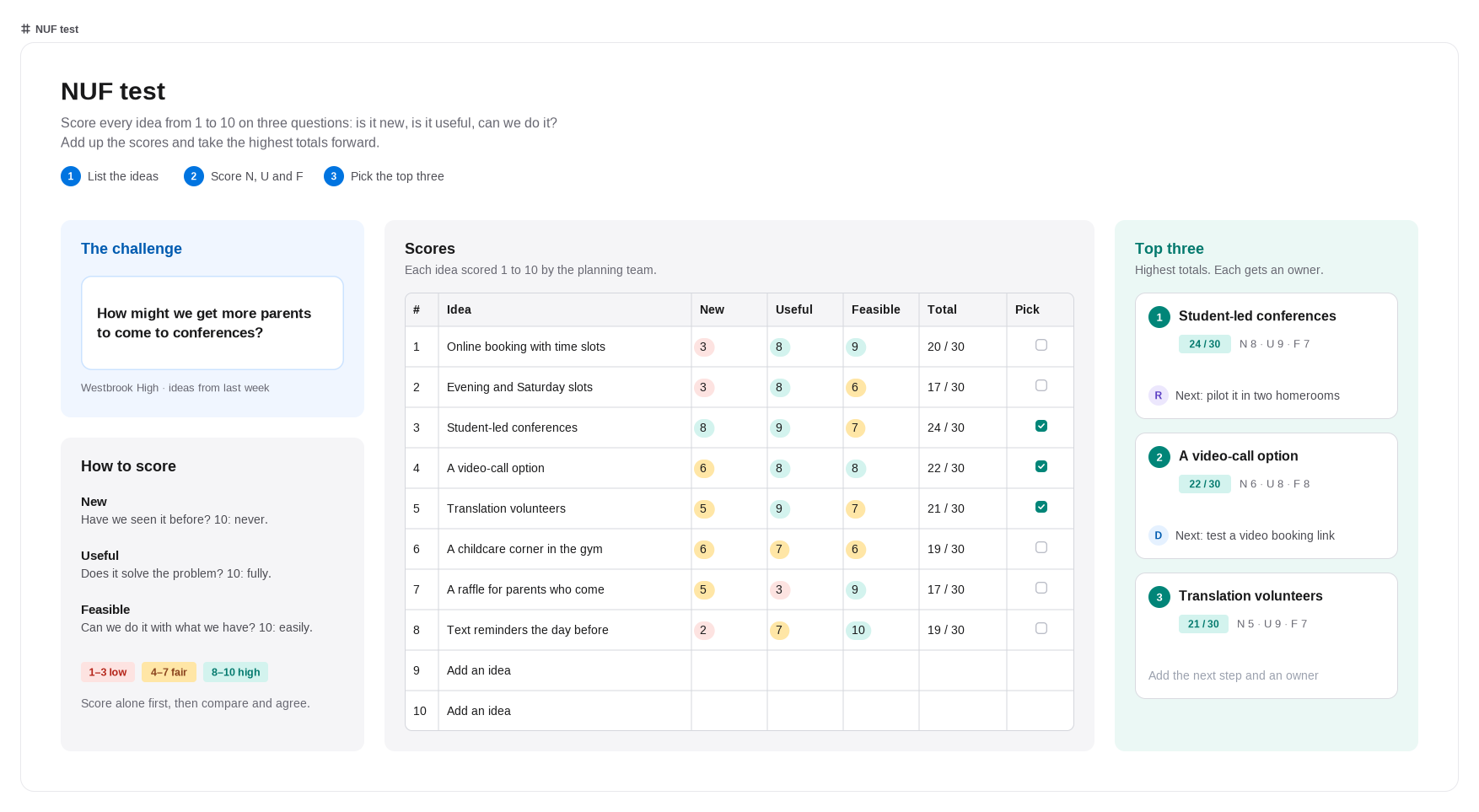
The How to score panel defines each letter as a question and says what a 10 means, so people score the same thing.
- New. Have we seen it before? 10: never.
- Useful. Does it solve the problem? 10: fully.
- Feasible. Can we do it with what we have? 10: easily.
Under the questions is a legend with three bands: 1 to 3 is low, 4 to 7 is fair, 8 to 10 is high. The score cells in the table are tinted by band, which lets you read a row at a glance.
The panel closes with the most important rule: score alone first, then compare and agree. If people call out numbers in turn, the second person adjusts to the first and you learn nothing about where the team disagrees.
The scores table
The table has seven columns: a number, the idea, New, Useful, Feasible, Total and Pick. Eight rows are filled with ideas from the school's brainstorm the week before, and two rows say “Add an idea”.
The totals run from 17 to 24. “Student-led conferences” leads with 24 / 30, “A video-call option” follows with 22 and “Translation volunteers” with 21. Those three rows are the ones marked in the Pick column. Just behind them is “Online booking with time slots” at 20, then “A childcare corner in the gym” and “Text reminders the day before” at 19 each.
Keep idea names short enough to fit on one line, as these are. The table is for comparing, and long descriptions belong on the notes the ideas came from.
Read the three numbers, not only the total
The total ranks the ideas, but the pattern inside a row tells you what kind of idea it is. Compare two rows from the example.
“Text reminders the day before” scores 2 for new, 7 for useful and 10 for feasible. Nothing about it is original and it could be running by Friday. “Student-led conferences” scores 8, 9 and 7: new to the school, aimed straight at the problem, and harder to set up. The first is a quick fix, the second is a change.
Low scores are informative too. “A raffle for parents who come” gets 9 for feasible but only 3 for useful. The team could do it tomorrow and does not believe it would work. Without the split, its total of 17 would look the same as “Evening and Saturday slots”, which scores 8 for useful and loses its points on novelty and effort.
When two people's scores for the same cell differ by four or more, talk about that cell before you average it. They are usually picturing different versions of the idea.
Take the top three forward
The Top three panel copies the winners out of the table and adds what a ranking lacks: someone responsible and a first move. Its subtitle says so: highest totals, each gets an owner.
The first card reads Student-led conferences, 24 / 30, N 8 · U 9 · F 7, with an initial badge and “Next: pilot it in two homerooms”. The second, a video-call option at 22 / 30, has “Next: test a video booking link”. The third, translation volunteers at 21 / 30, still shows the prompt “Add the next step and an owner”. It is a useful reminder that a score is not a commitment until a person takes it.
Both written next steps are small trials, two homerooms and one link, not full rollouts. A high NUF score earns an idea a test.
How to use the NUF test template
- Open it as a new board and put your own challenge in the card at the top left, with a line saying where the ideas came from.
- List the ideas. Type up to ten into the Idea column and clear the old numbers. If you have more than ten, vote first and bring only the leaders.
- Score N, U and F. Everyone writes three numbers per idea on their own. Then go row by row, agree a number for each cell and add the total.
- Pick the top three. Mark the three highest totals, copy them into the cards on the right with their three scores, and write an owner and a next step on each.
Short of ideas to score? FlowDraw AI can suggest some for your challenge, and the table will tell you fast which are worth keeping.
When the NUF test fits, and when to score another way
Use it right after a brainstorm, when there are five to fifteen ideas and the group needs a shortlist in ten minutes. The three questions suit early ideas, where nobody has cost figures yet.
It treats the three scores as equally important and it does not ask about cost or reach. For product backlogs where those matter, RICE scoring is the better table. If you want to see ideas on two axes and talk about where each one sits, use an impact effort matrix. And for a decision between a few options with criteria of your own, a decision matrix lets you set the weights.
Questions about the NUF test template
What does NUF stand for?
New, useful, feasible. New asks whether the idea has been tried before. Useful asks whether it solves the problem in front of you. Feasible asks whether you can do it with the people, money and time you already have.
Should the three scores be weighted?
The standard test adds them equally, which keeps it fast. If novelty does not matter for your problem, as with a safety fix, agree before scoring to count Useful twice or to leave New out. Change the rule before you see the totals, never after.
What if the top ideas have almost the same total?
Look at the three numbers. Prefer the idea with no low score over one that hides a 3 behind two high marks. If they are still close, take both forward to a small test, as the example does with its 22 and its 21.
How many people should score?
Three to eight works well. One scorer gives an opinion, not a test. With a large group, split into pairs that agree a number per cell and then compare pairs, so the discussion stays short and every idea gets more than one view.