What is a research plan?
A research plan is the agreement a team makes before a study starts: what it needs to learn, how it will learn it, from whom, by when, and what it gets at the end. Writing it down first stops the two usual failures, a study that answers a question nobody asked and a study that never ends.
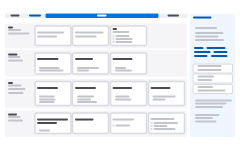
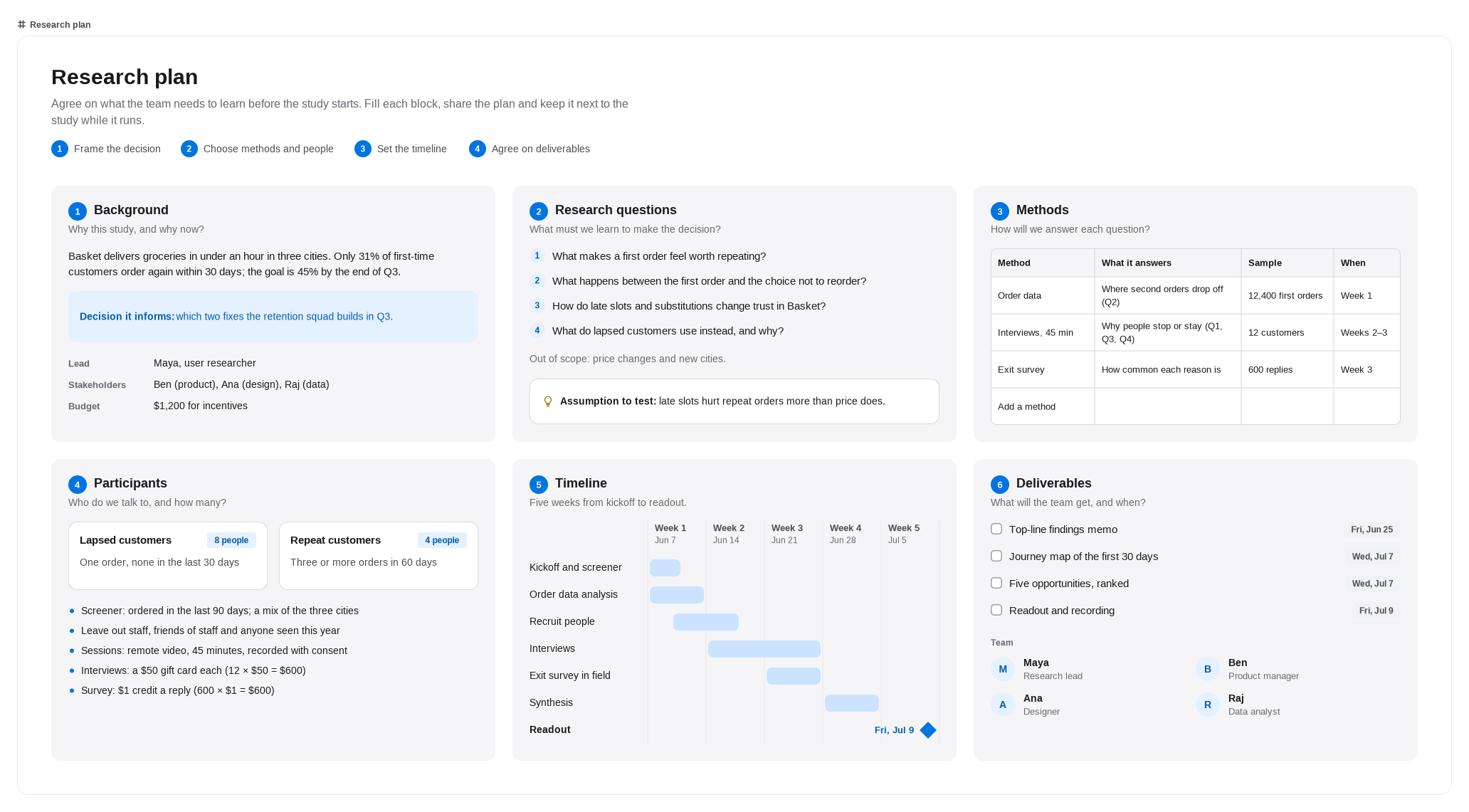
This template puts the whole plan on one board in six numbered blocks. The example is Basket, a company that delivers groceries in under an hour in three cities. Only 31% of its first-time customers order again within 30 days, and the goal is 45% by the end of Q3.
Background and research questions
Block 1, Background, answers “Why this study, and why now?” in two sentences, then names the lead (Maya, user researcher), the stakeholders and the budget of $1,200 for incentives. Its highlighted line matters most: the decision it informs. Here the study decides which two fixes the retention squad builds in Q3.
Block 2 lists four research questions, such as “What happens between the first order and the choice not to reorder?” Under them sit two guards against drift:
- Out of scope: price changes and new cities.
- Assumption to test: late slots hurt repeat orders more than price does.
Match every method to a question
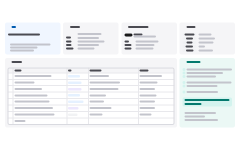
Block 3 is a table with four columns: method, what it answers, sample and when. The example uses three methods, and each one says which question it covers:
- Order data shows where second orders drop off (Q2), from 12,400 first orders, in week 1.
- Interviews, 45 min explain why people stop or stay (Q1, Q3, Q4), with 12 customers in weeks 2 and 3.
- Exit survey measures how common each reason is, with 600 replies in week 3.
If a question has no method beside it, the study will not answer it. If a method has no question, cut it. The last row, “Add a method”, is empty for your own.
Say exactly who takes part
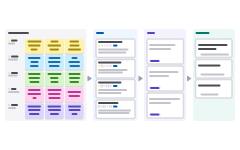
Block 4 turns “talk to some customers” into numbers. Two cards define the groups: 8 lapsed customers (one order, none in the last 30 days) and 4 repeat customers (three or more orders in 60 days). Together they make the 12 interviews in the methods table.
The list under the cards holds the screener, who to leave out (staff, friends of staff and anyone seen this year), the session format and the incentives. The sums are written out, 12 × $50 and 600 × $1, so anyone can see how the $1,200 budget is spent.
Timeline and deliverables
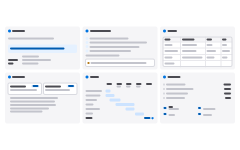
Block 5 is a small bar chart of five weeks, from kickoff on June 7 to the readout on Friday, July 9. Seven rows show the work: kickoff and screener, order data analysis, recruiting, interviews, the exit survey in the field, synthesis and the readout. Bars overlap where work runs in parallel, so recruiting starts before the order data is finished.
Block 6 lists what the team receives and on which day: a top-line findings memo on June 25, a journey map of the first 30 days and five ranked opportunities on July 7, then the readout and its recording. The four people on the study are named at the bottom with their roles.
How to use the research plan template
- Open it as a new board. Use this template copies the board into your workspace with the Basket example in place.
- Frame the decision. Rewrite the background and the “Decision it informs” line before anything else. If you cannot name a decision, the study is not ready.
- Choose methods and people. Write three to five questions, then fill one table row per method and set the group sizes in block 4.
- Set the timeline. Rename the week labels, then drag and stretch the bars to your dates.
- Agree on deliverables. Put a date beside each one and share the board with stakeholders for comments before recruiting starts.
The plan should stay beside the study while it runs. For more boards of this kind, see research and analysis in FlowDraw.
When a research plan helps, and what to use next
Write one for any study that takes more than a few days or needs other people’s time or money: discovery interviews, a usability round, a survey. For a single quick test, the first two blocks alone may be enough.
The plan covers the whole study, so each method needs its own detail. Prepare the conversations with an interview guide, design the questionnaire on a survey plan, and once the sessions are done, group what you heard with interview synthesis.
Questions about the Research plan template
How long should a research plan be?
One page that a stakeholder can read in five minutes. The six blocks on this board are enough for most studies. If a block overflows, the study is probably two studies, and splitting it is better than shrinking the text.
How many research questions should a plan have?
Three to five. The example has four, and all of them serve one decision. More than five usually means the scope has grown past what the timeline and budget can answer, so move the extras to the out-of-scope line.
What is the difference between a research question and an interview question?
A research question is what the team needs to learn, such as what makes a first order feel worth repeating. An interview question is what you say to a participant to find out. The plan holds the first kind, and a discussion guide holds the second.
Is the research plan template free?
Yes. Its 133 elements fit a Free board, and the Free plan covers three boards. Every block, table row and bar can be edited, and the finished plan exports as PNG, SVG or PDF.