What is jobs to be done?
Jobs to be done is a way of studying customers by the task they are trying to accomplish instead of by who they are. The idea is that people “hire” a product to get a job done, and they switch when another option does it better. If you understand the job in detail, you can see where today’s solutions fall short.
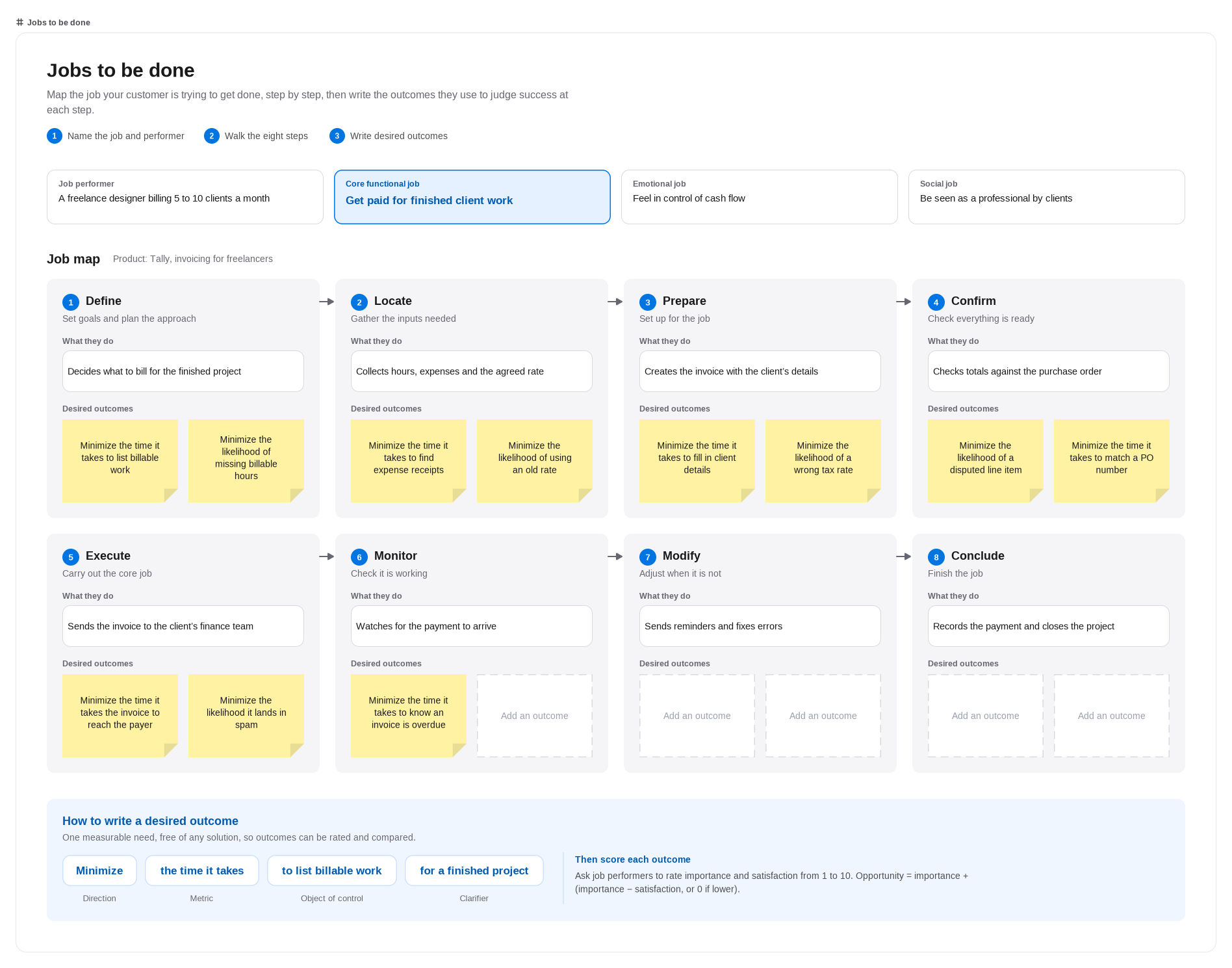
This template turns that idea into a working board. Four cards at the top name the job performer and three kinds of job. Below them, a job map breaks the main job into eight steps, each with the outcomes the customer wants. A panel at the bottom shows how to word an outcome and how to score it. The example product is an invoicing tool for freelancers.
The performer and the three jobs
The first card names the job performer: a freelance designer billing 5 to 10 clients a month. Be that precise. An agency with a finance department does the same job in a completely different way.
The next three cards separate what the performer wants.
- Core functional job: get paid for finished client work. This is the task itself, stated without any product in it.
- Emotional job: feel in control of cash flow. This is how the performer wants to feel while doing it.
- Social job: be seen as a professional by clients. This is how they want others to see them.
The job map that follows covers the functional job only. The first row holds steps 1 to 4: Define, Locate, Prepare and Confirm.
Eight steps that fit any job
Every job, whatever the field, can be walked through the same eight stages. The board prints a short hint under each stage name, then asks “What they do” for this particular job.
- Define, Locate, Prepare, Confirm: the designer decides what to bill, collects hours, expenses and the agreed rate, creates the invoice, and checks totals against the purchase order.
- Execute: sends the invoice to the client’s finance team. This is the step most products focus on.
- Monitor, Modify, Conclude: watches for the payment to arrive, sends reminders and fixes errors, then records the payment and closes the project.
Only one of the eight is the act of sending an invoice. The steps before and after it are where an invoicing tool can find room to be better.
Desired outcomes under each step
Under every step are sticky notes headed Desired outcomes. An outcome is how the performer measures whether the step went well. Look at step 1, Define: “Minimize the time it takes to list billable work” and “Minimize the likelihood of missing billable hours”. Step 2, Locate, has “Minimize the time it takes to find expense receipts” and “Minimize the likelihood of using an old rate”.
Two things stand out. None of them mentions a feature, so each stays true whatever tool the designer uses. And each can be measured, in minutes or in how often something goes wrong. Compare that with a note like “easy invoicing”, which nobody can rate or build toward.
Write the outcome, then score it
The bottom panel spells out the format. An outcome statement has four parts, shown as four chips: a direction (“Minimize”), a metric (“the time it takes”), an object of control (“to list billable work”) and a clarifier (“for a finished project”). This wording follows the outcome-driven approach associated with Tony Ulwick. Keeping to it makes outcomes comparable with each other.
Beside the chips is the scoring rule. Ask job performers to rate each outcome for importance and for satisfaction, from 1 to 10. The opportunity score is importance plus the gap between importance and satisfaction, where a negative gap counts as zero. An outcome that is very important and poorly satisfied rises to the top, and that is where to aim a product.
How to use the jobs to be done template
- Open it as a new board. Use this template copies the invoicing example into your workspace.
- Name the job and performer. Rewrite the four cards. Test the functional job by asking whether it would still be true if your product did not exist.
- Walk the eight steps. Interview people who do the job and fill the “What they do” line of each step in their words.
- Write desired outcomes. Add two or three per step in the four-part format. The dashed “Add an outcome” cards in steps 6 to 8 are waiting.
- Score and choose. Collect ratings, compute the opportunity scores and mark the highest ones on the board.
Outcomes scored this way can go straight into an opportunity solution tree as the opportunities to explore.
When to map a job, and when another template fits
Use this board when you enter a market, when feature requests pile up with no way to rank them, or when a product is good at one step and you are looking for the next one to serve.
It studies a task, not a person. If the team needs a face and a context to design for, add a user persona. To check how your current offer answers pains and gains, use the value proposition canvas. And when the question is how the experience feels over time, map it as a user journey map.
Questions about the Jobs to be done template
What is a job map?
A job map is the functional job broken into the stages every job passes through: define, locate, prepare, confirm, execute, monitor, modify and conclude. It describes what the customer is trying to get done at each stage, not what they click, so it stays valid when tools change.
How do I write a good desired outcome statement?
Use four parts: a direction, a metric, an object of control and a clarifier. For example: minimize the time it takes to list billable work for a finished project. Leave out any solution, and use time or likelihood as the metric so that people can rate it.
What is the difference between a functional, an emotional and a social job?
The functional job is the practical task, such as getting paid for finished work. The emotional job is how the person wants to feel while doing it, such as in control of cash flow. The social job is how they want to be perceived, such as professional in the eyes of clients.
How many customers do I need to interview?
Enough that new interviews stop adding steps or outcomes to the map. A narrow job with one kind of performer settles sooner than a broad one. Scoring is different: importance and satisfaction ratings need a larger group, usually gathered with a survey, before the opportunity scores mean much.