What is the Kano model?
The Kano model, named after Professor Noriaki Kano, sorts features by how they change customer satisfaction. Some features are expected and only cause anger when missing. Some satisfy in proportion to how well they are done. Some delight because nobody asked for them. Knowing which is which tells a team where extra effort pays and where it is wasted.
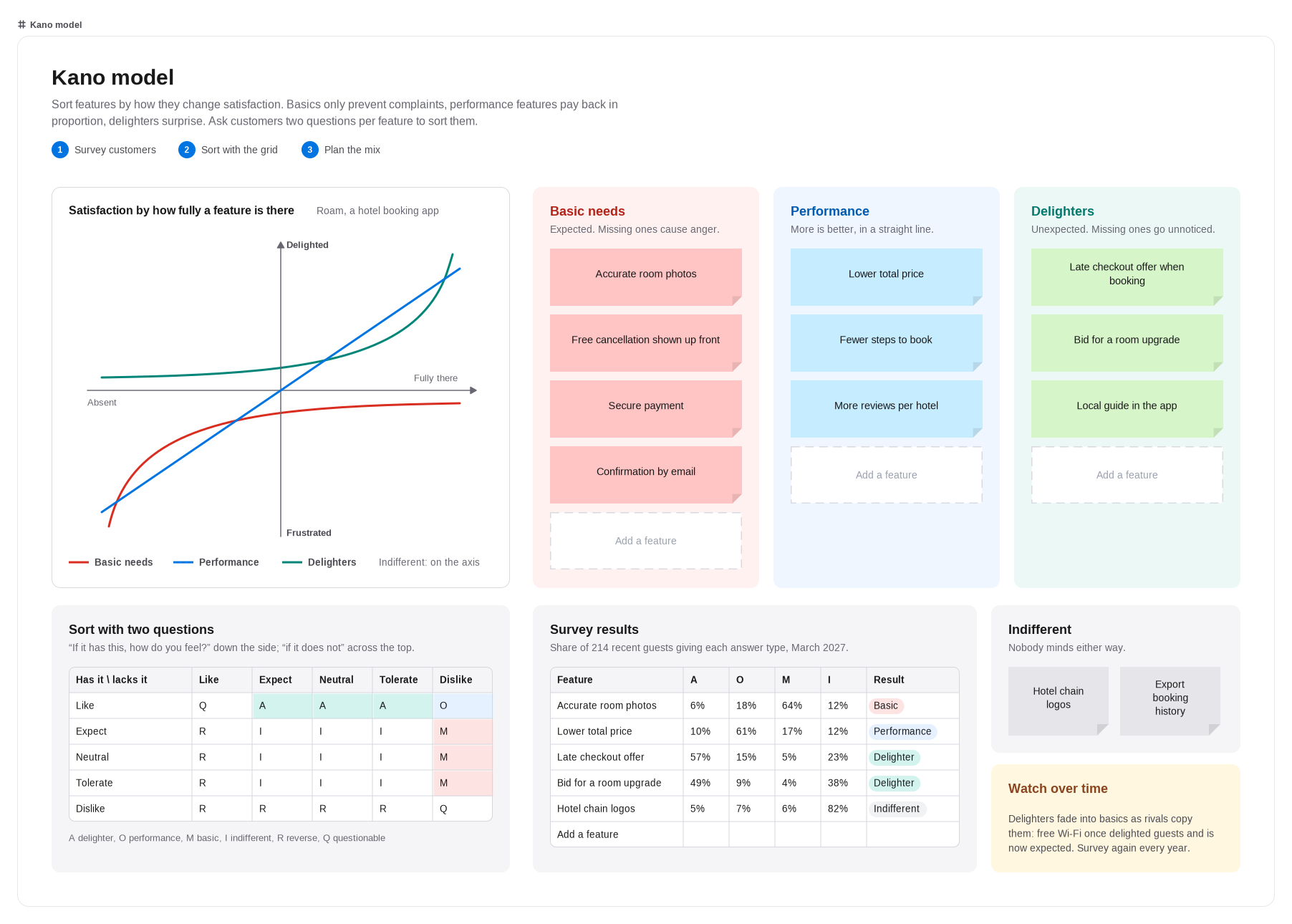
This template holds the full method on one board. The top half shows the graph and three columns of sorted features for a hotel booking app. The bottom half shows the survey grid and the results that justify the sorting.
The satisfaction graph
The graph plots satisfaction against how fully a feature is there. The horizontal axis runs from Absent to Fully there, the vertical one from Frustrated to Delighted. Three lines cross it, with a key below.
- Basic needs follow the lower curve. Doing them fully only brings people up to neutral.
- Performance is the straight diagonal. More is better at a steady rate.
- Delighters follow the upper curve. Leaving them out costs nothing, and adding them lifts satisfaction fast.
A fourth kind, indifferent, lies flat on the axis: present or not, the customer feels the same.
Three columns of features
Next to the graph, the features of the booking app are sorted into three columns, each with a one-line reminder under its title.
Basic needs are expected, and missing ones cause anger: accurate room photos, free cancellation shown up front, secure payment, confirmation by email. Performance features get better in a straight line: a lower total price, fewer steps to book, more reviews per hotel. Delighters are unexpected, and missing ones go unnoticed: a late checkout offer when booking, bidding for a room upgrade, a local guide in the app.
Each column ends with a dashed “Add a feature” card.
Sort with two questions
You do not sort by opinion. For each feature, a Kano survey asks two questions: “If it has this, how do you feel?” and the same for when it does not. The answers are Like, Expect, Neutral, Tolerate and Dislike.
The grid turns each pair of answers into a letter. Find the “has it” answer down the side and the “lacks it” answer across the top. Like with Dislike gives O, performance. Expect with Dislike gives M, basic. Like with Neutral gives A, a delighter. The key under the grid also lists I for indifferent, R for reverse and Q for questionable, which is what two contradictory answers produce.
Read the survey results
The results table shows the share of 214 recent guests who gave each answer type in March 2027. A feature takes the category with the largest share. “Accurate room photos” is basic at 64% M. “Lower total price” is performance at 61% O. “Late checkout offer” is a delighter at 57% A.
Watch the close calls. “Bid for a room upgrade” is a delighter at 49%, but 38% of guests are indifferent, so it will not please everyone. “Hotel chain logos” scores 82% indifferent and lands in the Indifferent box with “Export booking history”. The note under that box warns that delighters fade into basics as rivals copy them, and advises a new survey every year.
How to use the Kano model template
- Create a board from it. Use this template gives you the booking example as an editable copy.
- Survey customers. Pick 10 to 20 features and ask both questions about each one. Recent customers give the most reliable answers.
- Sort with the grid. Convert every answer pair to a letter, count the shares per feature and fill in the results table.
- Plan the mix. Move each feature note to its column. Cover every basic need first, then choose the performance features to compete on and one or two delighters.
When the Kano model helps, and what comes after
Use it when a team disagrees about what customers value, or before a release where you can afford only a few extras. It is strongest with survey answers behind it. A workshop sort without data is a start, and you should label it as a guess.
The model tells you what kind of feature you have, not what it costs. To weigh value against work, follow it with RICE scoring. To fit the result into a dated release, use MoSCoW prioritization. If you are still learning who the customer is, a user persona comes first.
Questions about the Kano model template
What are the categories in the Kano model?
The three main ones are basic needs, performance features and delighters. A survey can also return indifferent, where customers do not care either way, reverse, where they prefer the feature absent, and questionable, where the two answers contradict each other.
How many people should answer a Kano survey?
Enough for the shares to be stable. The example on the board uses 214 recent guests. A few dozen answers already show the clear cases, but close calls between two categories need a larger group before you trust them.
Why do delighters turn into basic needs?
Because expectations rise. Once competitors copy a pleasant surprise, customers start to assume it. The board’s own example is free Wi-Fi in hotels, which once delighted guests and is now expected. Repeating the survey each year catches the shift.
Do I need a survey to use the template?
The survey gives the sorting its evidence, but you can begin without one. Sort the features with your team as a first guess, mark the board as unverified, and replace the results table when real answers come in.