What is a literature review matrix?
A literature review reports what published research says about a question, where the studies agree and where they leave holes. The hard part is synthesis: comparing sources with each other, not summarizing them one after another.
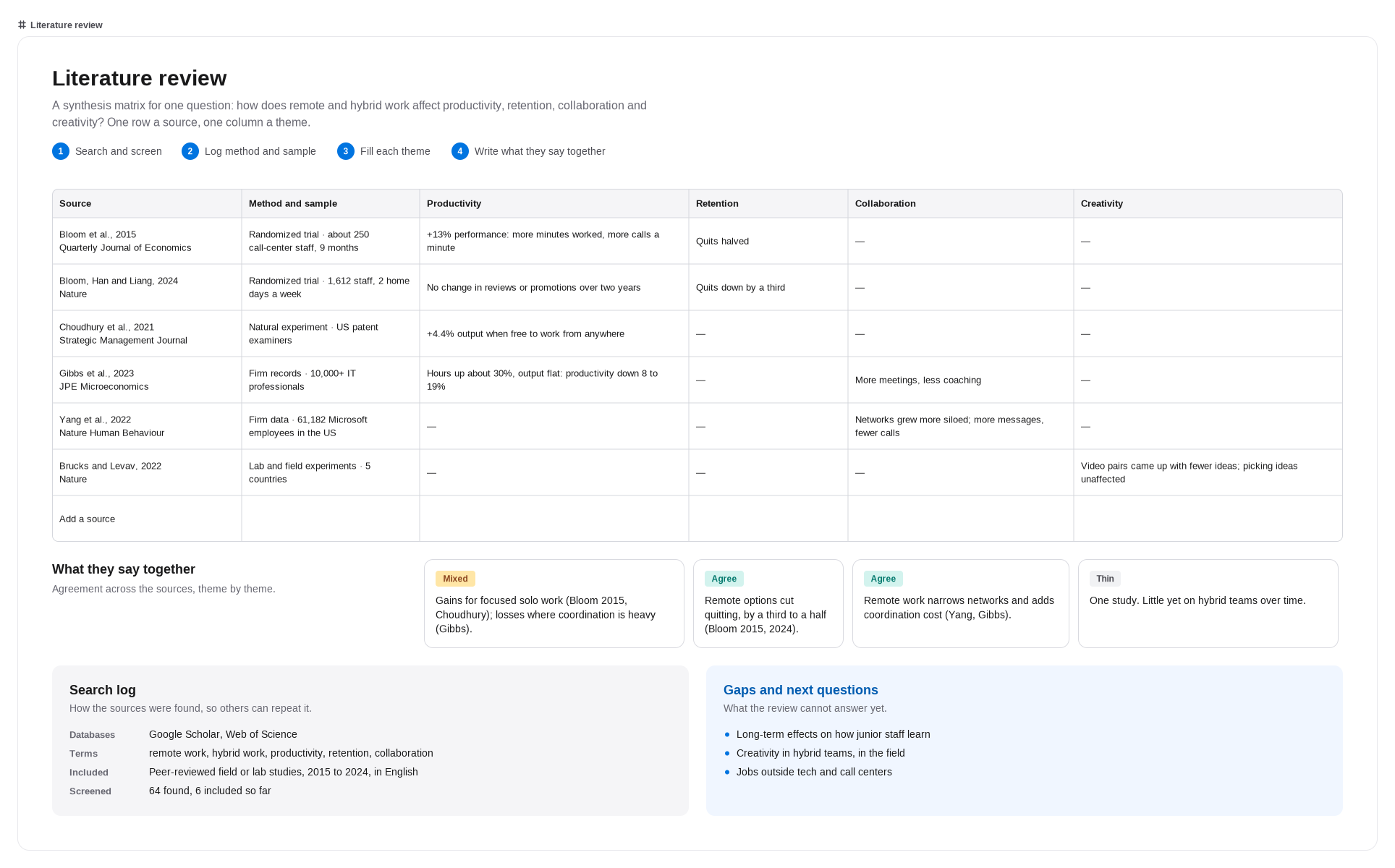
A synthesis matrix makes that comparison mechanical. Sources go down the side, themes go across the top, and each cell holds what one source found about one theme. This template is such a matrix for a single question: how does remote and hybrid work affect productivity, retention, collaboration and creativity? Below the table are a synthesis row, a search log and a list of gaps.
One row for each source
The first two columns identify the study. “Source” gives authors, year and journal. “Method and sample” says how the finding was produced, because that decides how much weight it can bear.
The example’s first row is Bloom et al., 2015: a randomized trial with about 250 call-center staff over 9 months. The fourth is Gibbs et al., 2023: firm records for more than 10,000 IT professionals. A trial and a set of company records are not equal evidence, and with the method beside every finding you never have to look that up twice.
The last row reads “Add a source”, ready for the next paper.
One column for each theme
The remaining columns are the themes of your question. Write one short finding in a cell, with the number if there is one. Under Productivity, the 2015 trial reports “+13% performance: more minutes worked, more calls a minute”, while the 2023 study reports hours up about 30% with output flat. Under Retention, two rows agree: quits halved in one, down by a third in the other.
Cells with nothing to say hold a dash. Do not delete them. A column of dashes is a finding in itself: in the example only one source, Brucks and Levav, 2022, says anything about Creativity.
What they say together
The row of cards under the table is the synthesis itself. Each card sits under its column and starts with a one-word verdict:
- Productivity: Mixed. Gains for focused solo work, losses where coordination is heavy.
- Retention: Agree. Remote options cut quitting, by a third to a half.
- Collaboration: Agree. Remote work narrows networks and adds coordination cost.
- Creativity: Thin. One study, and little yet on hybrid teams over time.
Three of the cards cite the rows they rest on by author. These four sentences are close to the topic sentences of the review you will write.
Keep a search log
The Search log panel records how the sources were found, “so others can repeat it”. It has four lines: the databases searched, the search terms (remote work, hybrid work, productivity, retention, collaboration), the inclusion rule (peer-reviewed field or lab studies, 2015 to 2024, in English) and the screening count: 64 found, 6 included so far.
Fill this in while you search, not afterwards. A supervisor or reviewer will ask why a well-known paper is missing, and the inclusion rule is your answer.
Gaps and next questions
The final panel lists what the review cannot answer yet. The example names three gaps: long-term effects on how junior staff learn, creativity in hybrid teams in the field, and jobs outside tech and call centers.
Each gap comes straight from the matrix. The third one, for instance, follows from the Method and sample column, where the samples are call-center staff, patent examiners and IT professionals. A gap you can point to in the table is a research question you can defend.
How to use the literature review template
- Open the template and replace the question. Rewrite the line under the title and rename the four theme columns to fit your topic.
- Search and screen. Run your searches, note databases, terms and counts in the search log, and keep only sources that meet your inclusion rule.
- Log method and sample. Add a row for each source with its design and sample size before you read for findings.
- Fill each theme. Enter one finding in a cell, or a dash when the source is silent.
- Write what they say together. Give each column a verdict card, then list the gaps.
The whole board has 46 elements, so a Free board leaves plenty of room for more rows.
When a matrix helps, and what to pair it with
Use the matrix for a thesis chapter, a research proposal, or a team decision that should rest on evidence. It pays off from about five sources upward, when you can no longer hold the comparisons in your head.
To plan a study that fills one of the gaps, move to a research plan. To show how the ideas in the literature relate, draw a concept map. When it is time to write, turn the verdict cards into sections with an essay outline.
Questions about the Literature review template
What is a synthesis matrix?
A table with sources as rows and themes as columns. Each cell records what one source says about one theme. Reading across a row summarizes a source; reading down a column compares all sources on one theme, which is the comparison a literature review needs.
How do you choose the themes?
Start from the parts of your research question. The example’s question names four outcomes of remote work, and those became the four columns. Add a theme when several sources discuss something your columns miss, and drop one that stays empty after a full search.
How is a literature review different from an annotated bibliography?
An annotated bibliography describes sources one at a time. A literature review is organized by theme and says what the sources show together: where they agree, where they conflict and what nobody has studied. The verdict cards on the template are that step.
How many sources does a literature review need?
It depends on the field and the purpose, so ask your supervisor or editor. What matters more is that the search is documented and the inclusion rule is applied evenly. The example has screened 64 papers and included 6 so far.