What is a concept map?
A concept map shows how ideas relate. Each idea goes in a box, and each arrow between two boxes carries a short linking phrase. Box, phrase, box: together they form a statement you can read aloud and check. The method comes from Joseph Novak’s work on how students learn science.
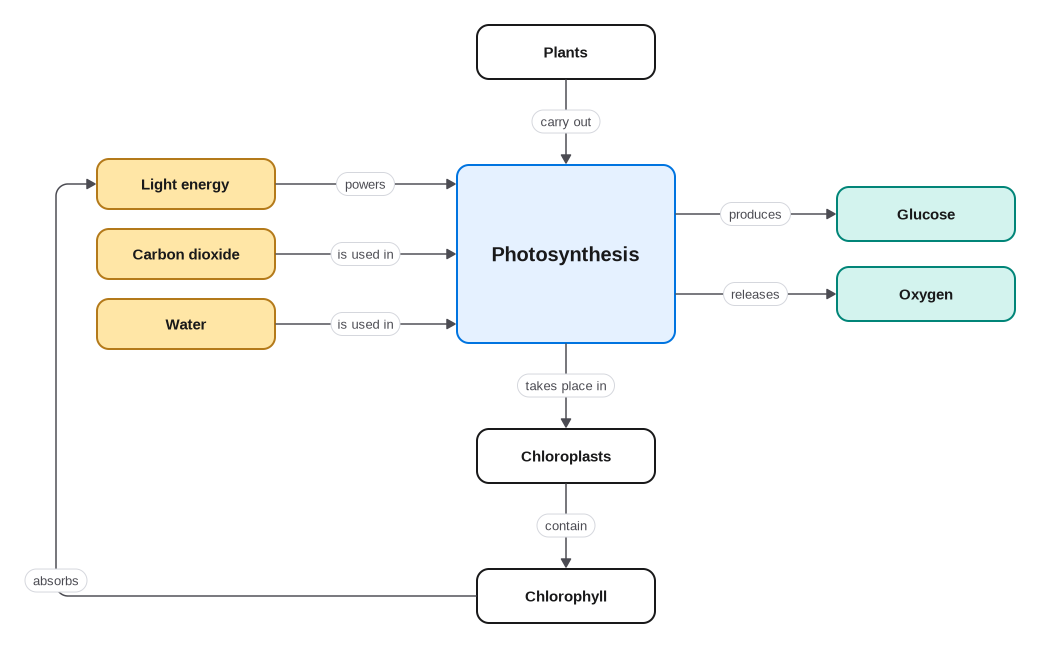
The template maps photosynthesis. Nine concepts, from Plants at the top to Chlorophyll at the bottom, are joined by nine labeled arrows. The first one reads: Plants carry out Photosynthesis.
Concepts and linking phrases
A concept is a noun or a short noun phrase: Plants, Photosynthesis, Light energy. Keep each one to a few words. If a box needs a sentence, it is hiding two concepts and the link between them.
The linking phrase is where the thinking shows. “Plants carry out Photosynthesis” says something precise. An arrow with no label, or one that just says “relates to”, says nothing a reader can test. Arrows also have a direction. Read from the tail to the head, and the statement comes out the right way round.
Each arrow is a statement you can check
Three boxes on the left feed the center. Light energy powers Photosynthesis. Carbon dioxide is used in Photosynthesis. Water is used in Photosynthesis. On the right, two arrows leave: Photosynthesis produces Glucose and releases Oxygen.
Look at the verbs. Light energy gets a different phrase from the two materials, because it does a different job. Glucose is produced and Oxygen is released, which hints at which one the plant keeps. Choosing the exact verb is the work of concept mapping. If you cannot find one, you have found a gap in what you know about the topic.
Add a cross-link
Follow the map down from the center: Photosynthesis takes place in Chloroplasts, and Chloroplasts contain Chlorophyll. A tree would stop there. This map has one more arrow. It leaves Chlorophyll, runs around the left side and arrives at Light energy with the label absorbs.
That arrow is a cross-link: a connection between two parts of the map that sit far apart. It ties the bottom of the map to the top of the input column and explains why chlorophyll matters at all. Cross-links are what separate a concept map from an outline. After the first pass on your own map, look for one pair of distant boxes that belong in the same sentence.
How to use the concept map template
- Open it as a new board. Use this template gives you the photosynthesis map to edit in your workspace.
- Write a focus question. Decide what the map should answer, such as “How do plants make food?”, and put the main concept in the large center box in place of Photosynthesis.
- List the concepts before you connect them. Rename the eight outer boxes with the ideas that matter most. Ten to twenty concepts is enough for one map.
- Label every arrow with a verb phrase. Replace powers, produces and contain with phrases that make true statements for your topic. Read each one aloud.
- Hunt for cross-links. Draw at least one arrow between boxes in different branches, the way absorbs joins Chlorophyll to Light energy.
The guide how to make a concept map shows the method on a second example.
Concept map or mind map?
Use a concept map to study a subject, plan a lesson, explain a system to a new colleague or check your own understanding. It is the right tool when the relationships are the content.
A mind map is faster when you only want to collect ideas around one topic, since its branches need no labels. A tree diagram fits a strict hierarchy where each item has one parent. And when the links are all causes of one problem, a fishbone diagram arranges them more clearly.
Questions about the Concept map template
What is the difference between a concept map and a mind map?
A mind map grows outward from one central topic, and its branches are unlabeled. A concept map can have several main ideas, labels every arrow with a linking phrase, and allows cross-links between distant parts. A mind map collects ideas. A concept map states how they are related.
What makes a good linking phrase?
A short verb or verb phrase that turns two concepts into a true sentence: produces, is used in, takes place in. Avoid phrases that fit anywhere, such as “is related to”. If the same phrase appears on most of your arrows, the map is not yet saying much.
How many concepts should a concept map have?
Between ten and twenty-five for most topics. The template has nine, which is enough to show the pattern. Start with the ones you could not explain the topic without, and add more only when they bring a new statement with them.
Can students use this template for free?
Yes. The concept map opens on the Free plan, which includes three boards. A student can edit the map, and a teacher or classmate with the link can view it and leave comments on any box.