What is a PESTLE analysis?
A PESTLE analysis scans the world outside a business for forces it cannot control: political, economic, social, technological, legal and environmental. It is a way to make sure a plan has been tested against all six before money is spent on it.
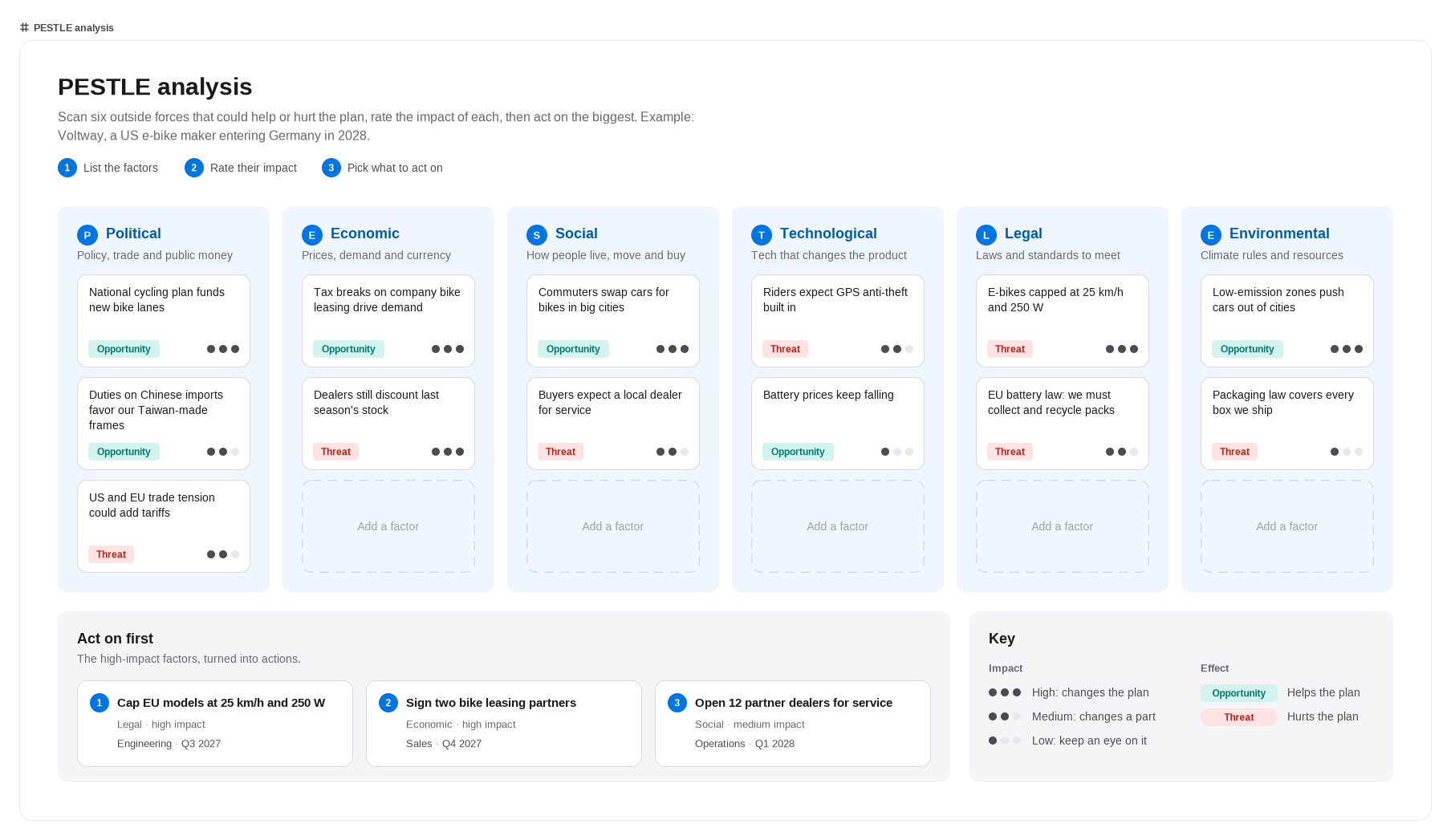
This template gives each force a column of factor cards, then adds a row for the actions that follow and a key. The example is Voltway, a US e-bike maker preparing to enter Germany in 2028. Every card is tagged as an opportunity or a threat and rated for impact.
Six columns of outside forces
Each column has a letter, a title and a one-line reminder of what belongs there:
- Political: policy, trade and public money. “National cycling plan funds new bike lanes”.
- Economic: prices, demand and currency. “Dealers still discount last season’s stock”.
- Social: how people live, move and buy. “Commuters swap cars for bikes in big cities”.
- Technological: tech that changes the product. “Riders expect GPS anti-theft built in”.
- Legal: laws and standards to meet. “E-bikes capped at 25 km/h and 250 W”.
- Environmental: climate rules and resources. “Low-emission zones push cars out of cities”.
Political holds three factors in the example. The other columns hold two and end with a dashed “Add a factor” card.
Tag every factor: opportunity or threat
A factor on its own is news. It becomes useful when you say what it does to the plan. Each card carries a tag, Opportunity or Threat, and an impact rating.
The Legal column shows why the tag matters. “E-bikes capped at 25 km/h and 250 W” is tagged a threat, and so is “EU battery law: we must collect and recycle packs”: both are rules the company has to meet before it can sell. In the Environmental column, “Low-emission zones push cars out of cities” is an opportunity, while “Packaging law covers every box we ship” is a threat.
The same event can be either one. “Duties on Chinese imports favor our Taiwan-made frames” is an opportunity for Voltway and would be a threat to a rival that builds elsewhere. Write the factor as a fact, then tag it from your own point of view.
Act on first
A PESTLE that ends as six lists has done half its job. The row below the columns, “Act on first”, holds the high-impact factors turned into actions. Voltway has three:
- “Cap EU models at 25 km/h and 250 W”. Legal, high impact. Engineering, Q3 2027.
- “Sign two bike leasing partners”. Economic, high impact. Sales, Q4 2027.
- “Open 12 partner dealers for service”. Social, medium impact. Operations, Q1 2028.
Each action names the force it answers, the team that owns it and a quarter. Trace the second one back: the Economic column says “Tax breaks on company bike leasing drive demand”, so leasing partners are how Voltway reaches that demand. If an action cannot be traced to a card, either the card is missing or the action belongs in another plan.
How to use the PESTLE analysis template
- Open it as a new board. The board has 154 elements, more than the 150 a Free board holds, so your copy needs the Pro or Team plan.
- List the factors. State the plan in one line at the top, then replace the cards column by column. Two or three per force is enough for a first pass.
- Rate their impact. Tag each card Opportunity or Threat and rate it with the key: high changes the plan, medium changes a part, low is something to keep an eye on.
- Pick what to act on. Move the high-impact factors into “Act on first” as actions, each with a team and a quarter.
Stuck on a column? FlowDraw AI can extend the board from a description of your plan. Check every factor it adds against a source before you rate it.
When PESTLE helps, and when another template fits
Run it before entering a new country, launching into a regulated market or writing a multi-year plan. It is most useful when the team knows its product well and the surroundings poorly, as a US company does when it looks at Germany.
It looks only outward. To set the findings beside your own strengths and weaknesses, carry the opportunities and threats into a SWOT analysis. To study competition inside one industry, use Porter’s five forces. When the big factors are uncertain and could go either way, scenario planning turns two of them into four possible futures.
Questions about the PESTLE analysis template
What is the difference between PEST and PESTLE?
PEST covers political, economic, social and technological factors. PESTLE adds legal and environmental as columns of their own, which matters when laws and climate rules shape the product, as the speed cap and the battery law do in the example.
Does the PESTLE analysis template work on the Free plan?
No. The board holds 154 elements and a Free board allows up to 150, so opening it takes the Pro or Team plan. Once it is in your workspace you can edit every card and export the board as PNG, SVG, PDF or JSON.
How many factors should each column have?
Two to four that could change the plan. The example has thirteen across six columns. A column with eight factors usually mixes real forces with background noise, so rate them and keep the ones that reach medium or high impact.
How often should a PESTLE analysis be repeated?
Review it once a year and again when something large shifts: an election, a new law, a jump in costs. The quarters on the action cards help here. When one passes, check whether the factor behind that action still holds.