What is scenario planning?
Scenario planning is a way to prepare for a future you cannot predict. Instead of betting on one forecast, you pick the two forces that matter most and are least certain, cross them, and describe the four worlds that result. Then you ask what you would do in each, and what you should do whichever one arrives.
This template holds that whole exercise: a focal question, the two uncertainties, a two-by-two of scenarios and a list of no-regret moves. The example is Fieldstone Market, a grocer, looking at 2032.
A focal question and two uncertainties
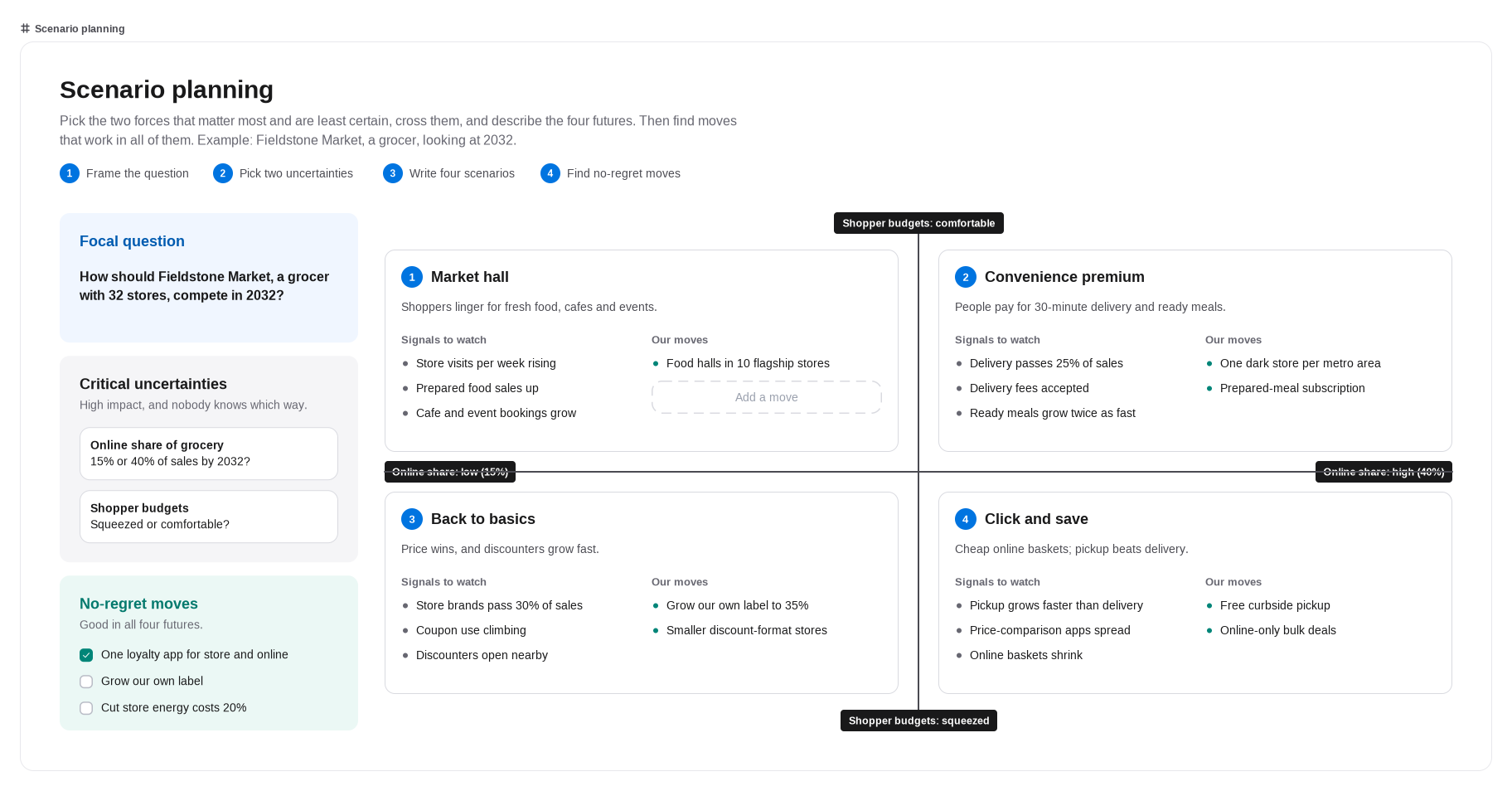
The first card pins down what the exercise is for: "How should Fieldstone Market, a grocer with 32 stores, compete in 2032?" A focal question names the organization, the decision and the year. Without the year, people argue about different futures.
The second card holds the two critical uncertainties, described on the board as "High impact, and nobody knows which way". Each is written as a question with two ends:
- Online share of grocery: 15% or 40% of sales by 2032?
- Shopper budgets: squeezed or comfortable?
Both tests matter. A force that is important but predictable, such as an aging population, belongs in every scenario as a given. A force that is uncertain but minor is noise.
Four futures on two axes
The two uncertainties become the axes of the grid. Shopper budgets run from comfortable at the top to squeezed at the bottom. Online share runs from low (15%) on the left to high (40%) on the right. Each corner is a scenario with a number, a name and one sentence:
- 1. Market hall. Shoppers linger for fresh food, cafes and events.
- 2. Convenience premium. People pay for 30-minute delivery and ready meals.
- 3. Back to basics. Price wins, and discounters grow fast.
- 4. Click and save. Cheap online baskets; pickup beats delivery.
The names do a lot of work. Six months later nobody remembers "high online, low budgets", but "Click and save" sticks, and a team can say "this looks like Back to basics" in a meeting.
Signals to watch
Each scenario card has a left column headed Signals to watch: early evidence that the world is drifting toward that corner. For Convenience premium the signals are "Delivery passes 25% of sales", "Delivery fees accepted" and "Ready meals grow twice as fast".
Good signals share two traits visible here. They can be observed in data the company already has or can easily get, and at least one has a threshold, like the 25%. Vague signals such as "customers want convenience" will always seem true. Put the list where it will be seen: someone should check these numbers every quarter and say which scenario is gaining.
Moves for each future, and the ones with no regrets
The right column of every scenario card lists Our moves: what Fieldstone would do if that future arrived. Food halls in 10 flagship stores suits Market hall. Smaller discount-format stores suit Back to basics. Some of these moves would be wasted, or harmful, in the opposite corner, and that is the point of writing them apart.
The No-regret moves card collects what is "Good in all four futures": one loyalty app for store and online, grow our own label, and cut store energy costs 20%. These can start now, before any signal settles the matter. The first is already ticked. Everything else waits for evidence, which is how scenario planning saves money as well as nerves.
How to use the scenario planning template
- Open it as a new board. The grocer’s four futures come along as a worked model.
- Frame the question. Rewrite the focal question with your organization and a year five to ten years out.
- Pick two uncertainties. List the forces acting on you, keep the two with the highest impact and the least agreement about direction, and relabel both axes with their extremes.
- Write four scenarios. Give each corner a name, a sentence, three signals and one or two moves. If two corners feel alike, your uncertainties are too closely linked; replace one.
- Find no-regret moves. Look for moves that appear, or would help, in all four cards, and copy them to the bottom-left list.
When scenario planning helps, and when to use another template
Use it for long, expensive, hard-to-reverse choices: where to open stores, which technology to commit to, how to shape a five-year strategy. It rewards a group with mixed views and half a day to think.
To collect the outside forces before you pick two, start with a PESTLE analysis. For a decision with clear options and odds you can estimate, a decision tree is more exact. And for the risks of a single project, not a whole strategy, a risk matrix is the right size.
Questions about the Scenario planning template
Why four scenarios and not three?
With three, people treat the middle one as the forecast and ignore the others. Crossing two uncertainties gives four that are equally plausible and clearly different, so the group has to take each one seriously.
How do I choose the two uncertainties?
List every outside force that could change your answer to the focal question. Score each for impact and for how unsure you are about its direction. Take the two that are highest on both, and check that they are independent: one should not simply cause the other.
Is scenario planning the same as forecasting?
No. A forecast says what will probably happen. Scenarios describe several things that could happen, without ranking them, so that your plans hold up across the range. They are most useful exactly where forecasts are least reliable.
How often should the scenarios be reviewed?
Check the signals every quarter and rework the scenarios themselves every year or two, or sooner if one of the uncertainties resolves. When a signal crosses its threshold, bring the matching moves into the regular plan.