What is a plot diagram?
A plot diagram shows how a story’s tension rises and falls. The shape most classes use is Freytag’s pyramid, named after the German writer Gustav Freytag: the story climbs from a calm opening to a peak, then comes down to an ending. Placing events on that shape makes students decide what each scene does, not just what happens in it.
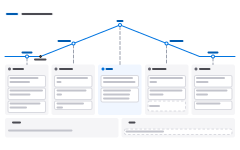
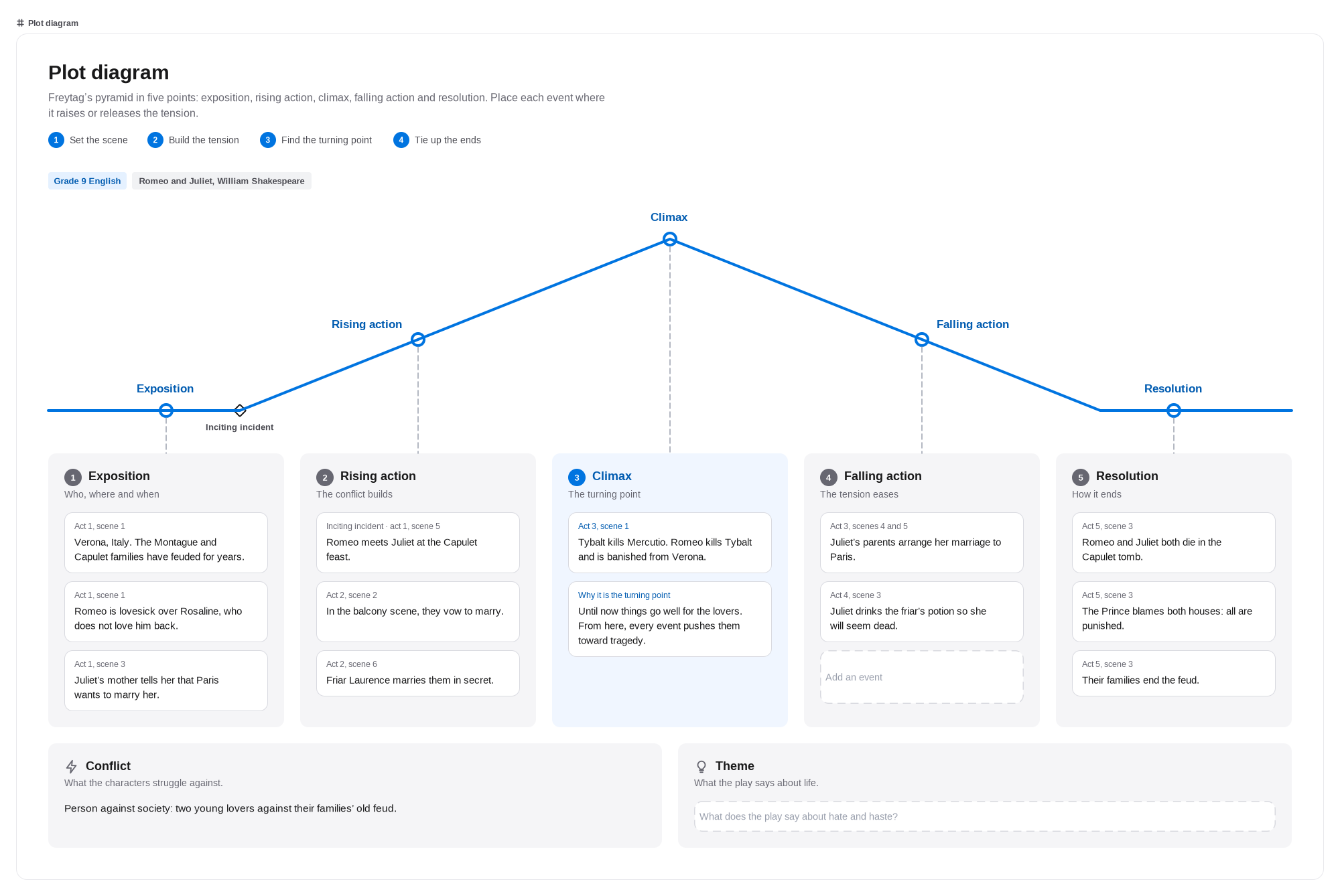
This template draws the pyramid across the top of the board and puts five columns of event cards under it, one for each stage. Two wide boxes at the bottom ask for the conflict and the theme. The example is William Shakespeare’s Romeo and Juliet, with every event tagged by act and scene.
The pyramid and its five points
The line across the top has five marked points. Exposition sits low on the left, Rising action halfway up the slope, Climax at the peak, Falling action on the way down and Resolution low on the right. The height of a point stands for tension, and the left-to-right position stands for time.
One smaller dot is marked near the start of the climb: the inciting incident. It is the event that ends the calm and sets the main conflict moving. Many students confuse it with the climax, so the pyramid gives it a place of its own, right where the flat line begins to rise.
From the opening to the turning point
Each numbered column under the pyramid has a short reminder under its title and a stack of cards. A card holds one event and where it happens in the text.
- 1. Exposition: who, where and when. Three cards set up Verona and the feud between the Montague and Capulet families, Romeo lovesick over Rosaline, and Paris wanting to marry Juliet.
- 2. Rising action: the conflict builds. The first card is tagged “Inciting incident · act 1, scene 5”: Romeo meets Juliet at the Capulet feast. Then the balcony scene, then Friar Laurence marries them in secret.
- 3. Climax: the turning point. Act 3, scene 1. Tybalt kills Mercutio, and Romeo kills Tybalt and is banished from Verona.
The climax column has a second card that the others do not: “Why it is the turning point”. Its answer is the test for any climax. Until now things go well for the lovers, and from here every event pushes them toward tragedy. If a student cannot write that card, they have probably picked the most exciting scene instead of the one where the story changes direction.
After the turning point
The last two columns bring the story down. Falling action, “The tension eases”, holds the consequences of the climax: Juliet’s parents arrange her marriage to Paris, and she drinks the friar’s potion so she will seem dead. A dashed card reading “Add an event” leaves room for one more, such as the message that never reaches Romeo.
Resolution, “How it ends”, has three cards, all from act 5, scene 3: the deaths in the Capulet tomb, the Prince blaming both houses, and the families ending the feud. Note that the deaths are placed here, not at the climax. In a tragedy the saddest moment is often the outcome, while the turning point came two acts earlier.
Conflict and theme
The two boxes at the bottom turn a summary into an analysis. Conflict asks what the characters struggle against and gives the example’s answer in one line: “Person against society: two young lovers against their families’ old feud.” Naming the type first (person against person, self, society or nature) helps students state it cleanly.
Theme asks what the play says about life. Here the board holds back. Instead of an answer it shows a prompt in a dashed box: “What does the play say about hate and haste?” That is on purpose. A theme is a claim the student makes and supports from the event cards above, so it is the one box the example leaves for them.
How to use the plot diagram template
- Open it as a new board. Use this template copies it to your workspace. Change the two chips to your class and the title and author of your text.
- Set the scene. Fill the Exposition cards with setting, main characters and the situation before anything goes wrong. Tag each with a chapter or scene.
- Build the tension. Find the inciting incident first, then add the two or three events that raise the stakes most.
- Find the turning point. Choose the climax and write why it changes the direction of the story.
- Tie up the ends. Add the falling action and resolution, then state the conflict and write a theme sentence.
When a plot diagram fits, and when to pick another
Use it for stories with one main arc: plays, novels, short stories, films. It works as a reading check after each act, as a study sheet before an essay, and as a planning tool for students writing their own stories.
For younger readers who need characters, setting, problem and solution without the arc, the story map is simpler. To study one person in depth, use the character map. And when the diagram is done and the writing begins, an essay outline turns the theme sentence into a thesis.
Questions about the Plot diagram template
What are the five parts of a plot diagram?
Exposition, rising action, climax, falling action and resolution. The exposition sets the scene, the rising action builds the conflict, the climax is the turning point, the falling action shows its consequences and the resolution is how the story ends.
What is the difference between the inciting incident and the climax?
The inciting incident starts the conflict and comes early: in the example, Romeo meeting Juliet at the feast. The climax is the point where the story turns and cannot go back: Romeo killing Tybalt and being banished. Everything between them is rising action.
How many events should each column have?
Two or three. The example uses three for most stages and a single event for the climax. If a column needs more than four cards, some of them are details. Keep the events that change something for the main characters.
Can students use it to plan their own story?
Yes. Clear the cards and fill them in order, one planned event per card. Starting with the climax and the resolution, then working backward to the exposition, often gives a tighter story than starting at the beginning.