What is a product vision board?
A product vision board is a one-page summary of a product strategy. It was devised by Roman Pichler to help a team state where a product is heading and test whether the idea holds together before writing a roadmap or a backlog.
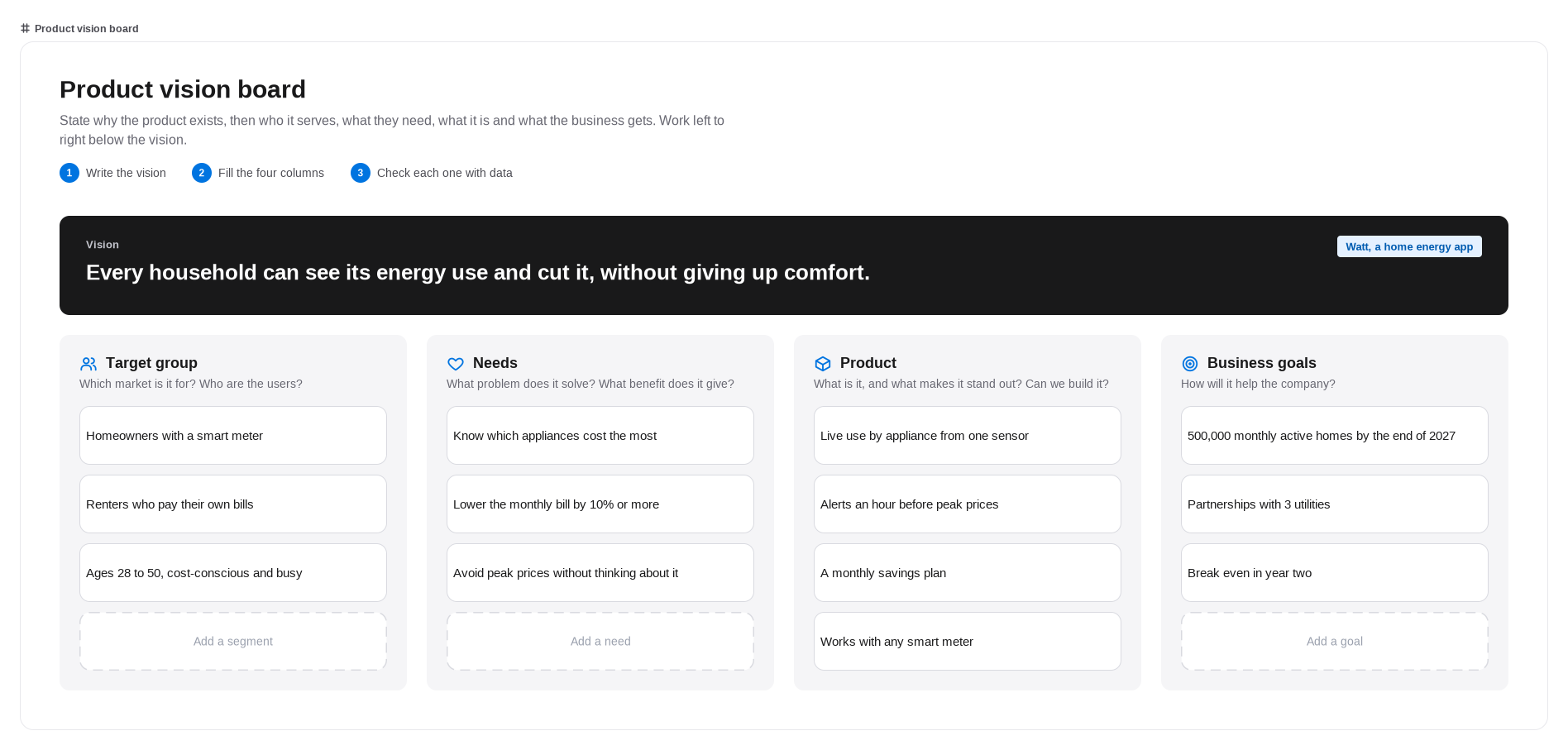
The template follows that layout. A wide band at the top carries the vision. Under it stand four columns: Target group, Needs, Product and Business goals, each with a question or two beneath its title and room for four cards. The example describes Watt, an app that shows a household where its energy goes.
The vision
The vision is the reason the product exists, written as a change in the world and not as a description of software. Watt’s reads: “Every household can see its energy use and cut it, without giving up comfort.” The name of the product sits at the right end of the band, apart from the sentence.
A useful vision passes three checks, and the example passes them. It names who benefits: every household. It names the change: seeing energy use and cutting it. And it holds a tension that guides decisions: without giving up comfort. That last clause rules out any feature that saves money by making the home colder. Keep yours to one sentence that a new hire could repeat the next day.
Target group and needs
The first two columns are about people. Target group asks which market the product is for and who the users are. The example names three segments: homeowners with a smart meter, renters who pay their own bills, and people aged 28 to 50 who are cost-conscious and busy. A dashed card invites a fourth.
Needs asks what problem the product solves and what benefit it gives. Watt’s users want to know which appliances cost the most, to lower the monthly bill by 10% or more, and to avoid peak prices without thinking about it. Each need is written from the user’s side. “Lower the monthly bill by 10% or more” is something a renter would say. “Usage analytics” is not.
Product: answer each need
The third column asks what the product is, what makes it stand out, and whether you can build it. It holds the three to five features that define the product, not a full list. Watt has four: live use by appliance from one sensor, alerts an hour before peak prices, a monthly savings plan, and working with any smart meter.
Read this column against the one before it. Knowing which appliances cost the most is answered by live use by appliance. Avoiding peak prices is answered by alerts an hour before them. Lowering the bill is answered by the savings plan. A feature that answers no need is a candidate to cut. A need with no feature is a promise the vision makes and the product does not keep.
Business goals
The last column asks how the product will help the company. Without it, a vision board describes a charity. Watt’s goals are 500,000 monthly active homes by the end of 2027, partnerships with 3 utilities, and breaking even in year two.
Good business goals have a number and a date where possible, as the first one does. They should also follow from the columns to their left. Partnerships with utilities make sense for a product that works with any smart meter. If a goal has no connection to the target group or the product, either the goal or the strategy needs another look. Rank the goals as well, since they will conflict: growth in active homes and breaking even pull in different directions.
How to use the product vision board template
- Open it as a new board. Use this template makes a copy with the Watt example, which you overwrite card by card.
- Write the vision. Draft several versions with the team, choose one sentence and put it in the top band.
- Fill the four columns. Work left to right below the vision. Keep each column to a handful of cards and delete what you cannot defend.
- Check each one with data. Go through every card and ask what evidence supports it. Mark the cards that are guesses and plan how to test the riskiest.
The board has 45 elements, so there is plenty of room on a Free board for notes and evidence beside each column.
When a vision board helps, and what comes after it
Use it for a new product, a major pivot, or a yearly strategy review. It is also a good first page for anyone joining the team, because it answers “what are we building and why” in under a minute.
The board states direction, not sequence or detail. To lay out what comes first, move to a now, next, later roadmap. To test the needs column more rigorously against your offer, use a value proposition canvas. And to write up a single feature for the team that will build it, a PRD one-pager fits.
Questions about the Product vision board template
What is the difference between a product vision and a product strategy?
The vision is the lasting purpose: the change the product should bring about. The strategy is the current plan for getting there: which people, which needs, which features and which business goals. On this board the top band is the vision, and the four columns together are the strategy.
How long should a vision statement be?
One sentence, short enough to remember. The example is fourteen words. If yours needs a second sentence to explain the first, it is probably describing features. Move those to the Product column and keep the vision about the people and the change.
How often should the board be updated?
Review it whenever you learn something that contradicts a card, and at least at each planning cycle. The vision should rarely change. The columns will, as research replaces guesses about the target group and needs and as business goals are reached or revised.
Who should create the product vision board?
The person responsible for the product leads it, working with design, engineering and someone who speaks for the business. Creating it together matters more than polishing it alone, because the board is only useful if the people who build the product agree with it.