What is a now next later roadmap?
A now next later roadmap groups work by how certain it is, not by when it ships. Now is what the team is building. Next is what it is shaping. Later is a set of problems it wants to explore. There are no month columns, so the roadmap does not turn into a list of promises that slip.
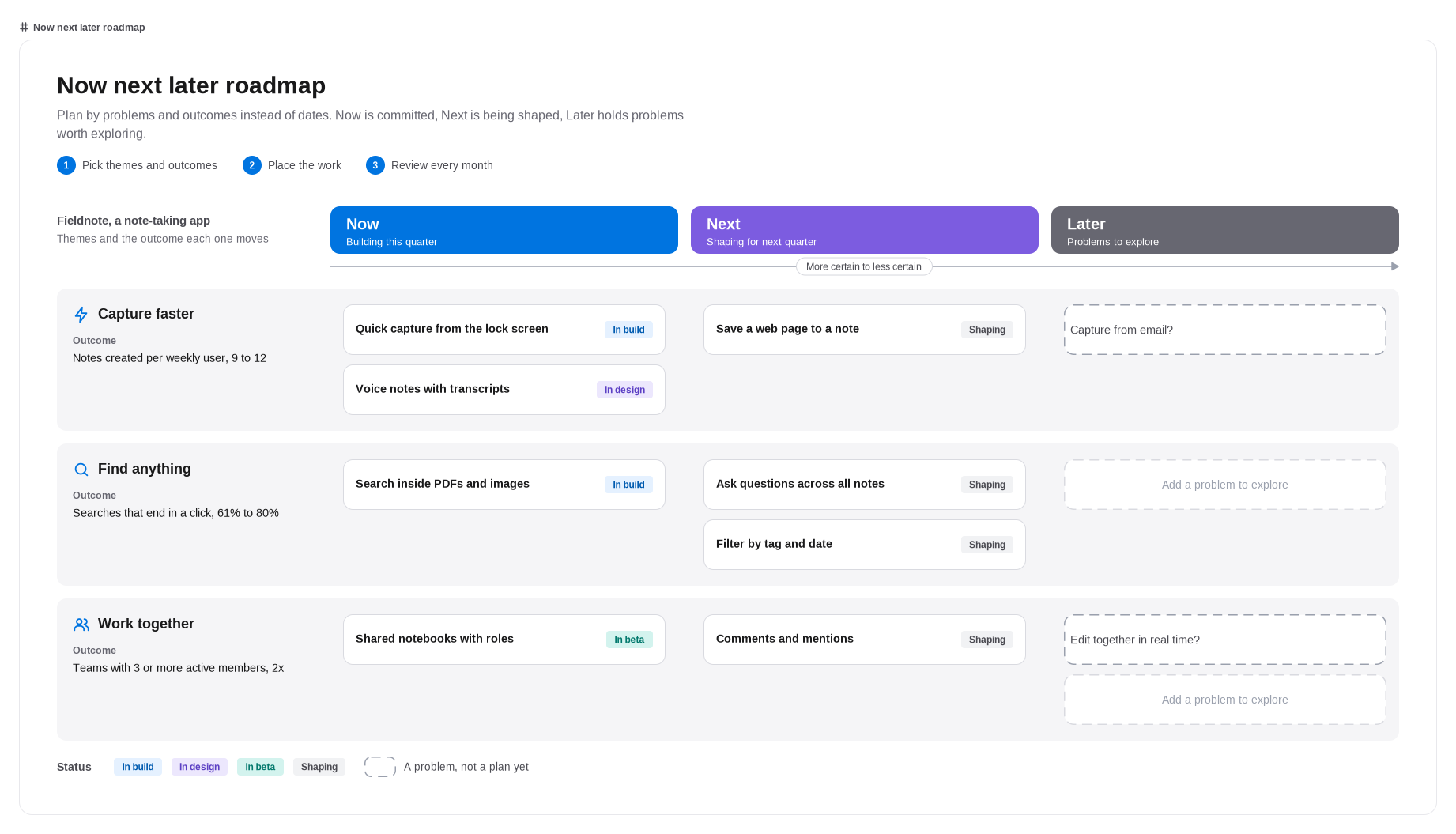
This template arranges the three horizons as columns and adds rows for themes. Each theme names the outcome it should move, which keeps the roadmap tied to results. The example belongs to a note-taking app.
Three horizons, from certain to uncertain
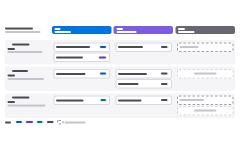
Each column heading carries a short definition. Now is “Building this quarter”. Next is “Shaping for next quarter”. Later is “Problems to explore”. An arrow labelled “More certain to less certain” runs across them, and that is how the board should be read.
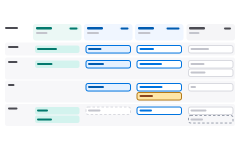
In the first row, the Now cell holds “Quick capture from the lock screen”, which is in build, and “Voice notes with transcripts”, which is in design. The Next cell has “Save a web page to a note”, still being shaped. The Later cell holds only a question: “Capture from email?”
Themes and the outcome each one moves
The rows are themes: Capture faster, Find anything and Work together. Under each name is an outcome with a number. Capture faster should raise notes created per weekly user from 9 to 12. Find anything should lift searches that end in a click from 61% to 80%. Work together aims to double the teams with 3 or more active members.
The outcome is what lets you judge the items in the row. “Search inside PDFs and images” earns its place in the Find anything row only if it helps more searches end in a click. If it does not, it should leave the roadmap, however far along it is.
Later holds problems, not features
The Later column looks different on purpose. Its cards have dashed outlines and end in question marks: “Capture from email?” and “Edit together in real time?”. The others read “Add a problem to explore”. The key at the bottom gives the dashed style a meaning: “A problem, not a plan yet”.
Writing Later items as questions protects the team. A feature name in a far column gets read as a commitment, and someone will ask for its date. A question invites research. When the answer is yes and the shape is clear, the card moves left and becomes a named piece of work.
Status labels show how far each item is
Every item in Now and Next carries a small label. The key lists four: In build, In design, In beta and Shaping. In the Work together row, “Shared notebooks with roles” is in beta, while “Comments and mentions” is still shaping.
The labels answer the question stakeholders ask most, which is how close something is, without a date. Keep the set small. Four labels are easy to scan, and each should mean the same thing in every row.
How to use the now next later roadmap template
- Copy the template to your workspace. The note-taking example comes with it as a guide.
- Pick themes and outcomes. Rename the three rows and give each an outcome with a current value and a target.
- Place the work. Put committed items in Now, items being shaped in Next, and write open problems as questions in Later. Add a status label to each.
- Review every month. Move cards left as they firm up, update the labels and remove items that no longer serve their theme’s outcome.
When this roadmap fits, and when you need dates
Choose this format when plans change often and you want to share direction without promising days. It suits product teams that report to leadership, customers or sales and are tired of defending missed dates.
Some work does have fixed dates: a launch tied to an event, a contract, a regulation. For that, a release plan or a project roadmap with a time axis is the better tool. To find the problems that belong in Later, an opportunity solution tree connects them to the outcome first. More ways to plan a product are on the product planning page.
Questions about the Now next later roadmap template
How long are the now, next and later horizons?
They are deliberately loose. On this board Now means the current quarter and Next the one after. Later has no length at all. Choose spans that match your planning cycle and write them under the column headings.
Why does this roadmap have no dates?
Dates on items far from delivery are guesses, and people treat them as promises. Grouping by certainty tells readers what is committed and what is still open, which is the information they need to plan around.
How many items should the Now column hold?
Only what the team can work on at once. The example has four items in Now across three themes. If the column fills beyond what your team can build this quarter, some of those items are really Next.
How do I share the roadmap with stakeholders?
Share the board so others can view it and leave comments, or export it as PNG, SVG or PDF for a document or a slide. Review it monthly so the shared version stays current.