What is reverse brainstorming?
Reverse brainstorming starts from the opposite question. Instead of “how do we solve this?”, the group asks “how could we cause this, or make it worse?” Bad ideas come quickly and without embarrassment. Then each bad idea is flipped into its opposite, and the opposites are your candidate fixes.
It works because people are better at spotting what goes wrong than at inventing what might go right, especially on a problem they have looked at for too long. This template has a card for the problem, a card for the reversed question, a row for ways to make it worse, a row for the flips and a strip for the ones to try first. The example is Bright Smile Dental, where patients miss about 1 in 8 visits.
Reverse the question, then make it worse
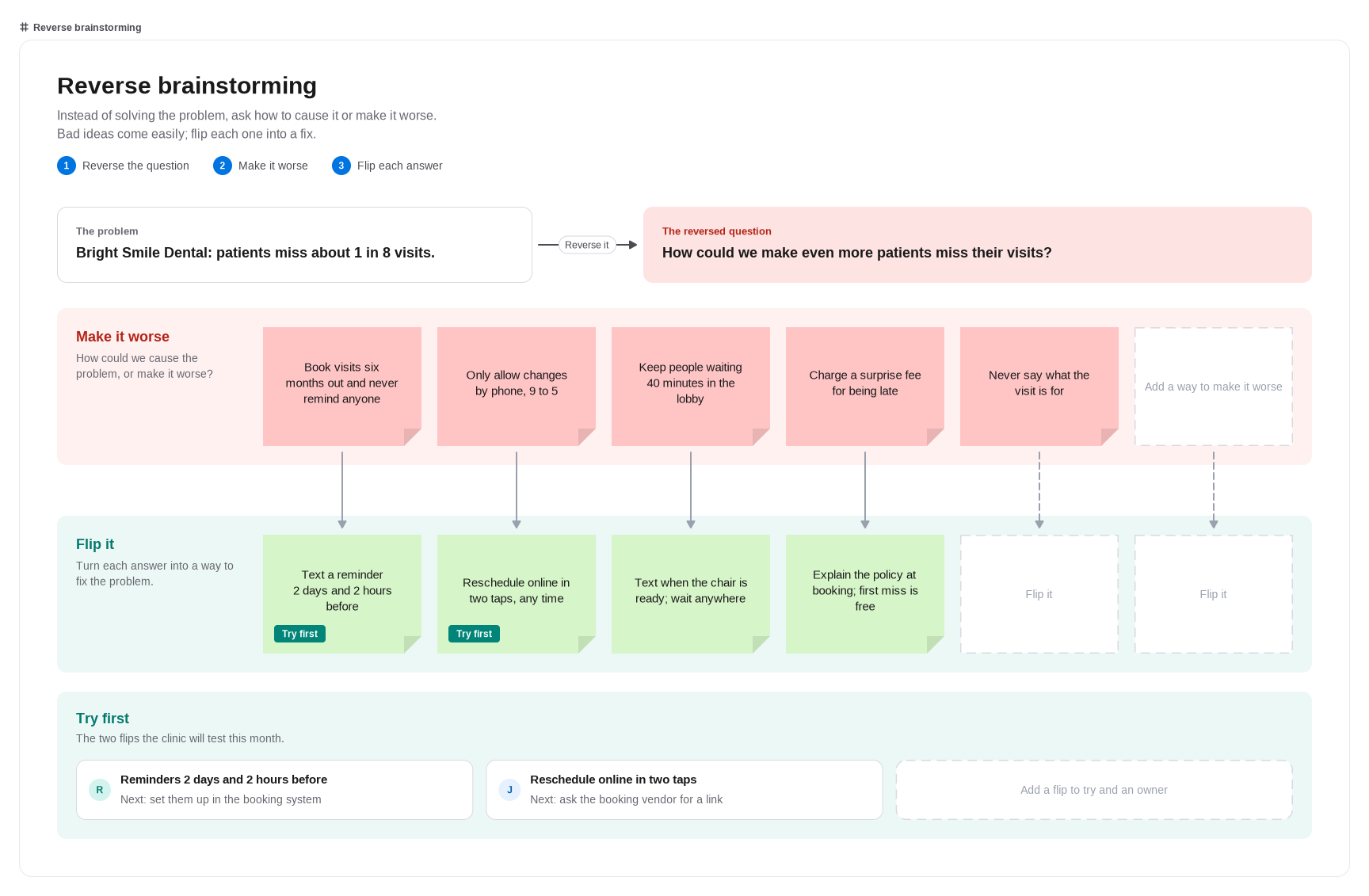
Two cards sit at the top. The left one states the problem with a number: “Bright Smile Dental: patients miss about 1 in 8 visits.” The right one turns it around: “How could we make even more patients miss their visits?”
The row below collects answers to that second question. The clinic's team wrote five:
- Book visits six months out and never remind anyone
- Only allow changes by phone, 9 to 5
- Keep people waiting 40 minutes in the lobby
- Charge a surprise fee for being late
- Never say what the visit is for
Some of these are uncomfortably close to how many clinics already work. That is the value of the exercise. A team asked for improvements might never say “our phone hours are a problem”, but a team asked to sabotage the clinic says it in the first minute.
Flip each answer into a fix
The second row sits directly under the first, so each flip lines up with the bad idea above it. Flipping means asking what the exact opposite would look like in practice:
- Never remind anyone becomes “Text a reminder 2 days and 2 hours before”.
- Changes by phone only becomes “Reschedule online in two taps, any time”.
- Forty minutes in the lobby becomes “Text when the chair is ready; wait anywhere”.
- A surprise late fee becomes “Explain the policy at booking; first miss is free”.
A good flip is as specific as the bad idea it came from. “Communicate better” would be a weak flip of “never remind anyone”. Two days and two hours is something the clinic can set up and then measure against the 1 in 8.
Leave no bad idea unflipped
The fifth column is unfinished. “Never say what the visit is for” has only a dashed “Flip it” card beneath it, and the sixth column has an empty card in both rows.
Pairs like these are worth a second look before the session ends. The bad ideas that are hard to flip are often the ones the team has not thought about before. What would the opposite of “never say what the visit is for” be? Perhaps a confirmation message that names the treatment and how long it takes, so the patient knows why coming matters.
Keep the pairs aligned as you add more. If a bad idea suggests two different fixes, duplicate the note above so that each flip still has its cause over it.
Choose two flips to try first
Not every flip gets built. Two of the notes in the flip row carry a small “Try first” tag, and the strip at the bottom repeats them with an owner and a next step. Its subtitle sets the scope: “The two flips the clinic will test this month.”
- Reminders 2 days and 2 hours before. Next: set them up in the booking system.
- Reschedule online in two taps. Next: ask the booking vendor for a link.
Both are cheap and aimed at the most likely causes: forgetting, and not being able to change a time. Testing only two means the clinic can tell which of them moved the missed-visit rate. A third slot stays open for the next round.
How to use the reverse brainstorming template
- Open it as a new board. State your problem on the left card with a number if you have one.
- Reverse the question. Rewrite it on the right card as “How could we make this worse?” in your own terms.
- Make it worse. Fill the first row for five to ten minutes. Aim for answers that are a little too real.
- Flip each answer. Write the specific opposite under every note. Leave the dashed card where a flip does not come yet.
- Pick two to try. Tag them, copy them to the bottom strip and name an owner and a next step for each.
When reverse brainstorming helps, and when it does not
Use it when a team is stuck, tired of a problem or too polite to name its causes. It suits process and service problems well: missed appointments, slow replies, sign-ups that stall, meetings nobody likes.
It is weaker for inventing something new, where there is no problem to reverse. If the team simply needs a jolt of energy and laughter before real ideas, the worst possible idea exercise is a looser cousin. To find the cause of one specific failure, a fishbone diagram sorts causes by type. And to stress-test a plan before it starts, a pre-mortem imagines it has already failed and asks why.
Questions about the Reverse brainstorming template
Why ask how to make the problem worse?
Because it is easier and safer to answer. People hold back criticism of their own workplace when asked for improvements, but they offer it freely as a joke about sabotage. Many of the bad ideas describe what is already happening.
How do you flip a bad idea?
Write the concrete opposite, at the same level of detail. If the bad idea is “only allow changes by phone, 9 to 5”, the flip names another channel and other hours: reschedule online, any time. Avoid flips that are only a general intention.
How many bad ideas do we need?
Enough to cover the different ways the problem can be caused, usually five to ten. The example has five. Stop when new notes repeat earlier ones, and spend the remaining time on the flips, which are the harder half.
Is reverse brainstorming the same as a pre-mortem?
No. A pre-mortem looks ahead at a plan and asks why it might fail. Reverse brainstorming looks at a problem that exists now and asks how to cause more of it. Both use negative thinking to reach practical fixes.