What is the worst possible idea method?
Worst possible idea is a brainstorming game with one odd rule: only bad ideas are allowed. The team competes to suggest the most useless, annoying or absurd answer to a challenge. Then it does two serious things with each one. It names exactly what makes the idea bad, and it turns that reason around into something worth trying.
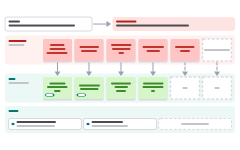
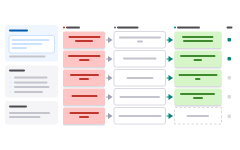
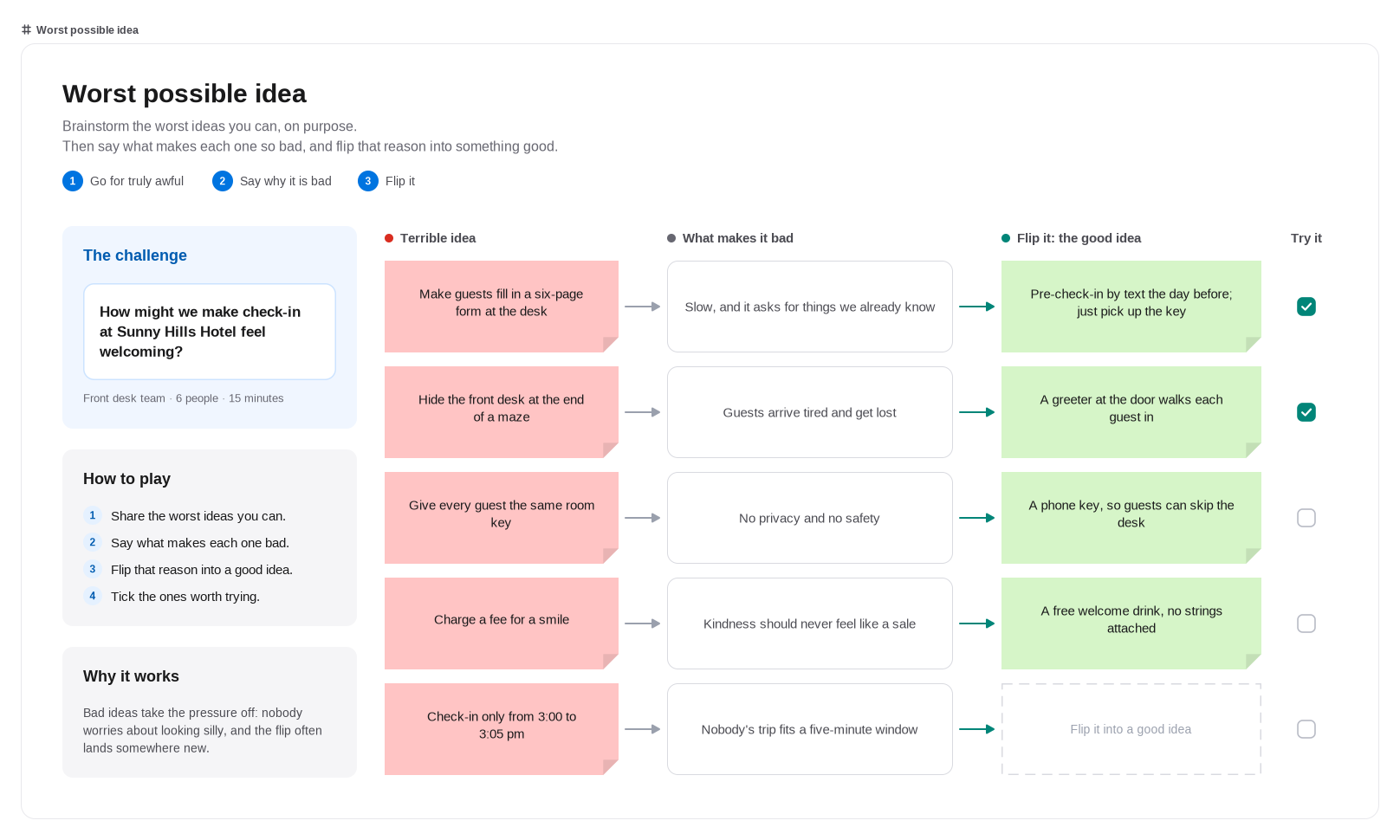
The template lays this out as three columns, Terrible idea, What makes it bad and Flip it: the good idea, with the challenge and the rules down the left side. The example belongs to the front desk team at Sunny Hills Hotel.
The challenge and the four rules
The card at the top left states the challenge as a question: “How might we make check-in at Sunny Hills Hotel feel welcoming?” Under it, one line sets the frame for the session: front desk team, 6 people, 15 minutes. A quarter of an hour is enough. The game runs on speed, and it stops being funny if it drags.
The How to play panel has four numbered lines:
- Share the worst ideas you can.
- Say what makes each one bad.
- Flip that reason into a good idea.
- Tick the ones worth trying.
Keep the challenge positive, as the hotel did. The team is asked for bad ways to reach a good goal, and that contrast is what the flip needs later.
From a terrible idea to the reason it fails
The first column is the fun part. The hotel team wrote “Make guests fill in a six-page form at the desk” and “Hide the front desk at the end of a maze”. Nobody would defend either, so nobody held back.
The middle column is where the method earns its place. For each idea the team had to say what is wrong with it in plain words. The form is “slow, and it asks for things we already know”. The maze fails because “guests arrive tired and get lost”. These short sentences are small pieces of insight about guests: they are tired, they dislike repeating themselves, they want the desk to be easy to find.
A reason like “it is stupid” is not enough. Push until the reason names what the guest feels or loses.
Flip the reason, not the idea
The third column reverses the reason, and that gives better results than reversing the idea itself. The opposite of “give every guest the same room key” is only “give guests different keys”, which the hotel already does. The reason, “no privacy and no safety”, points somewhere new: a phone key, so guests can skip the desk.
The same move works on “Charge a fee for a smile”. It is bad because kindness should never feel like a sale, and the flip is a free welcome drink, no strings attached.
The last row is left unfinished on purpose. “Check-in only from 3:00 to 3:05 pm” has its reason, nobody's trip fits a five-minute window, and an empty card that says “Flip it into a good idea”. Try it before you clear the board. On the far right, the Try it column gives every row a box to tick.
Why bad ideas get a quiet team talking
The panel at the bottom left explains the trick in one sentence: bad ideas take the pressure off, nobody worries about looking silly, and the flip often lands somewhere new.
In a normal brainstorm people filter. They hold back the half-formed thought because it might sound foolish. Here foolish is the assignment, so the filter has nothing to do. New hires and junior staff tend to speak early in this game, and once they have spoken they keep going when the session turns serious.
How to use the worst possible idea template
- Open it as a new board and write your own challenge in the card at the top left, phrased as a goal you do want.
- Go for truly awful. Give everyone five minutes to fill the notes in the first column. Add rows by copying one if five is not enough.
- Say why it is bad. Take the ideas one at a time and write the reason in the middle card. Ask “bad for whom?” until the answer mentions your customer.
- Flip it. Reverse each reason and write the good idea in the third column, then tick the rows the team wants to try this month.
If the first column stays empty, FlowDraw AI can suggest a few terrible ideas for your challenge to break the ice.
When to play it, and when to choose another board
Play it as a warm-up, with a team that has gone quiet, or when every idea in the room sounds like last year's. It also suits service problems, where the worst version is easy to picture because everyone has been on the receiving end of it.
It is a poor fit when you need a careful list of risks. For that, reverse brainstorming asks how to cause the problem and treats the answers as real threats. If the team already has plenty of sensible ideas and needs to choose, score them with the NUF test. And for stretching one existing product in new directions, SCAMPER gives seven prompts to work through.
Questions about the Worst possible idea template
How is this different from reverse brainstorming?
Reverse brainstorming asks how to make the problem worse and produces realistic causes to prevent. Worst possible idea asks for ridiculous solutions and uses them to loosen people up and expose what customers value. One is closer to risk analysis, the other to a creative warm-up.
What if a terrible idea turns out to be good?
It happens, and it is a fine result. Move the note to the third column as it is and write in the middle card what made the group assume it was bad. That assumption is often worth questioning too.
How many bad ideas should a session collect?
The board has five rows, which suits a 15-minute round with six people when you keep only the best of the worst. Collect more on the side if the group is on a roll, then bring the five with the clearest reasons into the rows.
Does every row need a flipped idea?
No. Some reasons flip into something you already do, and those rows can stay as they are. The tick column exists so the team marks only the flips worth trying. Two or three ticked rows from five is a good outcome.