What is a pre-mortem?
A pre-mortem is a risk exercise you run before a project begins. The team pretends the project is over and it went badly, then explains why. Asking “what went wrong?” about an imagined failure gets more honest answers than asking “what could go wrong?”, because nobody has to be the pessimist: the failure is given, and the job is to explain it. The technique is usually credited to the psychologist Gary Klein.
This template walks the four steps on one board: a failure scenario, a wall of reasons, a grid that rates them, and a table of preventions. The example is a retailer about to pilot self-checkout kiosks.
Start from the failure
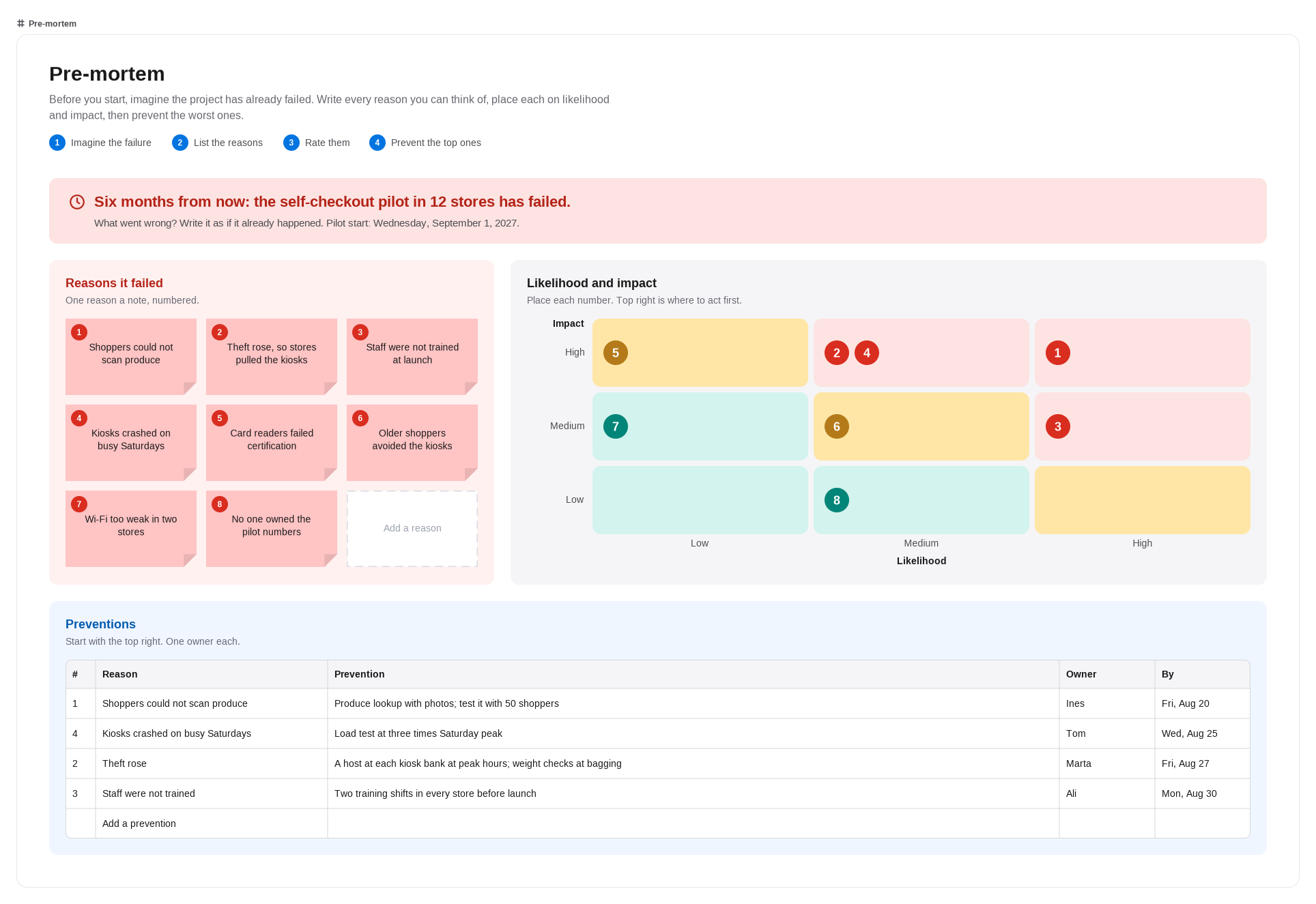
The banner across the top sets the scene in one sentence: “Six months from now: the self-checkout pilot in 12 stores has failed.” The line beneath it tells people how to answer: “What went wrong? Write it as if it already happened.” It also records the real date at stake, the pilot start on Wednesday, September 1, 2027.
The scenario needs three things to work: a point in time, the project’s name, and the plain word “failed”. Do not soften it to “faced challenges”. The past tense is the whole trick, since it moves people from defending the plan to explaining an outcome.
Reasons it failed
The left panel collects the answers, one reason a note, each with a number. The pilot team wrote eight:
- 1. Shoppers could not scan produce
- 2. Theft rose, so stores pulled the kiosks
- 3. Staff were not trained at launch
- 4. Kiosks crashed on busy Saturdays
- 5. Card readers failed certification
- 6. Older shoppers avoided the kiosks
- 7. Wi-Fi too weak in two stores
- 8. No one owned the pilot numbers
Good reasons read like these: short, in the past tense, and about one thing. They also come from different corners of the project: hardware, shoppers, staff, ownership. If every note is about technology, ask the room who else could have sunk it.
Rate each reason on likelihood and impact
Eight risks are too many to prevent with equal effort. The grid on the right sorts them. Likelihood runs along the bottom from Low to High, impact runs up the side, and each reason appears as its number in one of nine cells. The instruction above the grid says where to look: “Top right is where to act first.”
In the example, reason 1, produce that will not scan, sits alone in the top right cell: likely and damaging. Reasons 2 and 4, theft and Saturday crashes, are high impact with medium likelihood. Reason 3, untrained staff, is highly likely with medium impact. Reason 5, failed card certification, would hurt badly but is unlikely, and reason 8 sits low on impact.
Preventions, starting from the top right
The table at the bottom takes the highest-rated reasons and answers each one. A row holds the reason’s number, the reason, a prevention, an owner and a date. The example prevents four of the eight:
- 1. Produce lookup with photos, tested with 50 shoppers. Ines, by Friday, August 20.
- 4. A load test at three times Saturday peak. Tom.
- 2. A host at each kiosk bank at peak hours, and weight checks at bagging. Marta.
- 3. Two training shifts in every store before launch. Ali, by Monday, August 30.
Every date falls before the pilot starts on September 1. A prevention due after the launch is a repair, not a prevention.
How to use the pre-mortem template
- Open it as a new board. Rewrite the banner with your project, a date a few months after launch and the word “failed”.
- List the reasons. Everyone writes alone for five minutes, then reads their notes out. Merge duplicates and number what is left.
- Rate them. For each number, agree on a cell and drag its circle there. Settle disagreements by asking what evidence each side has.
- Prevent the top ones. Fill a table row for every number in the top right cell and its neighbors. One owner per row.
Want a head start on the list? FlowDraw AI can draft reasons from a description of your project, and the team edits them on the board.
When to run a pre-mortem, and when another board fits
Run it once the plan exists but before money and dates are locked: ahead of a pilot, a launch, a migration or a big event. An hour is enough for most teams.
For a long project that needs risks tracked month after month, move the results into a risk register. If the project has already gone wrong and you want to learn from it, use a post-mortem. When the team’s worries are more about the change itself than about delivery, a hopes and fears session is the gentler start.
Questions about the Pre-mortem template
What is the difference between a pre-mortem and a post-mortem?
Timing. A pre-mortem happens before the work and imagines a failure in order to prevent it. A post-mortem happens after a real failure and studies what actually occurred. The first deals in guesses, the second in facts and a timeline.
Who should be in the room for a pre-mortem?
The people who will do the work and the people who will live with the result. The example’s reasons cover shoppers, store staff, hardware and reporting, so each of those views needs a voice. Six to ten people is a good size.
How many reasons should we try to prevent?
Start with the cell where likelihood and impact are both high, then its neighbors. The example prevents four of eight. Trying to prevent everything spreads the team thin; the lower cells can simply be watched.
Is a pre-mortem the same as a risk assessment?
It is one way to start one. A classic risk assessment asks what might happen. A pre-mortem states that it did happen and asks why, which tends to produce reasons people would otherwise keep to themselves.