What is a strategy one-pager?
A strategy one-pager fits a company’s whole strategy on a single page: where it is going, why it exists, what it will focus on, what it will leave alone and how it will know it is working. The limit is the point. A strategy that cannot be shown on one page is hard to remember, and a strategy nobody remembers does not guide decisions.
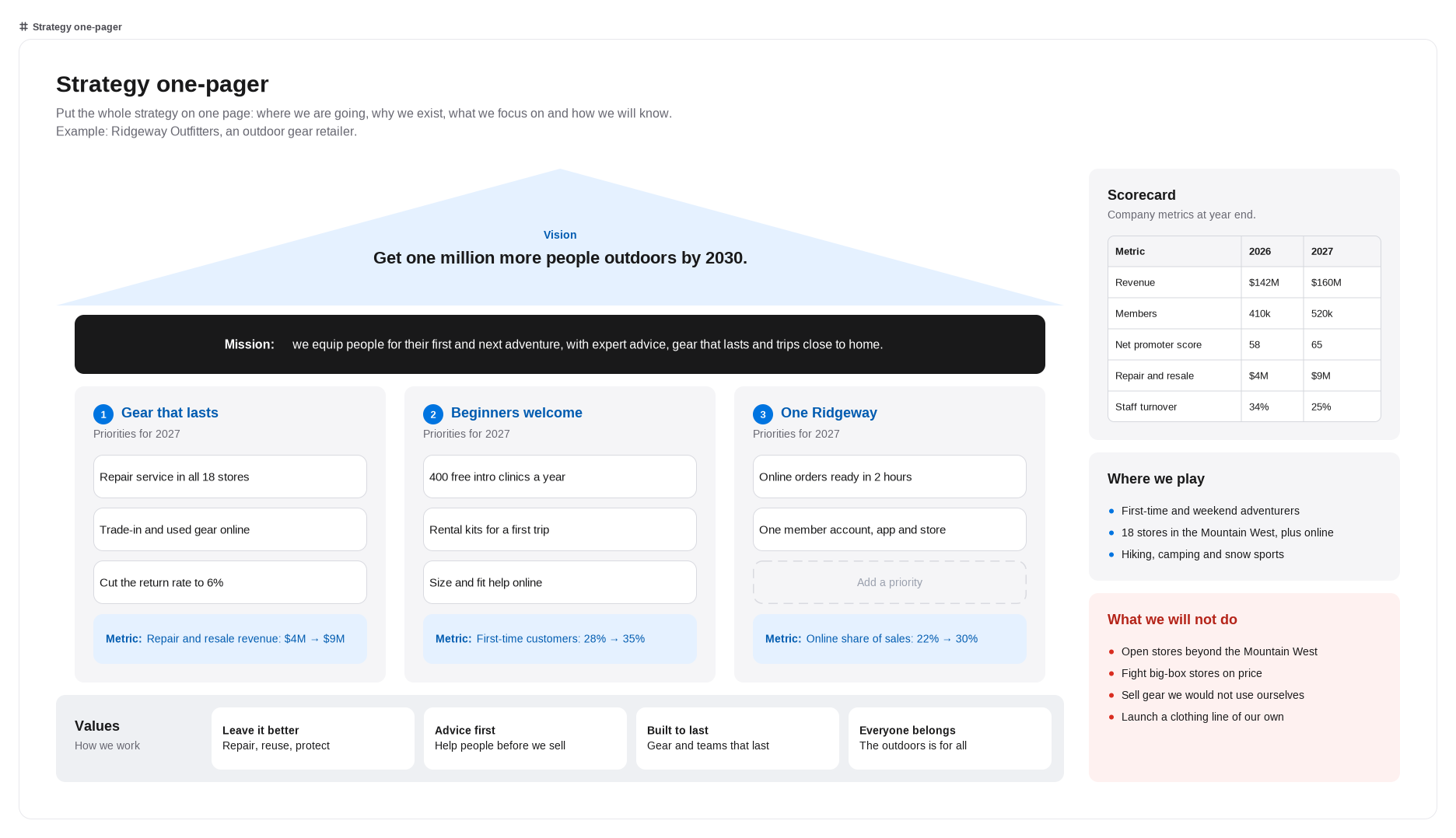
This template arranges those parts in layers: vision and mission across the top, three pillars of priorities in the middle, values along the base, and a column on the right for the scorecard and the boundaries. The example is Ridgeway Outfitters, an outdoor gear retailer.
Vision and mission at the top
The banner at the top states the vision: “Get one million more people outdoors by 2030.” It is a destination with a number and a year, which makes it something the company can reach or miss.
The strip under it carries the mission, which says what the company does every day to get there: “we equip people for their first and next adventure, with expert advice, gear that lasts and trips close to home.”
Keep the two apart. The vision is the future you want. The mission is your part in bringing it about. Notice how the mission’s phrases return lower on the page: “gear that lasts” is the first pillar, and “expert advice” becomes the value “Advice first”.
Three pillars, each with priorities and a metric
The middle of the page holds three numbered pillars. Each has a name, a list headed “Priorities for 2027” and one metric at its foot.
- 1. Gear that lasts: “Repair service in all 18 stores”, “Trade-in and used gear online”, “Cut the return rate to 6%”. Metric: repair and resale revenue from $4M to $9M.
- 2. Beginners welcome: “400 free intro clinics a year”, “Rental kits for a first trip”, “Size and fit help online”. Metric: first-time customers from 28% to 35%.
- 3. One Ridgeway: “Online orders ready in 2 hours”, “One member account, app and store”, and an open “Add a priority” slot. Metric: online share of sales from 22% to 30%.
The layout leaves room for three priorities per pillar, and that is useful. Nine things is about as many as a company can push in a year.
Say where you play and what you will not do
Two short lists in the right column set the boundaries. “Where we play” names the customers, the territory and the categories: “First-time and weekend adventurers”, “18 stores in the Mountain West, plus online”, and “Hiking, camping and snow sports”.
“What we will not do” is the list most strategies leave out. Ridgeway’s has four lines, among them “Fight big-box stores on price” and “Launch a clothing line of our own”. Each one is something a reasonable person at the company might propose. That is the test for this list. A refusal nobody would have suggested adds nothing.
A scorecard for the year
The scorecard at the top right is a small table of company metrics at year end, with a column for 2026 and one for 2027. Revenue goes from $142M to $160M, members from 410k to 520k, net promoter score from 58 to 65, and staff turnover from 34% to 25%.
One row repeats a pillar metric: repair and resale, $4M to $9M. That link matters. It shows the pillars are expected to move the company’s numbers, not sit beside them. Keep the scorecard to five or six rows that the pillars can be expected to move.
How to use the strategy one-pager template
- Open it as a new board. Ridgeway’s strategy stays on the page so you can see how long each line should be.
- Write the vision and mission. One sentence each. Give the vision a number and a year if you can.
- Name three pillars. Under each, list up to three priorities for the year and choose the one metric that shows the pillar is working.
- Set the boundaries. Fill “Where we play”, then write at least three honest lines under “What we will not do”.
- Finish with values and the scorecard. Give each value a name and a short line of meaning, as in “Advice first: Help people before we sell”, and enter the year-end numbers.
When a one-pager helps, and when another template fits
Use it at the end of a planning cycle to share the result, in onboarding to show new staff how the pieces connect, and before a board meeting as the page everything else refers to.
It records decisions; it does not make them. To show how the objectives cause one another, draw a strategy map. To turn a pillar’s priorities into quarterly numbers, use OKR planning. To lay the year’s initiatives out by quarter, use annual planning.
Questions about the Strategy one-pager template
What belongs on a strategy one-pager?
A vision, a mission, three or so focus areas with their priorities and metrics, the boundaries of where you compete, and a handful of company numbers. The template adds values and a list of things the company will not do.
What is the difference between a vision and a mission?
The vision describes the future the company wants to see, ideally with a date. The mission describes what the company does to get there. In the example, the vision is one million more people outdoors by 2030, and the mission is equipping them.
How many pillars should a strategy have?
Three pillars is common and is what the template provides. Two can work for a small company. With five or more, people stop being able to recall them, and the pillars start to describe everything the company already does.
How often should the one-pager change?
The vision, mission and values should hold for years. Pillars may last two or three years. Priorities, metrics and the scorecard are yearly: the example labels them for 2027. Revise those each planning cycle and leave the rest alone unless the strategy itself changes.