What is an annual plan?
An annual plan answers three questions for the next twelve months: what are we trying to achieve, what work will get us there, and when does each piece happen. Written as a document, it runs to pages that few people reread. Drawn as one board, it becomes something a team can point at in March and again in October.
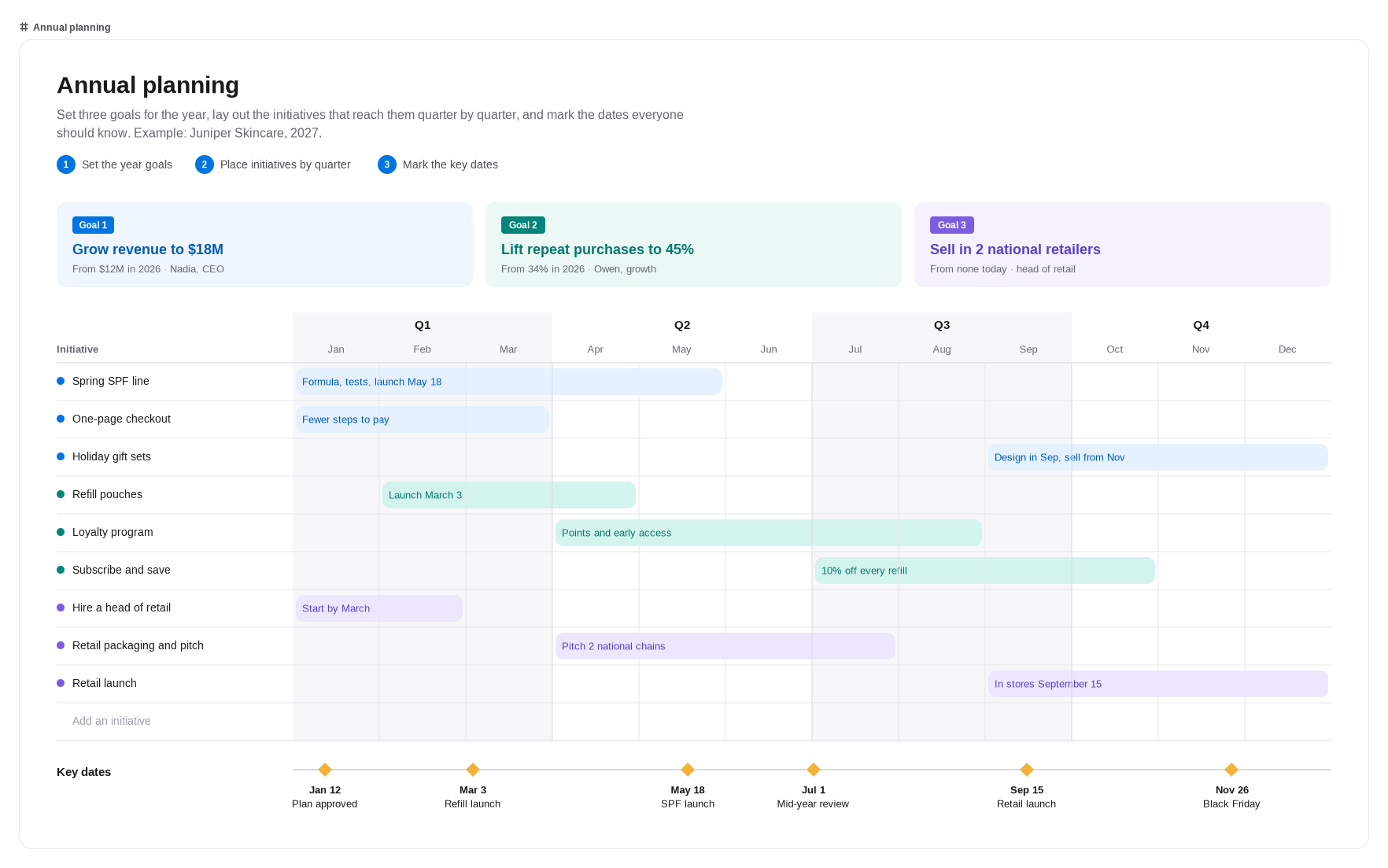
This template puts the year on a single screen: three goal cards on top, a calendar of initiatives by quarter and month under them, and a line of key dates along the bottom. The example is Juniper Skincare planning 2027.
Three goals, each with a baseline and an owner
The goal cards are short on purpose. Each has a target, the number it starts from, and one name:
- Goal 1: Grow revenue to $18M. From $12M in 2026, owned by Nadia, CEO.
- Goal 2: Lift repeat purchases to 45%. From 34% in 2026, owned by Owen, growth.
- Goal 3: Sell in 2 national retailers. From none today, owned by the head of retail.
The baseline is the part people skip. "45%" means little until you see it beside 34%: now everyone knows the size of the climb. Three goals is also a limit worth keeping. A year with eight goals has none.
Initiatives placed by quarter and month
Under the goals, the calendar runs from Jan to Dec in four quarter bands. Each row is one initiative and each bar shows when the work happens. Spring SPF line runs from January into May. Loyalty program starts in April and ends in August. Holiday gift sets and Retail launch both fill September to December.
Reading down a column shows the load in any month. In the example, Q1 carries four bars at once: the SPF line, One-page checkout, Refill pouches and Hire a head of retail. That is the kind of pile-up a list of projects hides and a calendar exposes. The last row, Add an initiative, is empty for your own.
Color ties each initiative to a goal
The bars come in three colors that match the goal cards. Blue bars serve the revenue goal: the SPF line, the checkout and the gift sets. Green bars serve repeat purchases: Refill pouches, Loyalty program, and Subscribe and save. Purple bars are the retail goal, from the hire to the launch.
An initiative that matches no goal has no color to take, and that is a useful test before it gets a row. Each bar also carries a few words that say what it delivers: "Formula, tests, launch May 18", "Fewer steps to pay", "Launch March 3". Keep that habit. A bar with only a project name tells readers when you are busy, not what they will get.
Mark the key dates
The line at the bottom holds six diamonds, each a date the whole company should know: Jan 12 Plan approved, Mar 3 Refill launch, May 18 SPF launch, Jul 1 Mid-year review, Sep 15 Retail launch and Nov 26 Black Friday.
These are not tasks. They are the moments where the plan meets the outside world or gets checked against it. Put the mid-year review on the line from the start: it is the scheduled chance to move bars, drop an initiative or raise a goal, and plans that never get one are the plans people stop opening.
How to use the annual planning template
- Open it as a new board. Juniper’s 2027 comes with your copy as a model to write over.
- Set the year goals. Rewrite the three cards. Keep the pattern: a target, last year’s number, an owner.
- Place initiatives by quarter. Rename the rows, then drag and stretch each bar to its months. Recolor a bar to the goal it serves.
- Look for crowded months. If one quarter holds most of the bars, move something. The team that makes the checkout may be the team that launches the refills.
- Mark the key dates. Move the diamonds to your launches and reviews, and relabel them.
When an annual plan fits, and what to use beside it
Use this board in the last weeks of a year or the first of a new one, when leaders need to agree on a small set of goals and show the rest of the company how the year unfolds. It also works for one department or one product line.
A year is too coarse for a team deciding what to ship next month. Break each quarter down with quarterly planning, where capacity and risks get their own space. If your goals need measurable key results under them, set them up as OKRs. And for a horizon longer than twelve months, a strategic roadmap spreads themes over several years.
Questions about the Annual planning template
How many goals should an annual plan have?
Three, as on this template, or at most five. Each goal needs an owner and enough initiatives to move it, and a company rarely has the people for more. If a fourth goal appears, ask which of the first three it replaces.
When should annual planning start?
Six to eight weeks before the year begins is typical for a small or mid-sized company. That leaves time to review last year’s numbers, draft goals, let teams propose initiatives and approve the plan early in January, as the example’s Jan 12 date shows.
What is the difference between a goal and an initiative?
A goal is a result you want, such as repeat purchases at 45%. An initiative is work you choose in order to get it, such as a loyalty program. Goals should survive the year; initiatives can be swapped at the mid-year review if they are not moving the number.
Can I use it for a fiscal year that does not start in January?
Yes. The month labels are plain text. Retype them in your own order, for example Jul to Jun, and keep the quarter bands above them. Then slide the bars and the diamonds to the months where your own work and dates fall.